
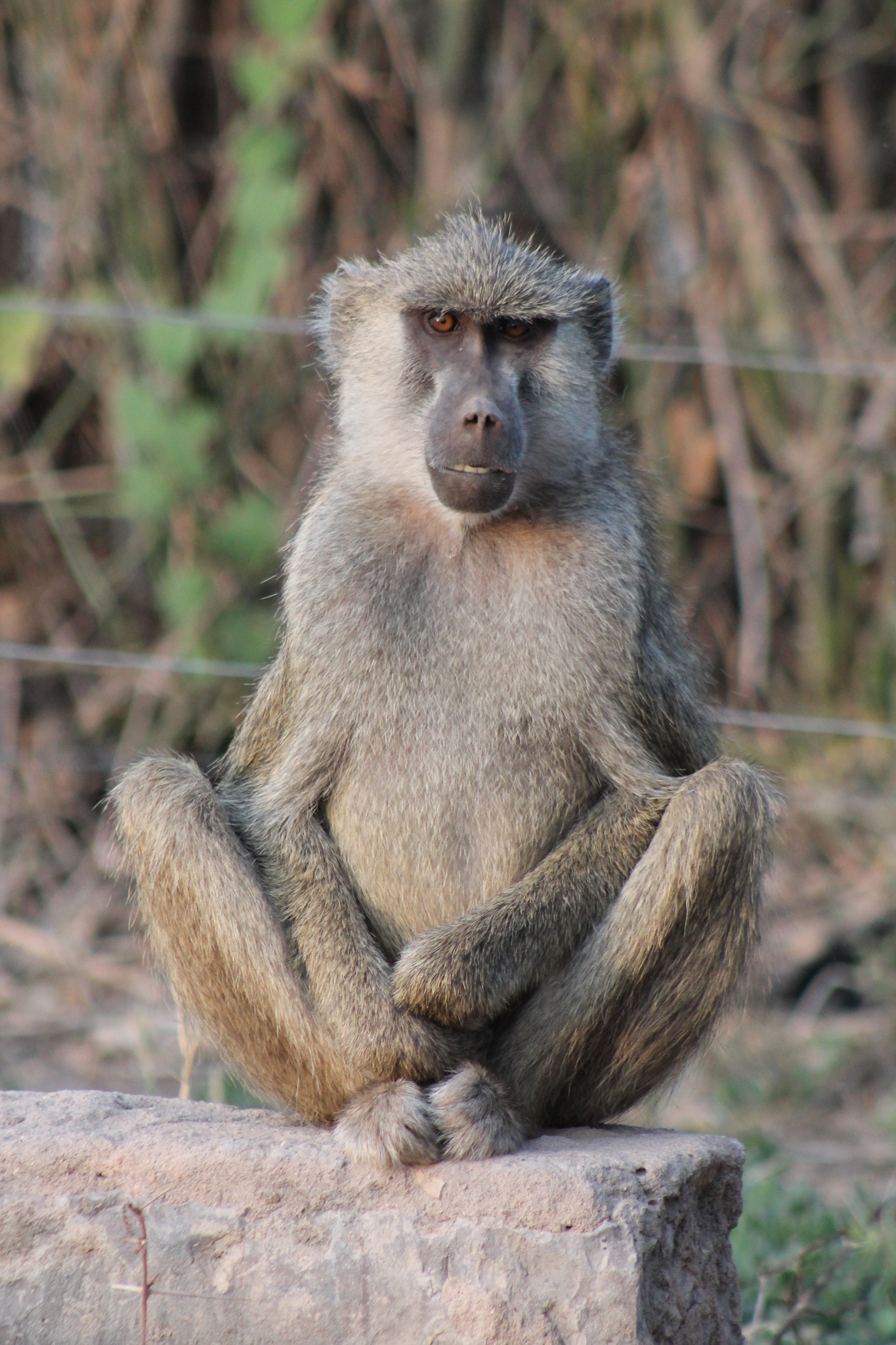
Yellow Baboon (Papio cynocephalus) is a terrestrial Old World monkey of eastern and southeastern Africa. Its dog-like muzzle, bent tail and yellow-brown coat are distinctive, but its most remarkable feature is a flexible multi-level social life built from matrilineal families, friendships, rank and cooperation. This guide separates well-supported biology from common assumptions and covers identification, range, habitat, diet, behavior, reproduction and conservation.
Identification
Adults have long yellowish-brown fur created by hairs with dark tips, a narrow dog-like muzzle, dark bare face, close-set amber eyes and prominent cheek ridges. Pale whiskers frame the muzzle. The tail typically extends horizontally from the rump before dropping sharply, creating a broken-looking angle. Infants of the central and northern forms are born in a conspicuous black coat that changes toward adult color during the first year. Males can be about twice the mass of females and have much larger canine teeth, heavier shoulders and longer hair at the neck. Both sexes share the basic yellow-brown coloration.
Identification should combine body shape, markings, size, voice or movement, and location. One feature by itself can overlap with a related animal, a juvenile, or an individual in unusual light.
Photographs are most useful when they preserve scale and show several diagnostic features. Handling or repositioning a wild yellow baboon for identification can cause stress and is unnecessary.
Size and physical adaptations
Yellow Baboon typically measures head–body length about 51–114 cm, plus a 46–71 cm tail and weighs females commonly about 11–12 kg; males commonly about 23–26 kg. Body size varies geographically, and older sources may mix measurements from the now-separated Kinda baboon.
Its useful adaptations include cheek pouches carry food to safer eating places, large canines defend and display, especially in males, strong limbs support long daily travel on the ground, forward-facing eyes give precise depth perception, opposable thumbs handle small foods and groom fur, broad omnivory tracks seasonal food changes. These traits work together in the animal’s normal setting rather than serving as isolated curiosities.
Published measurements may use different methods, life stages or sample locations. Comparing figures responsibly means checking what was measured rather than selecting the largest number available.
Range and distribution
Native to eastern and southeastern Africa, from southeastern Somalia and eastern Kenya through Tanzania to Malawi, eastern Zambia and northern Mozambique, with marginal records in southeastern Ethiopia. Natural hybrid zones occur with olive baboons in Kenya and Tanzania. The native range includes Ethiopia, Kenya, Malawi, Mozambique, Somalia, Tanzania, Zambia.
A country-level map indicates broad distribution, not continuous occupation. Climate, elevation, water, vegetation, prey, breeding sites, barriers and survey effort all affect where records occur.
Records near the edge of the range deserve careful documentation because they may reflect natural movement, improved survey coverage, accidental transport or a genuine distribution change.
Habitat
Savanna, grassland, thorn scrub, open woodland, gallery forest, river margins and agricultural mosaics where water and sleeping sites remain available.
Troops travel across open feeding grounds but depend on trees, cliffs or other protected places for night sleeping. Gallery forest offers shade, fruit and refuge during the dry season, while grassland supplies seeds, bulbs and grazing foods after rain. A troop’s home range expands when food and water are scattered. Their ability to use farms and settlement edges brings opportunity but also conflict with people. Protecting a population therefore requires the feeding, shelter and breeding features that make a site usable, along with connections that allow movement.
Microhabitat matters. Shade, soil, current, moisture, shelter or host plants can determine whether a small area is usable even when the surrounding landscape appears suitable.
Diet and feeding
Yellow Baboon is a highly flexible omnivore with a plant-heavy diet. Important foods include grass blades and seeds, fruit and pods, roots, bulbs and tubers, flowers and leaves, insects and other invertebrates, bird eggs and small vertebrates, occasional carrion. Yellow baboons walk and search for much of the day, plucking grass, turning stones, digging for underground storage organs and opening fruit or seed pods with skilled hands. Cheek pouches let an animal gather quickly and eat after moving away from a dominant neighbor. Seasonal flexibility is crucial: tender shoots dominate after rain, while dry months require seeds, bark, roots and scattered fruit. Animal prey supplies concentrated protein but makes up a smaller part of most diets.
Diet changes with age, season, location and food supply. A dramatic prey record does not establish what most individuals eat most of the time; repeated field observations provide a stronger picture.
Feeding opportunities also create risk. An animal focused on prey may be less alert to predators, traffic or people, while contaminated prey can transfer pollutants through the food web.
Behavior and communication
Diurnal and mainly terrestrial, moving between sleeping sites, water, shade and feeding areas. A troop is a moving society of several adult males, many related females and their young. Females inherit rank near their mothers and support relatives in disputes. Adolescent males usually leave and negotiate entry into another troop. Grooming cleans fur but also repairs tension and maintains bonds. Adult males compete for mating access, yet they may form long associations with females and protect infants. Groups coordinate daily travel while individuals monitor neighbors, predators and food at the same time.
A rich vocal and visual repertoire coordinates the troop. Contact grunts maintain calm at close range, barks warn of predators, loud wahoo calls advertise males and screams accompany conflict. Eyebrow raises, yawns exposing canines, lip-smacks, presenting and body orientation change the meaning of an encounter. Touch through grooming, embracing and infant handling strengthens social bonds. Behavior should be interpreted in context: alarm, courtship, feeding and temperature regulation can produce very different actions from the same animal.
Daily schedules are flexible responses, not rigid rules. Weather, breeding condition, disturbance, tides or food can move activity into a different part of the day.
Reproduction and development
Mating can occur throughout the year where food permits. A female’s perineal skin swells conspicuously near ovulation. A male and receptive female may form a temporary consortship, traveling close together while the male discourages rivals. Female choice, rank, friendships and male competition all affect access; both sexes may mate with several partners across a cycle. Usually 1 infant; twins are rare A newborn clings to its mother’s belly and later rides on her back. The natal coat makes an infant a focus of attention from female relatives. The mother nurses, grooms and protects it, while siblings and other females may handle or carry it. Solid foods enter the diet gradually, and weaning commonly occurs near one year. Daughters remain in the natal troop; most young males disperse before full adulthood.
Young animals face different risks and may use different microhabitats or food than adults. Breeding success depends on adult condition, suitable sites and the survival of offspring through vulnerable early stages.
Counts of eggs or young describe reproductive output, not the number expected to reach adulthood. Mortality is normally greatest during eggs, larval or juvenile stages.
Predators and ecological role
Yellow baboons disperse seeds in dung and carry fruit away from parent trees. Digging for bulbs and invertebrates turns and aerates soil. They consume insects and small vertebrates and serve as prey for large cats. Because troops respond quickly to rainfall, vegetation, livestock, tourism and farms, decades-long records reveal how environmental and social conditions shape survival and reproduction in a long-lived primate. Documented or likely predators include Leopard, Lion, Spotted Hyena, Nile Crocodile, African Rock Python, Humans.
This animal is both a consumer and a food source. Its influence comes through many repeated interactions, so ecological claims should be based on measured populations rather than assumptions drawn from appearance.
Predator and prey relationships differ among places. A species can be ecologically influential without being abundant everywhere, and its role can change across its range.
Relationship with people
Crop raiding and scavenging can bring troops into conflict with farmers, towns and tourist sites. Feeding makes baboons bolder, increases aggression and spreads disease, while unsecured waste rewards repeated visits. Coexistence relies on baboon-proof storage, guarded crops, protected water and sleeping sites, community planning and nonlethal deterrence. Baboons also hold major scientific value, but any research or captive care requires strong ethical review because they are intelligent, socially dependent primates.
Never feed, tease or approach a baboon, and keep food out of sight in parks. Stay in a vehicle where rules require it, give a troop an open route and do not stare at or display food to a large male. If one approaches, remain calm, back away slowly and follow ranger guidance. Secure doors, windows and rubbish in conflict areas. A bite or scratch needs urgent medical care because of infection and zoonotic-disease risk. Responsible observation means keeping an appropriate distance, avoiding capture or feeding, protecting habitat and following local wildlife or invasive-species guidance.
Wildlife guidance should come from the responsible local agency because collection rules, reporting requests and appropriate responses differ between native and introduced ranges.
Conservation
The IUCN lists the Yellow Baboon as Least Concern because it remains widespread and occurs in several protected areas. Local populations still face habitat conversion, hunting and lethal conflict, and a stable global estimate is unavailable. The reported global trend is Generally stable at the species level, with local declines and conflict-driven losses.
Important pressures include habitat conversion and fragmentation, hunting for meat, lethal crop-protection measures, road mortality, disease exchange with people and livestock, drought and water loss, illegal capture. Global status can hide local decline or recovery, so current regional monitoring and habitat management remain necessary.
The most useful conservation action follows the documented pressure. Protecting breeding sites, reducing road deaths or limiting pollutants can require different tools in different populations.