
Home/Animals/Reptilia/Yellow-Bellied Sea Snake
Species profileIUCN: LC

Yellow-Bellied Sea Snake

Hydrophis platurus

A fully marine venomous snake that drifts and hunts across tropical open oceans.

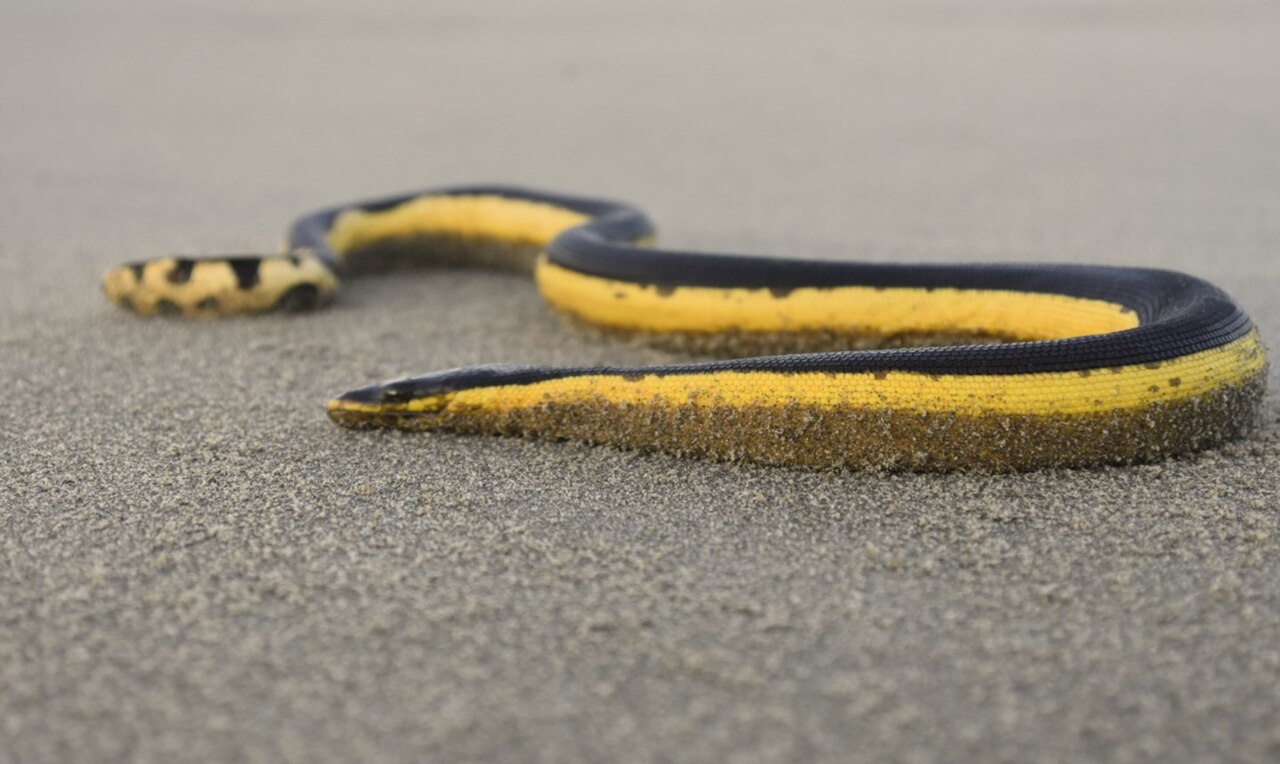
Yellow-bellied sea snake showing dark back, yellow underside and paddle tail
Luis Correa / Wikimedia Commons / CC BY 4.0
๐ŸŒ Read in Language:

โšก At a Glance

Species profile
Also Known As
Pelagic sea snake
Diet Category
Carnivore
Activity Rhythm
Active by day and night according to sea conditions and prey.
Wild Lifespan
Not well established in the wild
Typical Weight
commonly under 300 g
Conservation Status
LC
๐Ÿ’ก Key Biological Insight: It can spend its entire life at sea and gives birth to live young in the water.

๐ŸŒณ Scientific Taxonomy Hierarchy

It is a true sea snake in the cobra family Elapidae and subfamily Hydrophiinae.

KingdomAnimalia
PhylumChordata
ClassReptilia
OrderSquamata
FamilyElapidae
GenusHydrophis
SpeciesHydrophis platurus

Distinguishing Anatomical Features

  • โœ“A small snake with a dark brown or black back, sharply contrasting yellow belly and flattened paddle-shaped tail, often with mottled yellow and dark markings toward the tail.
  • โœ“Paddle tail propels swimming
  • โœ“Valved nostrils exclude water
  • โœ“Lung extends through much of the body
  • โœ“Skin helps exchange gases and salts

๐Ÿ“ Physical Measurements

Total Lengthusually 24โ€“35 in
Body Weightcommonly under 11 oz
Tail LengthNot separately reported
WingspanNot applicable
Top SpeedNo dependable universal maximumMovement changes with context and conditions.

๐ŸŽจ Appearance & Distinctive Markings

BlackDark brownYellow

Skin / Covering: Smooth overlapping scales

Sexual Dimorphism: Females tend to be larger than males, while the color pattern is similar.

๐Ÿ—บ๏ธ Geographic Distribution & Habitat

Tropical Indo-Pacific and eastern Pacific waters, carried broadly by currents; it is absent from the Atlantic under normal conditions.

Warm pelagic surface waters, drift lines and coastal waters after winds or currents carry individuals shoreward.

Country-level distribution map

Native range
FijiTanzaniaWestern SaharaCanadaUnited StatesKazakhstanUzbekistanPapua New GuineaIndonesia โ€” Native rangeArgentinaChileCongo - KinshasaSomaliaKenyaSudanChadHaitiDominican RepublicRussiaBahamasFalkland IslandsNorwayGreenlandFrench Southern TerritoriesTimor-LesteSouth Africa โ€” Native rangeLesothoMexico โ€” Native rangeUruguayBrazilBoliviaPeru โ€” Native rangeColombia โ€” Native rangePanama โ€” Native rangeCosta Rica โ€” Native rangeNicaraguaHondurasEl SalvadorGuatemalaBelizeVenezuelaGuyanaSurinameFranceEcuador โ€” Native rangePuerto RicoJamaicaCubaZimbabweBotswanaNamibiaSenegalMaliMauritaniaBeninNigerNigeriaCameroonTogoGhanaCรดte dโ€™IvoireGuineaGuinea-BissauLiberiaSierra LeoneBurkina FasoCentral African RepublicCongo - BrazzavilleGabonEquatorial GuineaZambiaMalawiMozambiqueEswatiniAngolaBurundiIsraelLebanonMadagascarPalestinian TerritoriesGambiaTunisiaAlgeriaJordanUnited Arab EmiratesQatarKuwaitIraqOmanVanuatuCambodiaThailandLaosMyanmar (Burma)VietnamNorth KoreaSouth KoreaMongoliaIndiaBangladeshBhutanNepalPakistanAfghanistanTajikistanKyrgyzstanTurkmenistanIranSyriaArmeniaSwedenBelarusUkrainePolandAustriaHungaryMoldovaRomaniaLithuaniaLatviaEstoniaGermanyBulgariaGreeceTรผrkiyeAlbaniaCroatiaSwitzerlandLuxembourgBelgiumNetherlandsPortugalSpainIrelandNew CaledoniaSolomon IslandsNew ZealandAustralia โ€” Native rangeSri LankaChinaTaiwanItalyDenmarkUnited KingdomIcelandAzerbaijanGeorgiaPhilippines โ€” Native rangeMalaysiaBruneiSloveniaFinlandSlovakiaCzechiaEritreaJapan โ€” Native rangeParaguayYemenSaudi ArabiaCyprusMoroccoEgyptLibyaEthiopiaDjiboutiUgandaRwandaBosnia & HerzegovinaNorth MacedoniaSerbiaMontenegroKosovoTrinidad & TobagoSouth Sudan
Highlighted countries are recorded profile locations, not precise biological range boundaries.Map boundaries: Natural Earth

๐Ÿ’ก Did You Know?

  • ๐Ÿ’กPaddle tail propels swimming
  • ๐Ÿ’กValved nostrils exclude water
  • ๐Ÿ’กLung extends through much of the body
  • ๐Ÿ’กSkin helps exchange gases and salts

๐ŸŒฟ Conservation Status & Threats

IUCN: LC โ€” Least Concern

โ€œLeast Concern globally because of its extremely broad range, although local impacts remain possible.โ€

Population TrendUnknown
Wild Population EstimateNo dependable current global total is available.

โš ๏ธ Major Threats to Yellow-Bellied Sea Snake

  • โ€ขBycatch
  • โ€ขOil pollution
  • โ€ขMarine debris
  • โ€ขOcean warming and current change

๐Ÿ”„ Life Cycle & Reproduction

Wild vs. Captivity Lifespan Comparison

๐ŸŒฟ In the WildNot well established in the wild
๐Ÿ  In Captivity (with veterinary care)Can live longer under expert managed care.
Clutch / Litter SizeUsually two to six live young.
Incubation / GestationInternal gestation lasts several months
Fledging / WeaningYoung are born live, swim immediately and hunt small prey without parental care.
Sexual MaturityLikely within several years
Mating SystemInternal fertilization
Nesting / Den TypeNo nest; live birth at sea

๐Ÿฆ… Behavior & Field Ecology

Carnivore

๐ŸŒ Ecological Food Web & Relationships: Pelagic predator of small fish and prey for large fish and seabirds.

Social Group SizeUsually solitary, with current-driven aggregations
Activity RhythmActive by day and night according to sea conditions and prey.
Feeding StrategyCarnivore

๐Ÿฅฉ Primary Prey & Preferred Diet

โœ“ Small fishโœ“ Fish larvae

๐Ÿ“ข Communication & Territorial Signals

  • Chemical cues
  • Touch
  • Body movement

๐Ÿพ Wild Temperament & Traits

โ€ข Pelagicโ€ข Secretiveโ€ข Defensive if handled

๐Ÿค Human Interaction & Pet Advisory

โš ๏ธ Strictly Wild Species
๐Ÿšซ

Can You Keep a Yellow-Bellied Sea Snake as a Pet?

Dangerous protected marine wildlife and wholly unsuitable as a pet.

Domestication StatusWild and not domesticated
Danger to HumansHighly venomous, though bites are uncommon
Economic & Ecotourism RolePart of tropical pelagic food webs and research on marine adaptation.

โš ๏ธ Behavioral Risk Factors & Wildlife Safety

  • Potent neurotoxic and myotoxic venom
  • Small mouth still capable of biting exposed skin

๐ŸŒ Ecological Food Web & Relationships

๐Ÿฆ… Natural Predators (3)

SharksSelachimorpha
Large Predatory FishActinopterygii
SeabirdsAves

๐Ÿงฌ Related Species (2)

Olive Sea SnakeAipysurus laevisReef-dwelling true sea snake
Sea KraitsLaticauda speciesAmphibious elapid relatives

Yellow-Bellied Sea Snake (Hydrophis platurus) is the most widely distributed sea snake and lives far from shore in tropical waters. This guide separates well-supported biology from common assumptions and covers identification, range, habitat, diet, behavior, reproduction and conservation.

Identification

A small snake with a dark brown or black back, sharply contrasting yellow belly and flattened paddle-shaped tail, often with mottled yellow and dark markings toward the tail. Females tend to be larger than males, while the color pattern is similar.

Identification should combine body shape, markings, size, voice or movement, and location. One feature by itself can overlap with a related animal, a juvenile, or an individual in unusual light.

Photographs are most useful when they preserve scale and show several diagnostic features. Handling or repositioning a wild yellow-bellied sea snake for identification can cause stress and is unnecessary.

Size and physical adaptations

Yellow-Bellied Sea Snake typically measures usually 60โ€“90 cm and weighs commonly under 300 g. Exceptional individuals may exceed one meter.

Its useful adaptations include paddle tail propels swimming, valved nostrils exclude water, lung extends through much of the body, skin helps exchange gases and salts. These traits work together in the animal’s normal setting rather than serving as isolated curiosities.

Published measurements may use different methods, life stages or sample locations. Comparing figures responsibly means checking what was measured rather than selecting the largest number available.

Range and distribution

Tropical Indo-Pacific and eastern Pacific waters, carried broadly by currents; it is absent from the Atlantic under normal conditions. The native range includes Mexico, Costa Rica, Panama, Colombia, Ecuador, Peru, Australia, Indonesia, Philippines, Japan, South Africa.

A country-level map indicates broad distribution, not continuous occupation. Climate, elevation, water, vegetation, prey, breeding sites, barriers and survey effort all affect where records occur.

Records near the edge of the range deserve careful documentation because they may reflect natural movement, improved survey coverage, accidental transport or a genuine distribution change.

Habitat

Warm pelagic surface waters, drift lines and coastal waters after winds or currents carry individuals shoreward.

Floating debris and current convergence zones concentrate small fish and provide feeding opportunities. Protecting a population therefore requires the feeding, shelter and breeding features that make a site usable, along with connections that allow movement.

Microhabitat matters. Shade, soil, current, moisture, shelter or host plants can determine whether a small area is usable even when the surrounding landscape appears suitable.

Diet and feeding

Yellow-Bellied Sea Snake is a carnivore. Important foods include small fish, fish larvae. It floats at the surface and ambushes fish attracted to the shelter-like shape of its body.

Diet changes with age, season, location and food supply. A dramatic prey record does not establish what most individuals eat most of the time; repeated field observations provide a stronger picture.

Feeding opportunities also create risk. An animal focused on prey may be less alert to predators, traffic or people, while contaminated prey can transfer pollutants through the food web.

Behavior and communication

Active by day and night according to sea conditions and prey. It swims with lateral waves, drifts with currents and sometimes forms aggregations along slicks.

Little social communication is known; chemical cues and touch guide mating and feeding. Behavior should be interpreted in context: alarm, courtship, feeding and temperature regulation can produce very different actions from the same animal.

Daily schedules are flexible responses, not rigid rules. Weather, breeding condition, disturbance, tides or food can move activity into a different part of the day.

Reproduction and development

Mating and birth occur entirely at sea. Usually two to six live young. undefined

Young animals face different risks and may use different microhabitats or food than adults. Breeding success depends on adult condition, suitable sites and the survival of offspring through vulnerable early stages.

Counts of eggs or young describe reproductive output, not the number expected to reach adulthood. Mortality is normally greatest during eggs, larval or juvenile stages.

Predators and ecological role

Pelagic predator of small fish and prey for large fish and seabirds. Documented or likely predators include Sharks, Large Predatory Fish, Seabirds.

This animal is both a consumer and a food source. Its influence comes through many repeated interactions, so ecological claims should be based on measured populations rather than assumptions drawn from appearance.

Predator and prey relationships differ among places. A species can be ecologically influential without being abundant everywhere, and its role can change across its range.

Relationship with people

Beach strandings attract attention, but people should never return a snake by hand.

Highly venomous. Keep well away, prevent pets approaching and contact local wildlife or emergency authorities. Responsible observation means keeping an appropriate distance, avoiding capture or feeding, protecting habitat and following local wildlife or invasive-species guidance.

Wildlife guidance should come from the responsible local agency because collection rules, reporting requests and appropriate responses differ between native and introduced ranges.

Conservation

Least Concern globally because of its extremely broad range, although local impacts remain possible. The reported global trend is Unknown.

Important pressures include bycatch, oil pollution, marine debris, ocean warming and current change. Global status can hide local decline or recovery, so current regional monitoring and habitat management remain necessary.

The most useful conservation action follows the documented pressure. Protecting breeding sites, reducing road deaths or limiting pollutants can require different tools in different populations.

Sources and further reading

โ“ Frequently Asked Questions

Answers to frequently asked questions verified against peer-reviewed zoological research.

Yes. It has potent venom and must never be handled, even though bites to people are uncommon.