
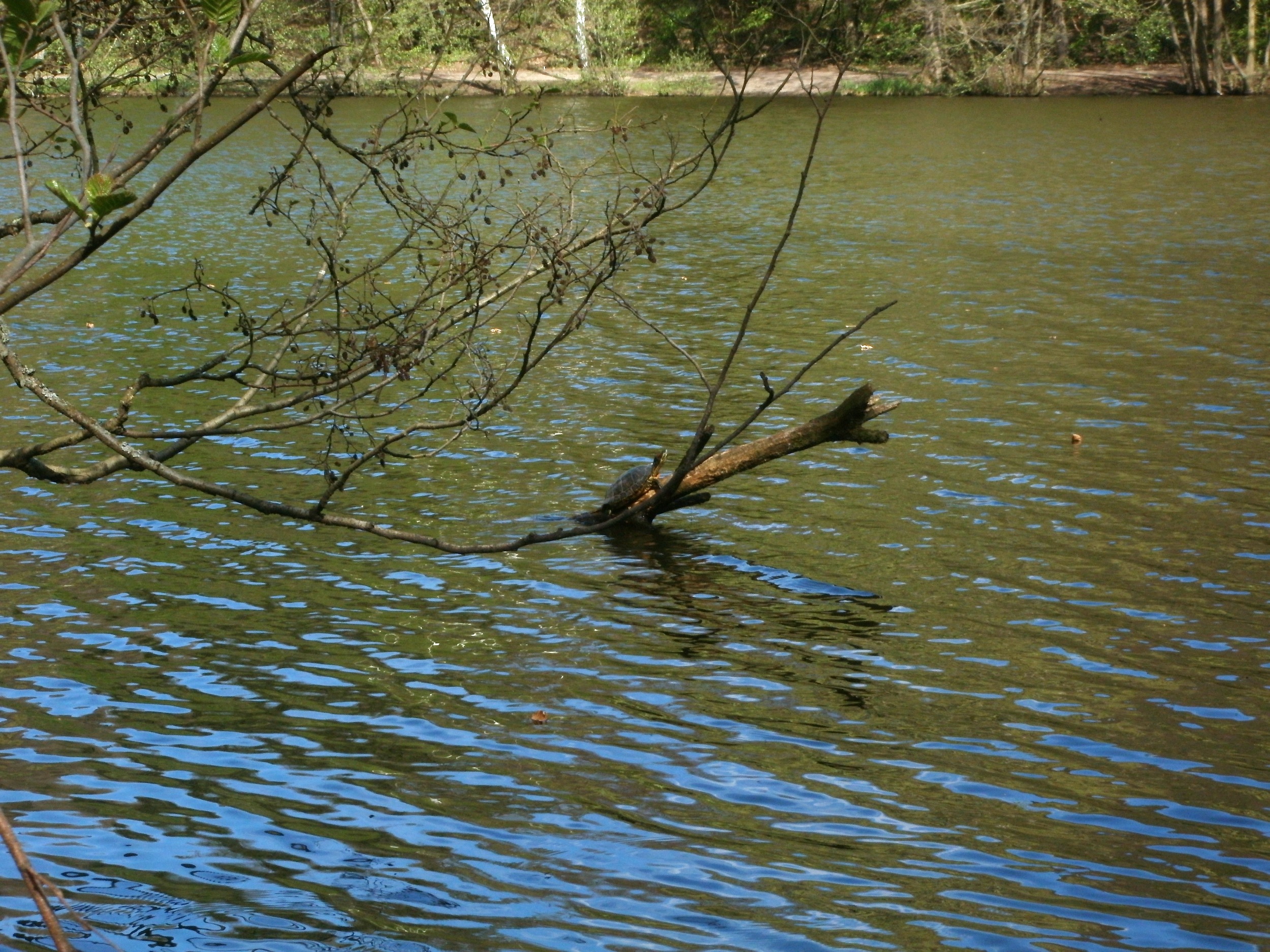
Yellow-bellied Slider (Trachemys scripta scripta) is the nominate subspecies of the pond slider, a semiaquatic turtle native to the Atlantic and Gulf Coastal Plains of the southeastern United States. It spends much of each day in ponds, swamps and slow rivers, then climbs onto logs or banks to warm in the sun. The large yellow patch behind each eye, striped limbs and yellow lower shell distinguish it from the red-eared slider and many cooters. This guide separates well-supported biology from common assumptions and covers identification, range, habitat, diet, behavior, reproduction and conservation.
Identification
A large yellow blotch behind the eye is most obvious in juveniles and females. Narrow yellow stripes cross the dark head, neck and front legs. The upper shell is olive to dark brown with yellow vertical bars and curved markings that fade as adults age. The plastron is yellow and often plain or marked with only a few round dark smudges. Old males can become very dark, obscuring the original pattern. Females grow much larger and have short foreclaws and a short tail; males have elongated foreclaws, a longer thicker tail and the vent beyond the shell edge.
Identification should combine body shape, markings, size, voice or movement, and location. One feature by itself can overlap with a related animal, a juvenile, or an individual in unusual light.
Photographs are most useful when they preserve scale and show several diagnostic features. Handling or repositioning a wild yellow-bellied slider for identification can cause stress and is unnecessary.
Size and physical adaptations
Yellow-bellied Slider typically measures Males about 13–20 cm shell length; females about 20–33 cm and weighs Large females may weigh several kilograms. Female shell length can be roughly half again that of adult males.
Its useful adaptations include webbed feet propel swimming, flattened shell reduces drag, dark shell absorbs basking heat, strong claws grip logs and dig nests, flexible omnivorous diet changes with age, aquatic overwintering conserves energy. These traits work together in the animal’s normal setting rather than serving as isolated curiosities.
Published measurements may use different methods, life stages or sample locations. Comparing figures responsibly means checking what was measured rather than selecting the largest number available.
Range and distribution
The native range extends from southeastern Virginia through the Carolinas and Georgia into northern Florida and eastern Alabama, mainly across the Coastal Plain. Released pets have established scattered populations far outside this area, including parts of the western United States, Europe and Asia. Records beyond the native range should be checked carefully because pond-slider subspecies hybridize and are often misidentified. The native range includes United States.
A country-level map indicates broad distribution, not continuous occupation. Climate, elevation, water, vegetation, prey, breeding sites, barriers and survey effort all affect where records occur.
Records near the edge of the range deserve careful documentation because they may reflect natural movement, improved survey coverage, accidental transport or a genuine distribution change.
Habitat
Shallow ponds, lakes, swamps, marshes, oxbows and slow rivers with vegetation and sunny basking sites.
Yellow-bellied sliders favor calm permanent water with muddy bottoms, aquatic plants and logs or banks exposed to sunlight. Basking raises body temperature for digestion, movement and immune function. Turtles drop quickly into deep water when alarmed. Females leave the water to nest and may cross roads or lawns, while drought can force both sexes to travel overland toward another wetland. Protecting a population therefore requires the feeding, shelter and breeding features that make a site usable, along with connections that allow movement.
Microhabitat matters. Shade, soil, current, moisture, shelter or host plants can determine whether a small area is usable even when the surrounding landscape appears suitable.
Diet and feeding
Yellow-bellied Slider is a omnivore, becoming more plant-focused with age. Important foods include aquatic plants, algae, insects and larvae, snails and small crustaceans, tadpoles, carrion and occasional small fish. Young sliders need protein for rapid growth and take many insects, crustaceans and other small animals. Adults eat more leaves, stems, algae and fallen fruit while still accepting animal prey and carrion. They forage by sight and smell, tear food with the horny beak and swallow underwater because the tongue does not move food efficiently on land. Feeding activity rises as water warms.
Diet changes with age, season, location and food supply. A dramatic prey record does not establish what most individuals eat most of the time; repeated field observations provide a stronger picture.
Feeding opportunities also create risk. An animal focused on prey may be less alert to predators, traffic or people, while contaminated prey can transfer pollutants through the food web.
Behavior and communication
Diurnal, with frequent morning and midday basking; less active in cold weather. Sliders alternate between swimming, bottom walking, feeding and basking. Several turtles may stack on one log, yet each remains ready to dive. They use familiar basking and refuge sites and can orient back to home water after short movements. In winter, native populations become sluggish underwater, sheltering in mud or submerged cover while drawing limited oxygen through exposed tissues.
Vision, touch and water movement are central. Courting males swim backward in front of females and vibrate their long foreclaws near the female’s face. Turtles also use scent to locate food and mates. Threatened animals withdraw, hiss as air leaves the lungs, kick with sharp claws or bite rather than using social calls. Behavior should be interpreted in context: alarm, courtship, feeding and temperature regulation can produce very different actions from the same animal.
Daily schedules are flexible responses, not rigid rules. Weather, breeding condition, disturbance, tides or food can move activity into a different part of the day.
Reproduction and development
Courtship and mating occur mainly in spring and autumn. A female may store sperm and produce more than one clutch. She leaves the pond, chooses sunny soil and digs a flask-shaped nest with her hind feet, moistening hard ground with bladder water. After laying, she covers and disguises the site. Incubation temperature influences offspring sex, and hatchlings receive no care. Usually 6–11 eggs, with a broader range of about 2–20 Hatchlings may emerge in late summer or remain in the nest until spring. Their shells are bright green with crisp yellow patterning. Growth is quickest during warm seasons with abundant food. Males often mature in two to five years, while the larger females usually take five to eight years or longer. Shell markings darken and wear with age.
Young animals face different risks and may use different microhabitats or food than adults. Breeding success depends on adult condition, suitable sites and the survival of offspring through vulnerable early stages.
Counts of eggs or young describe reproductive output, not the number expected to reach adulthood. Mortality is normally greatest during eggs, larval or juvenile stages.
Predators and ecological role
Yellow-bellied sliders consume aquatic plants, invertebrates, carrion and small vertebrates, then return nutrients through waste. Eggs and hatchlings feed raccoons, foxes, skunks, herons, large fish and alligators. Adults are more protected by the shell but still suffer road mortality and predation. Where released outside the native range, sliders may compete with native turtles for basking platforms, food and nesting habitat. Documented or likely predators include Raccoon, American Alligator, Great Blue Heron, Largemouth Bass.
This animal is both a consumer and a food source. Its influence comes through many repeated interactions, so ecological claims should be based on measured populations rather than assumptions drawn from appearance.
Predator and prey relationships differ among places. A species can be ecologically influential without being abundant everywhere, and its role can change across its range.
Relationship with people
People encounter sliders on basking logs, roads and lawns during nesting season. A turtle crossing a safe road can be moved only in the direction it was already traveling; relocation to another pond can separate it from familiar habitat. The pet trade has spread sliders widely. Owners who cannot keep one must contact a rescue or wildlife agency and never release it, because releases can introduce disease, genes and competition.
Wild turtles should be watched without handling. Like other reptiles, sliders can carry Salmonella even when healthy, so hands and surfaces must be washed after necessary contact. Children should not kiss turtles or clean habitat equipment in food-preparation sinks. Responsible observation means keeping an appropriate distance, avoiding capture or feeding, protecting habitat and following local wildlife or invasive-species guidance.
Wildlife guidance should come from the responsible local agency because collection rules, reporting requests and appropriate responses differ between native and introduced ranges.
Conservation
The pond slider species is globally assessed as Least Concern and the yellow-bellied subspecies remains widespread in its native southeastern U.S. range. Wetland loss, road deaths, collection, pollution and hybridization can still reduce local populations. Outside its native range, management often focuses on preventing pet releases and protecting native turtle communities. The reported global trend is Generally stable across much of the native range, with local declines and nonnative expansions.
Important pressures include wetland drainage and shoreline development, road mortality during nesting movements, illegal or excessive collection, water pollution, pet release outside the native range, hybridization with other slider subspecies. Global status can hide local decline or recovery, so current regional monitoring and habitat management remain necessary.
The most useful conservation action follows the documented pressure. Protecting breeding sites, reducing road deaths or limiting pollutants can require different tools in different populations.
