
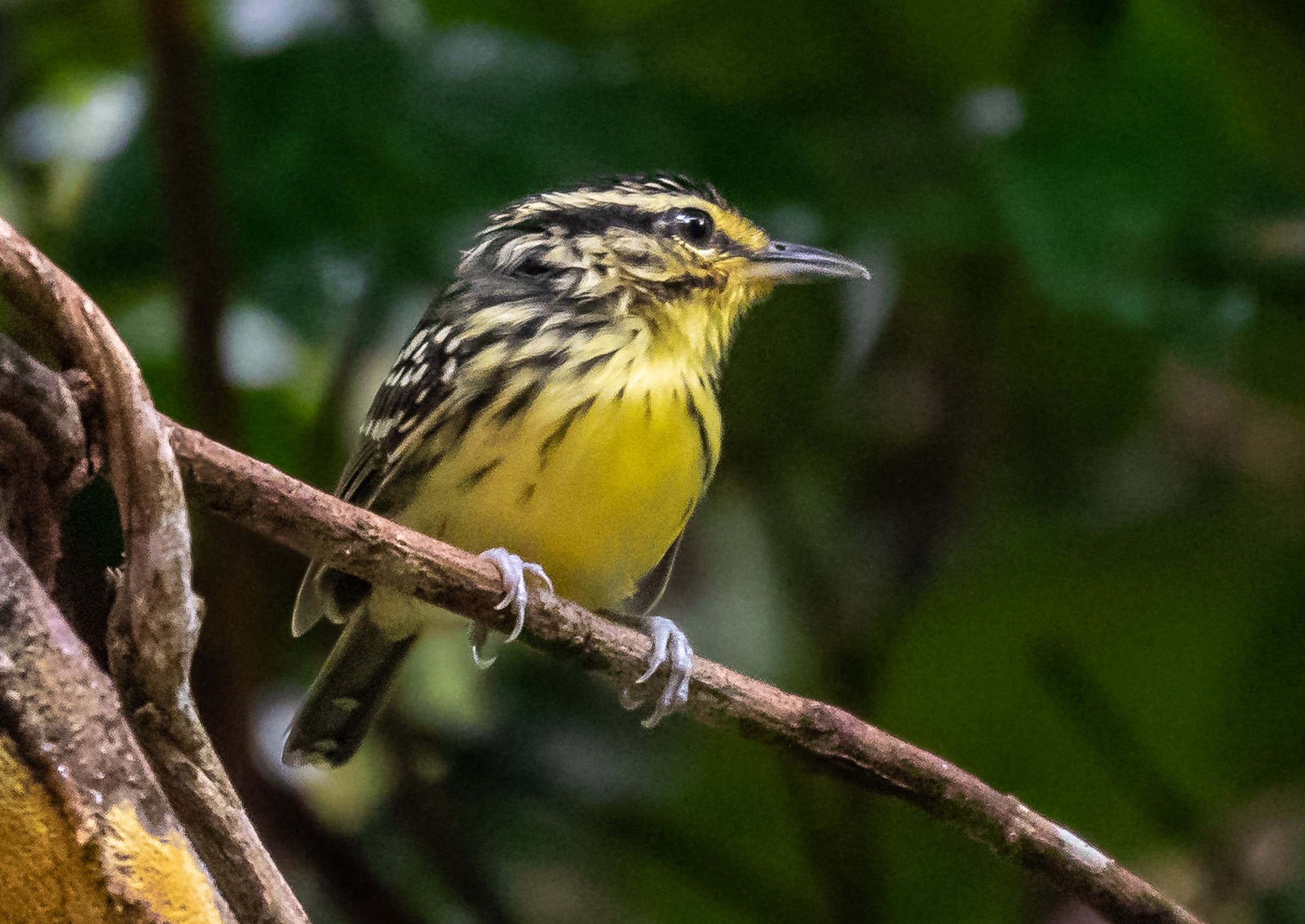
A living bird of the western Amazon
The Yellow-browed Antbird, Hypocnemis hypoxantha, is a living passerine of humid Amazonian forest. It belongs to the typical antbird family, Thamnophilidae, and occurs in parts of Colombia, Ecuador, Peru and Brazil. The name refers to the yellow or buff stripe above the eye, one of several warm markings that contrast with its dark crown and streaked upperparts. The Integrated Taxonomic Information System recognizes the species as Hypocnemis hypoxantha.
This is a small forest bird, usually detected by voice before it is seen. Dense foliage conceals it, and pairs often forage below the canopy where filtered light breaks across leaves and tangled branches. Its restricted relationship with Amazonian forest makes habitat condition more important than its broad country list might suggest.
Appearance and identification
Adults are about 11–13 centimetres long. A pale yellow eyebrow runs above a dark eye stripe, while the crown is blackish with fine pale streaks. The cheeks and underparts are yellow to buff-yellow, often marked with dark streaks on the throat and breast. The back and wings carry a mixture of black, olive, cream and yellowish markings that disrupt the bird’s outline in shaded vegetation.
Males and females differ subtly, and plumage also varies geographically. Light, viewing angle and leaf shadows can change how bright the yellow appears. Identification therefore uses voice, range, facial pattern and breast markings together. Similar warbling antbirds occupy neighboring parts of Amazonia, and records near contact zones deserve careful documentation rather than identification from color alone.
Range and habitat
The species inhabits the western and central Amazon Basin. Current references place it in southeastern Colombia, eastern Ecuador, northeastern Peru and western Brazil, with populations farther east associated with the Amazonian region between major rivers. Taxonomic treatments have differed over whether some eastern populations belong within this species, so a locality should be checked against an up-to-date bird list.
Yellow-browed Antbirds use humid lowland and foothill forest, including mature forest and well-developed secondary growth. They forage in the understory and lower middle levels, often among vine tangles, dense shrubs and branches that provide both prey and cover. Some records come from white-sand forest, a distinctive Amazonian habitat with nutrient-poor soils and specialized plant communities. The species is mostly resident rather than a long-distance migrant.
Foraging and diet
Insects and spiders form the core of the diet. A bird moves deliberately through leaves and branches, searching surfaces, probing curled vegetation and making short hops or sallies to seize prey. Its compact body and strong feet suit maneuvering through crowded understory growth. Detailed percentages are poorly known, so it is safer to describe it as an insect-eating generalist than to claim one prey group dominates everywhere.
Despite the family name, antbirds do not necessarily eat ants as their main food. Some species attend army-ant swarms to catch insects and other small animals flushed by the ants. The Yellow-browed Antbird may exploit disturbed prey opportunistically, but it is not best described as an obligate swarm follower. It also searches independently, frequently in pairs and sometimes within mixed-species feeding groups.
Voice and social behavior
Song is central to life in dim forest where sight lines are short. The Yellow-browed Antbird gives a clear series of notes that can help distinguish it from related species. Males and females may answer one another, maintaining contact as a pair moves through vegetation. Calls also mark territory and signal alarm. Recordings in the Macaulay Library document the living species in Amazonian habitat.
Pairs appear to defend year-round territories. They remain close enough to communicate even when foliage hides one bird from the other. When alarmed, an individual may slip deeper into cover rather than fly a long distance. Its short, rounded wings favor agile movement between nearby perches. This quiet, concealed behavior explains why surveyors often rely on sound to establish presence.
Breeding and development
Published breeding information is limited compared with knowledge of the bird’s voice and distribution. Like other typical antbirds, the species is expected to build a small open cup in low vegetation and lay a small clutch, but exact nest placement and seasonal timing can differ across its large range. Statements about clutch size or incubation should be tied to direct records rather than borrowed uncritically from relatives.
Both members of an antbird pair commonly contribute to parental care in the family. Chicks hatch helpless and depend on adults for warmth and food. After leaving the nest, young birds remain vulnerable while learning to forage in dense vegetation. Forest structure around the nest matters: thick cover conceals eggs and young, while nearby foliage provides a steady supply of small arthropods.
Ecological relationships
By eating insects and spiders, the Yellow-browed Antbird transfers energy from small arthropods to larger forest predators. Hawks, forest falcons, snakes and small carnivorous mammals may take antbirds or their nests. Mixed-species flocking can improve detection of predators and provide access to prey disturbed by other birds, although participation varies by place and season.
The bird also contributes to biological surveys. Its song can reveal intact or recovering understory habitat even when observers get only a brief view. Because closely related antbirds can replace one another across rivers, distribution records help researchers understand how Amazonian waterways, forest history and habitat differences shape species boundaries.
Conservation
The Yellow-browed Antbird is currently assessed as Least Concern. A broad range and records from several countries reduce immediate global extinction risk, but they do not protect every population. Deforestation for roads, mining, agriculture, pasture and settlement removes habitat and divides remaining forest into smaller patches. Fire can damage humid understory even where large canopy trees survive.
Maintaining connected forest across river basins is the most effective protection. Reserves, Indigenous territories and responsibly managed surrounding lands all contribute. Bird records with dates, sounds and accurate locations improve monitoring, while sensitive nest sites should not be disturbed. The Avibase taxonomic summary helps track names and checklist treatments used for this species.
Watching responsibly
Observers have the best chance early in the day by listening along quiet forest trails. Remaining still after hearing a song is more effective than entering dense vegetation. Brief, low-volume playback may be restricted or discouraged, especially during breeding. Repeated playback can draw a territorial bird away from feeding or nest care and should be avoided.
Photographers should stay on established routes, avoid trimming branches and never move a bird toward a cleaner background. The scarcity of freely reusable photographs reflects how difficult the species is to see, not a reason to stage contact. A distant image or sound recording with reliable locality can be more valuable than a close photograph obtained by disrupting the bird.