
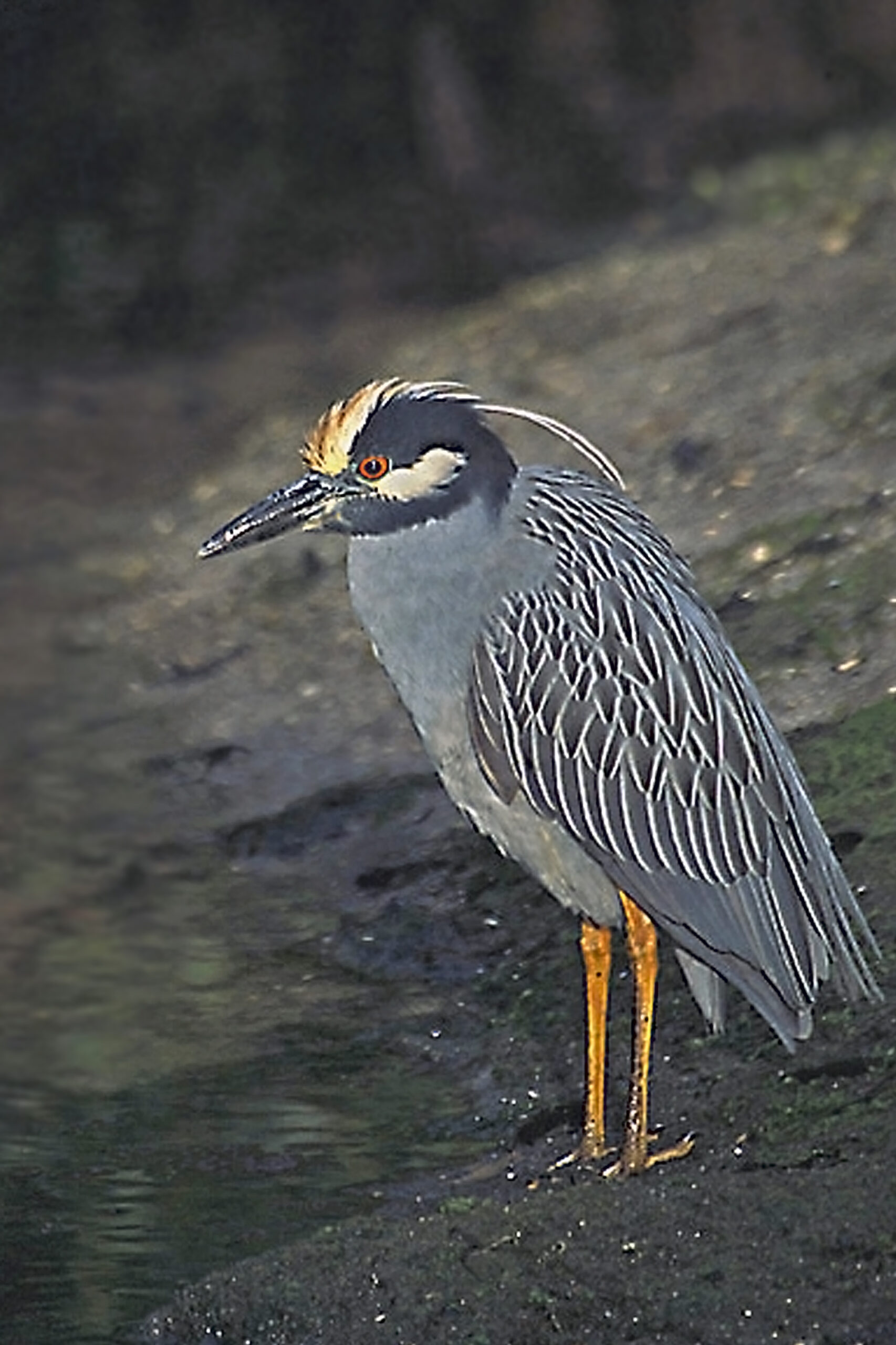
Yellow-crowned Night Heron (Nyctanassa violacea) is a medium-sized heron of warm coastal marshes, mangroves, wooded streams and other shallow wetlands in the Americas. Adults combine a smoky gray body with a black-and-white face and pale yellow crown plumes. The species feeds at night and by day, often timing coastal foraging to the tides rather than to the clock. This guide separates well-supported biology from common assumptions and covers identification, range, habitat, diet, behavior, reproduction and conservation.
Identification
Adults are compact gray herons with a thick black bill, black head, broad white cheek patch and creamy yellow crown that extends into long plumes. The eyes are orange-red and the legs yellow to orange. Juveniles are brown, streaked below and finely spotted above; their heavier bill and longer legs help separate them from young black-crowned night herons. Adult males and females look alike, although males average slightly larger.
Identification should combine body shape, markings, size, voice or movement, and location. One feature by itself can overlap with a related animal, a juvenile, or an individual in unusual light.
Photographs are most useful when they preserve scale and show several diagnostic features. Handling or repositioning a wild yellow-crowned night heron for identification can cause stress and is unnecessary.
Size and physical adaptations
Yellow-crowned Night Heron typically measures 55–70 cm and weighs 650–850 g approximately. A stocky, medium-sized heron; measurements vary by sex and region.
Its useful adaptations include heavy bill grips and breaks crustaceans, long toes spread weight on mud, forward-facing eyes aid precise strikes, retracted-neck flight reduces drag, tide-linked foraging tracks exposed crabs, cryptic juvenile plumage reduces detection. These traits work together in the animal’s normal setting rather than serving as isolated curiosities.
Published measurements may use different methods, life stages or sample locations. Comparing figures responsibly means checking what was measured rather than selecting the largest number available.
Range and distribution
The species occurs from the southeastern and locally northeastern United States through Mexico, Central America and the Caribbean to northern and western South America. Northern breeders migrate or disperse, while many birds in tropical regions and the warm southern Atlantic and Gulf coasts remain year-round. Young birds commonly wander north and west after breeding. The native range includes United States, Mexico, Central America, Caribbean islands, Northern South America.
A country-level map indicates broad distribution, not continuous occupation. Climate, elevation, water, vegetation, prey, breeding sites, barriers and survey effort all affect where records occur.
Records near the edge of the range deserve careful documentation because they may reflect natural movement, improved survey coverage, accidental transport or a genuine distribution change.
Habitat
Salt marshes, mangroves, tidal creeks, lagoons, barrier islands, wooded swamps, river margins, ponds and wet fields.
Birds roost quietly in trees or dense vegetation and forage in shallow water, mudflats or wet ground. Coastal birds concentrate near tidal creeks and pools rich in crabs. Inland populations follow streams, ponds and flooded woods where crayfish are abundant. Nests are usually placed in trees or shrubs near water, sometimes in mixed heron colonies. Protecting a population therefore requires the feeding, shelter and breeding features that make a site usable, along with connections that allow movement.
Microhabitat matters. Shade, soil, current, moisture, shelter or host plants can determine whether a small area is usable even when the surrounding landscape appears suitable.
Diet and feeding
Yellow-crowned Night Heron is a carnivorous crustacean specialist. Important foods include fiddler and marsh crabs, blue and ghost crabs, crayfish, aquatic insects, mollusks and worms, frogs and small fish. A heron stands still or walks slowly with its body angled forward, then lunges when prey comes within reach. Small crustaceans may be swallowed whole. Larger crabs are seized by a leg or claw, shaken apart, stabbed or crushed with the bill, and swallowed in pieces. Coastal feeding peaks around favorable tide stages; inland birds rely heavily on crayfish.
Diet changes with age, season, location and food supply. A dramatic prey record does not establish what most individuals eat most of the time; repeated field observations provide a stronger picture.
Feeding opportunities also create risk. An animal focused on prey may be less alert to predators, traffic or people, while contaminated prey can transfer pollutants through the food web.
Behavior and communication
Crepuscular, nocturnal and diurnal; coastal activity is strongly influenced by tides. Yellow-crowned Night Herons often forage alone and defend space around productive feeding patches. They commute with slow, steady wingbeats and the neck folded back. During courtship, a male performs display flights and raises then retracts his head while spreading long shoulder plumes. Adults defend nest sites with calls, lunges and bill jabs.
A harsh squawk or scaup-like call is often heard when birds fly at dusk or are disturbed. Courtship combines calls with head, neck and plume displays. Threatened adults and older nestlings use vocalizations, lunging and bill movements to warn intruders. Behavior should be interpreted in context: alarm, courtship, feeding and temperature regulation can produce very different actions from the same animal.
Daily schedules are flexible responses, not rigid rules. Weather, breeding condition, disturbance, tides or food can move activity into a different part of the day.
Reproduction and development
Pairs are socially monogamous, and some bonds may continue across years. The male selects a nest area and initially brings sticks while the female places them; later both partners collect and arrange material. Birds nest singly or in colonies, sometimes beside other herons, and may reuse and enlarge a nest in later seasons. Usually 2–6 eggs Chicks hatch helpless in pale down. Both parents incubate, shade and feed the young by regurgitation. Nestlings begin climbing nearby branches before sustained flight and normally remain in the nest area for roughly 30–43 days. Sibling competition can be intense when food is scarce.
Young animals face different risks and may use different microhabitats or food than adults. Breeding success depends on adult condition, suitable sites and the survival of offspring through vulnerable early stages.
Counts of eggs or young describe reproductive output, not the number expected to reach adulthood. Mortality is normally greatest during eggs, larval or juvenile stages.
Predators and ecological role
By consuming abundant crabs and crayfish, the heron connects aquatic invertebrate production with wetland food webs. Eggs and chicks may be taken by raccoons, snakes, crows and raptors, while adults are less vulnerable. Colonies deposit nutrients beneath nest trees, and abandoned stick nests may later be reused by other waterbirds. Documented or likely predators include Raccoon, American Crow, Rat Snake, Large raptors.
This animal is both a consumer and a food source. Its influence comes through many repeated interactions, so ecological claims should be based on measured populations rather than assumptions drawn from appearance.
Predator and prey relationships differ among places. A species can be ecologically influential without being abundant everywhere, and its role can change across its range.
Relationship with people
People encounter these herons along tidal parks, neighborhood canals, golf courses and wooded streams. Quiet observation protects feeding birds and colonies. Droppings, noise and fallen nest material can create conflict when colonies form over streets or houses, but harassment during nesting can destroy eggs or young and may violate wildlife law.
Watch from a respectful distance, keep dogs leashed near colonies and never approach a nest or corner an injured bird. Contact a licensed wildlife rehabilitator for a bird in distress. Responsible observation means keeping an appropriate distance, avoiding capture or feeding, protecting habitat and following local wildlife or invasive-species guidance.
Wildlife guidance should come from the responsible local agency because collection rules, reporting requests and appropriate responses differ between native and introduced ranges.
Conservation
The IUCN Red List assesses Nyctanassa violacea as Least Concern. It remains widespread and fairly numerous, although monitoring is difficult because nesting birds are secretive. Wetland loss, altered water flow, pollution, disturbance and removal of colony trees can cause serious local declines even when the global species is not threatened. The reported global trend is No clear significant long-term change in North American surveys; some data suggest decline.
Important pressures include loss and degradation of coastal wetlands, drainage or channelization of inland wetlands, disturbance at nesting colonies, removal of nest trees, oil and chemical pollution, changes in crustacean prey and water regimes. Global status can hide local decline or recovery, so current regional monitoring and habitat management remain necessary.
The most useful conservation action follows the documented pressure. Protecting breeding sites, reducing road deaths or limiting pollutants can require different tools in different populations.
