
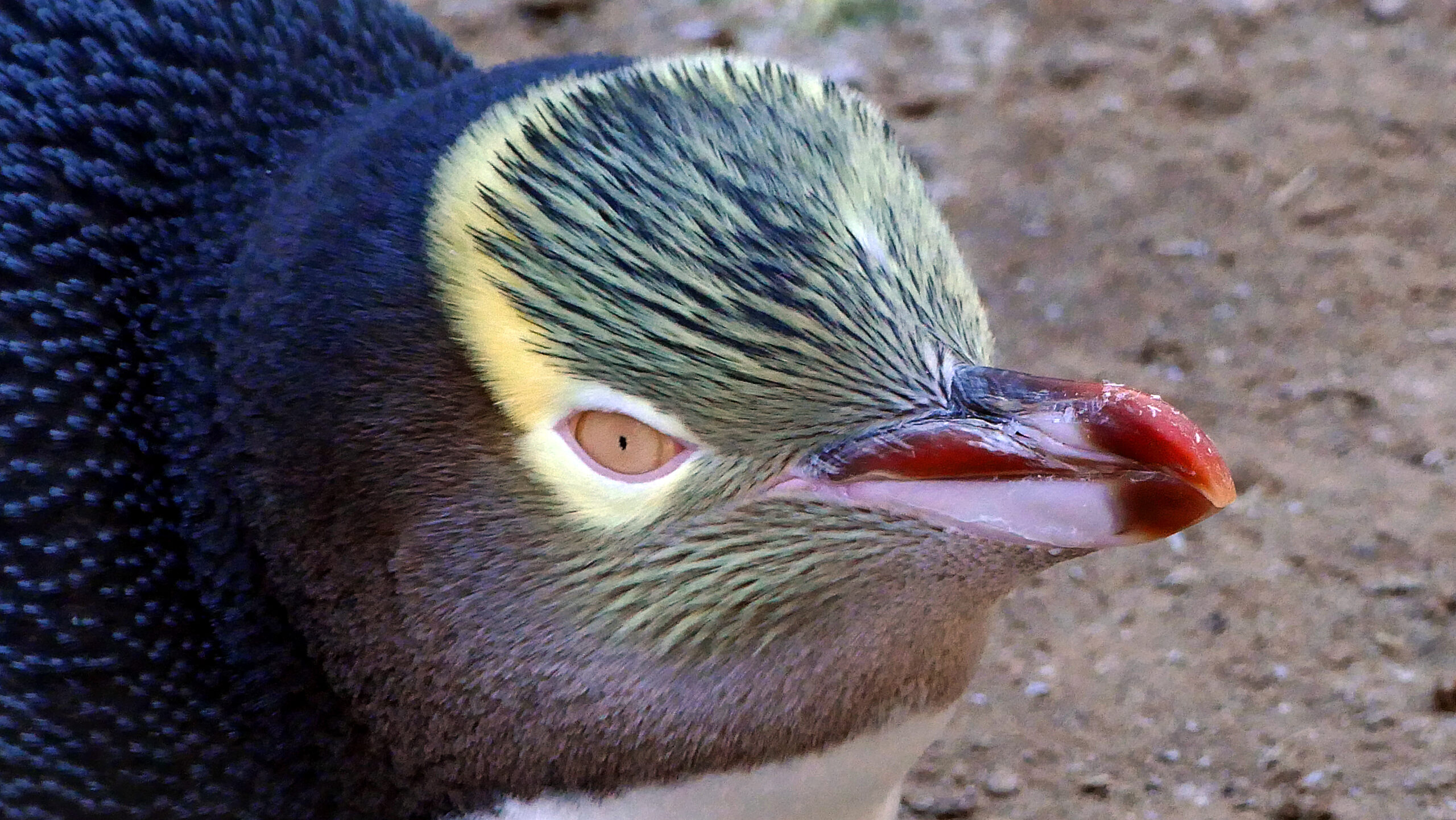
Yellow-eyed Penguin (Megadyptes antipodes) is an endangered penguin found nowhere outside New Zealand. Known as hoiho, it forages along the seabed by day and returns through surf to secluded nests in coastal vegetation, where disturbance, disease and changing seas now threaten its future. This guide separates well-supported biology from common assumptions and covers identification, range, habitat, diet, behavior, reproduction and conservation.
Identification
Adults have a slate-gray back, white belly, pale yellow eyes and a broad band of yellow feathers running from each eye around the back of the head. The bill is long and reddish orange. Pink feet and a narrow upright stance complete the profile. Juveniles lack the bright head band and have gray eyes, making age visible at a distance. Hoiho are taller and more slender than the little penguins that share some beaches. Males and females look similar, although males average slightly larger and often have a deeper bill. Plumage is not a reliable way to sex an individual.
Identification should combine body shape, markings, size, voice or movement, and location. One feature by itself can overlap with a related animal, a juvenile, or an individual in unusual light.
Photographs are most useful when they preserve scale and show several diagnostic features. Handling or repositioning a wild yellow-eyed penguin for identification can cause stress and is unnecessary.
Size and physical adaptations
Yellow-eyed Penguin typically measures about 56–78 cm tall, commonly near 65–70 cm and weighs about 5–8 kg, changing substantially before and after breeding or moult. Body mass rises before the annual moult because the bird must fast ashore while replacing every feather.
Its useful adaptations include dense waterproof feathers trap an insulating air layer, stiff flippers generate thrust underwater, heavy bones reduce buoyancy during deep dives, countershading conceals the bird from above and below, salt glands remove excess salt from seawater, streamlined body and backward-pointing papillae help capture fish. These traits work together in the animal’s normal setting rather than serving as isolated curiosities.
Published measurements may use different methods, life stages or sample locations. Comparing figures responsibly means checking what was measured rather than selecting the largest number available.
Range and distribution
Endemic to New Zealand. The northern population breeds from Banks Peninsula down the southeast South Island coast, on Rakiura/Stewart Island and nearby islands. The southern population breeds on the subantarctic Auckland Islands and Campbell Island. Birds remain within New Zealand waters throughout the year. The native range includes New Zealand.
A country-level map indicates broad distribution, not continuous occupation. Climate, elevation, water, vegetation, prey, breeding sites, barriers and survey effort all affect where records occur.
Records near the edge of the range deserve careful documentation because they may reflect natural movement, improved survey coverage, accidental transport or a genuine distribution change.
Habitat
Temperate and subantarctic coasts with sheltered landing beaches, coastal forest, scrub or grassland for nesting, and nearby continental-shelf feeding grounds.
A breeding bird walks inland from the shore to a nest hidden from neighboring pairs by vegetation, a bank, rock or artificial shelter. Coastal forest was the ancestral setting, although pairs now also use regenerating scrub, farmland margins and planted reserves. At sea they favor benthic feeding habitat, repeatedly diving toward the seafloor over the continental shelf. Safe travel corridors between nest and water are essential because dogs, visitors, fences and vehicles can block or delay returning adults. Protecting a population therefore requires the feeding, shelter and breeding features that make a site usable, along with connections that allow movement.
Microhabitat matters. Shade, soil, current, moisture, shelter or host plants can determine whether a small area is usable even when the surrounding landscape appears suitable.
Diet and feeding
Yellow-eyed Penguin is a marine carnivore specializing in fish and cephalopods. Important foods include red cod, blue cod, opalfish, sprats, silversides, arrow squid, small crustaceans. Hoiho usually leave after dawn and forage alone within tens of kilometres of shore. They make repeated dives, often following the bottom and pursuing fish close to the seafloor. Documented dives can approach 160 metres, although most are shallower. The bill grips fish and squid, which are swallowed underwater. Adults carrying food return in the evening and regurgitate meals for chicks. A shift from nutritious red cod toward other prey can reduce the energy delivered to growing young.
Diet changes with age, season, location and food supply. A dramatic prey record does not establish what most individuals eat most of the time; repeated field observations provide a stronger picture.
Feeding opportunities also create risk. An animal focused on prey may be less alert to predators, traffic or people, while contaminated prey can transfer pollutants through the food web.
Behavior and communication
Diurnal at sea, with land activity concentrated around departure, evening return, nesting and the annual moult. This is one of the least colonial penguins. Pairs space nests out of sight of other pairs, and birds use calls to locate partners and chicks in vegetation. They follow familiar paths between sea and nest and often pause at social areas above the beach. Hoiho are wary of people; a bird that sees visitors near its route may wait offshore, delaying a meal for its chicks. In late summer and autumn each adult undergoes a catastrophic moult, remaining ashore and fasting for roughly three to four weeks while all feathers are replaced.
The name hoiho is commonly translated as “noise shouter.” Adults use loud trumpeting or braying calls to advertise, reunite with a partner and identify family members. Chicks beg for food, and close birds also communicate through posture, bill movements and touch. Individual voice patterns help a pair find each other among coastal vegetation. Behavior should be interpreted in context: alarm, courtship, feeding and temperature regulation can produce very different actions from the same animal.
Daily schedules are flexible responses, not rigid rules. Weather, breeding condition, disturbance, tides or food can move activity into a different part of the day.
Reproduction and development
Pairs are seasonally monogamous and many reunite in later years. Courtship and nest preparation begin in winter. The pair chooses a screened site under shrubs, among roots, beside a log or in a shelter box. Both adults incubate and later alternate between guarding and feeding. Their unusually private nesting system reduces conflict but makes each pair vulnerable when coastal cover is fragmented. Usually 2 eggs; both are similar in size and can produce viable chicks New chicks remain at the nest under close parental care. Both adults supply regurgitated fish and squid. As the chicks grow, both parents may forage on the same day. Young replace brown down with waterproof juvenile feathers and head to sea at roughly 100–120 days. They acquire the full yellow adult head pattern after later moults.
Young animals face different risks and may use different microhabitats or food than adults. Breeding success depends on adult condition, suitable sites and the survival of offspring through vulnerable early stages.
Counts of eggs or young describe reproductive output, not the number expected to reach adulthood. Mortality is normally greatest during eggs, larval or juvenile stages.
Predators and ecological role
Hoiho transfer energy from continental-shelf fish and squid to terrestrial coastal ecosystems through eggs, feathers and guano. Their need for both intact seabed feeding habitat and predator-free coastal vegetation makes them a sensitive indicator of ecosystem condition. They also support conservation tourism and connect marine protection with forest restoration. Because adults raise at most two chicks in a season and mature slowly, deaths of breeding birds cannot be quickly replaced. Documented or likely predators include New Zealand Sea Lion, Sharks, Stoat, Ferret, Domestic Dog, Feral Cat.
This animal is both a consumer and a food source. Its influence comes through many repeated interactions, so ecological claims should be based on measured populations rather than assumptions drawn from appearance.
Predator and prey relationships differ among places. A species can be ecologically influential without being abundant everywhere, and its role can change across its range.
Relationship with people
Forest clearance removed much mainland nesting cover, while introduced mammals brought new predation. Today set-net bycatch, seabed disturbance, warming water, reduced prey quality, disease, dog attacks and visitors near landing routes interact. Conservation teams monitor nests, control predators, restore native shrubs, provide shelters, treat sick birds and rescue starving individuals. Māori, government agencies, wildlife hospitals, fishers, landowners and community trusts share recovery work. Responsible viewing means using designated hides, keeping well back and leaving before a returning bird must wait.
Hoiho are not dangerous to people, but approaching harms the bird. Never block the route between sea and nest, use flash, follow a penguin into vegetation or take a dog onto restricted beaches. Watch only from approved hides or at the distance required by local signs. If a penguin appears sick, injured or trapped, keep people and pets away and call New Zealand wildlife authorities rather than touching it. Responsible observation means keeping an appropriate distance, avoiding capture or feeding, protecting habitat and following local wildlife or invasive-species guidance.
Wildlife guidance should come from the responsible local agency because collection rules, reporting requests and appropriate responses differ between native and introduced ranges.
Conservation
The IUCN lists the Yellow-eyed Penguin as Endangered, and New Zealand classifies it as Threatened–Nationally Endangered. DOC estimated 4,000–5,000 mature individuals in 2019, but the better-monitored northern population has declined sharply; uncertainty remains for remote subantarctic populations. The reported global trend is Decreasing, especially in the northern population.
Important pressures include ocean warming and changing prey, set-net bycatch, bottom-trawl habitat effects, disease and parasites, introduced mammal predation, dog attacks, human disturbance, coastal habitat loss, starvation and severe weather. Global status can hide local decline or recovery, so current regional monitoring and habitat management remain necessary.
The most useful conservation action follows the documented pressure. Protecting breeding sites, reducing road deaths or limiting pollutants can require different tools in different populations.
The Yellow-eyed Penguin nests relatively privately along New Zealand coasts, contrasting with the dense colonies of the Chinstrap Penguin.