
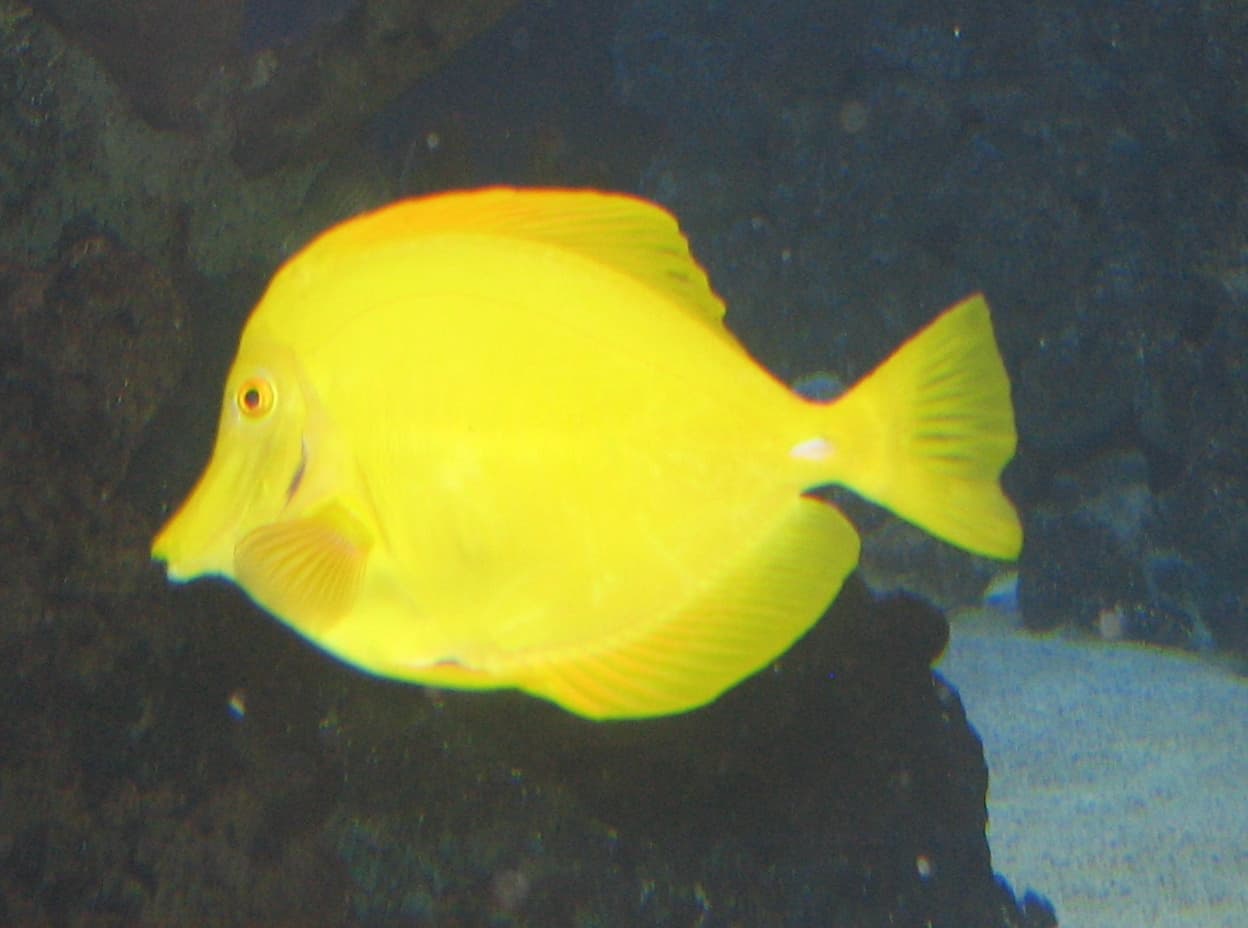
Yellow Tang (Zebrasoma flavescens) are deep-bodied reef fish of the central and northwestern Pacific, especially familiar in Hawai‘i, where they spend daylight hours cropping filamentous algae from hard reef surfaces. This guide separates well-supported biology from common assumptions and covers identification, range, habitat, diet, behavior, reproduction and conservation.
Identification
Yellow tangs have a laterally compressed, disk-like body, a moderately projecting snout, high dorsal and anal fins and nearly uniform lemon-yellow coloration. A white, razor-like defensive spine sits on each side of the narrow caudal peduncle and can be exposed when the fish is threatened. Males and females are similar in color. Mature males tend to grow larger, and sex is usually determined from size, behavior or examination rather than ordinary visual markings.
Identification should combine body shape, markings, size, voice or movement, and location. One feature by itself can overlap with a related animal, a juvenile, or an individual in unusual light.
Photographs are most useful when they preserve scale and show several diagnostic features. Handling or repositioning a wild yellow tang for identification can cause stress and is unnecessary.
Size and physical adaptations
Yellow Tang typically measures up to about 20 cm total length and weighs Not consistently reported for wild populations. Most individuals are smaller than the published maximum, and measurements depend on total versus standard length.
Its useful adaptations include laterally compressed body turns tightly around reef structure, projecting snout reaches algae in small crevices, close-set spatulate teeth crop filamentous algae, sharp caudal spine deters close predators and rivals, large dorsal and anal fins improve maneuvering. These traits work together in the animal’s normal setting rather than serving as isolated curiosities.
Published measurements may use different methods, life stages or sample locations. Comparing figures responsibly means checking what was measured rather than selecting the largest number available.
Range and distribution
Native to the northwestern and central Pacific, from southwest Japan through the Mariana, Marshall and Micronesian island groups to Hawai‘i and other central Pacific localities. Hawai‘i contains especially prominent populations. The native range includes Japan, Taiwan, Philippines, United States (Hawai‘i and Pacific islands), Northern Mariana Islands, Guam, Federated States of Micronesia, Marshall Islands, Palau.
A country-level map indicates broad distribution, not continuous occupation. Climate, elevation, water, vegetation, prey, breeding sites, barriers and survey effort all affect where records occur.
Records near the edge of the range deserve careful documentation because they may reflect natural movement, improved survey coverage, accidental transport or a genuine distribution change.
Habitat
Coral-rich lagoons and seaward reefs, rocky reef flats and slopes, generally in shallow to moderate depths but recorded much deeper.
Adults forage over hard reef surfaces by day and shelter singly in crevices or among coral at night. Juveniles settle to deeper coral-rich habitat before moving among nursery and adult areas as they grow. Protecting a population therefore requires the feeding, shelter and breeding features that make a site usable, along with connections that allow movement.
Microhabitat matters. Shade, soil, current, moisture, shelter or host plants can determine whether a small area is usable even when the surrounding landscape appears suitable.
Diet and feeding
Yellow Tang is a primarily herbivorous reef grazer. Important foods include filamentous algae, turf algae, diatoms, detritus associated with algal mats. The fish uses its projecting snout and spatulate teeth to crop short algae from rock and dead coral. Individuals may feed alone, in loose groups or in larger aggregations, helping keep fast-growing algae in check.
Diet changes with age, season, location and food supply. A dramatic prey record does not establish what most individuals eat most of the time; repeated field observations provide a stronger picture.
Feeding opportunities also create risk. An animal focused on prey may be less alert to predators, traffic or people, while contaminated prey can transfer pollutants through the food web.
Behavior and communication
Diurnal, feeding during daylight and sheltering at night. Yellow tangs range from solitary to highly social. Feeding groups move over reef surfaces, while some mature males defend temporary spawning territories and court passing females around lunar and daily cycles.
Color, body posture, fin position, chasing and close swimming coordinate territorial and reproductive encounters. Chemical and current cues also help pelagic larvae locate suitable reef habitat. Behavior should be interpreted in context: alarm, courtship, feeding and temperature regulation can produce very different actions from the same animal.
Daily schedules are flexible responses, not rigid rules. Weather, breeding condition, disturbance, tides or food can move activity into a different part of the day.
Reproduction and development
Yellow tangs release eggs and sperm into open water, either in pairs or groups. Courtship intensifies near sunset, and Hawaiian observations show lunar periodicity with greater spawning activity near the full moon. Many tiny pelagic eggs released during a spawning event; counts differ with female size Larvae drift and feed in the plankton before transforming into transparent postlarvae and settling onto reefs at roughly 30 mm total length after about two months in studies from Hawai‘i.
Young animals face different risks and may use different microhabitats or food than adults. Breeding success depends on adult condition, suitable sites and the survival of offspring through vulnerable early stages.
Counts of eggs or young describe reproductive output, not the number expected to reach adulthood. Mortality is normally greatest during eggs, larval or juvenile stages.
Predators and ecological role
As persistent grazers, yellow tangs remove filamentous algae that can compete with corals for space and light. Their eggs and larvae enter pelagic food webs, while juveniles and adults support larger reef predators. Documented or likely predators include Large Reef Fish, Moray Eel, Shark.
This animal is both a consumer and a food source. Its influence comes through many repeated interactions, so ecological claims should be based on measured populations rather than assumptions drawn from appearance.
Predator and prey relationships differ among places. A species can be ecologically influential without being abundant everywhere, and its role can change across its range.
Relationship with people
Yellow tangs are major aquarium-trade fish and culturally familiar reef animals in Hawai‘i. Collection policy has been controversial, while aquaculture research has developed commercial captive production and fishery studies guide size and population management.
Do not chase, touch or collect reef fish without authorization. The caudal spine can cut skin, and reef contact damages living habitat. Aquarium buyers should prefer captive-bred stock and verify legal, traceable sourcing. Responsible observation means keeping an appropriate distance, avoiding capture or feeding, protecting habitat and following local wildlife or invasive-species guidance.
Wildlife guidance should come from the responsible local agency because collection rules, reporting requests and appropriate responses differ between native and introduced ranges.
Conservation
The IUCN Red List classifies the yellow tang as Least Concern. Local abundance and collection pressure still require monitoring, especially where aquarium harvest has historically concentrated. The reported global trend is No single simple trend across the whole Pacific range.
Important pressures include coral-reef degradation, marine heat waves, poorly managed aquarium collection, pollution and sedimentation, loss of algal grazing habitat, ocean acidification, illegal fishing. Global status can hide local decline or recovery, so current regional monitoring and habitat management remain necessary.
The most useful conservation action follows the documented pressure. Protecting breeding sites, reducing road deaths or limiting pollutants can require different tools in different populations.
