
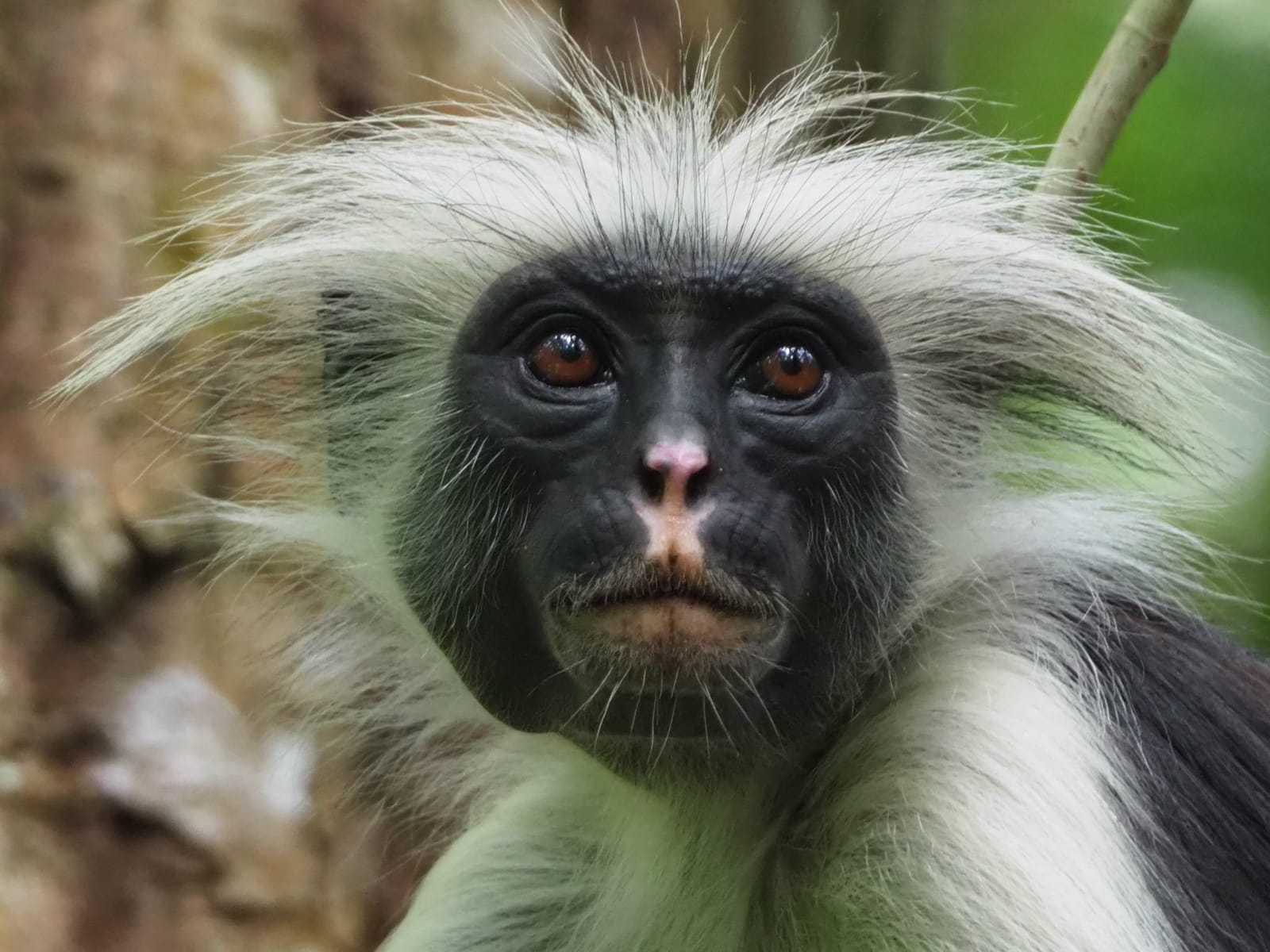
Zanzibar Red Colobus (Piliocolobus kirkii) is an endangered monkey found naturally only in Tanzania’s Zanzibar archipelago. It is the smallest red colobus and lives in social groups that ferment leaves in a multi-chambered stomach, sometimes adapting to farms and mangroves as native forest shrinks. This guide separates well-supported biology from common assumptions and covers identification, range, habitat, diet, behavior, reproduction and conservation.
Identification
The face is black and framed by long white hair beneath a reddish crown. Shoulders and upper back are black, while the middle and lower back range from orange to deep red-brown. Belly, inner limbs and shoulder fronts are white or gray. Black hands and feet contrast with gray legs, and the long tail mixes red-brown, gray and blonde. Individuals differ noticeably in the boundaries between colors. Infants begin black and white, developing red tones after several months. Males and females are unusually similar in body size for red colobus monkeys. Males average only slightly heavier but have larger canines, a more robust skull and often a thicker tail.
Identification should combine body shape, markings, size, voice or movement, and location. One feature by itself can overlap with a related animal, a juvenile, or an individual in unusual light.
Photographs are most useful when they preserve scale and show several diagnostic features. Handling or repositioning a wild zanzibar red colobus for identification can cause stress and is unnecessary.
Size and physical adaptations
Zanzibar Red Colobus typically measures head–body length about 45–70 cm, with a tail that can equal or exceed the body and weighs females average about 5.5 kg and males about 5.8 kg. It is considered the smallest living red colobus species, an example consistent with reduced body size in an island lineage.
Its useful adaptations include multi-chambered stomach ferments fibrous leaves, gut microbes detoxify and unlock plant nutrients, long limbs and tail balance movement between branches, reduced thumbs reduce snagging during rapid travel, color pattern breaks up the outline in sunlit foliage, charcoal consumption may bind toxins from some foods. These traits work together in the animal’s normal setting rather than serving as isolated curiosities.
Published measurements may use different methods, life stages or sample locations. Comparing figures responsibly means checking what was measured rather than selecting the largest number available.
Range and distribution
Endemic to Zanzibar, principally Unguja Island with smaller populations on Uzi and Vundwe. A translocated group also persists on Pemba. On Unguja the species survives in fragmented patches from Jozani-Chwaka Bay and Kiwengwa-Pongwe to community forests and southern coral-rag thickets. The native range includes Tanzania.
A country-level map indicates broad distribution, not continuous occupation. Climate, elevation, water, vegetation, prey, breeding sites, barriers and survey effort all affect where records occur.
Records near the edge of the range deserve careful documentation because they may reflect natural movement, improved survey coverage, accidental transport or a genuine distribution change.
Habitat
Groundwater forest, coral-rag thicket, mangrove, coastal scrub, plantations and mixed smallholder farmland with connected trees.
Native groundwater and coral-rag forests provide diverse young leaves and unripe fruit. Mangroves serve as refuge where disturbance is intense, though mangrove food alone may be nutritionally incomplete. Some groups use shamba farmland, traveling through coconut palms, fruit trees and planted exotics. Road gaps, treeless fields and dense settlement isolate groups, so wooded corridors between forest fragments are essential for gene flow and safe movement. Protecting a population therefore requires the feeding, shelter and breeding features that make a site usable, along with connections that allow movement.
Microhabitat matters. Shade, soil, current, moisture, shelter or host plants can determine whether a small area is usable even when the surrounding landscape appears suitable.
Diet and feeding
Zanzibar Red Colobus is a leaf specialist with unripe fruit, seeds and flowers. Important foods include young leaves, unripe fruit and soft seeds, mature leaves, leaf stems and petioles, flowers and buds, mangrove foliage, occasional charcoal. Young leaves form the largest share of most diets because they offer more protein and less structural fibre than old leaves. The monkey also chooses unripe fruit, swallowing soft seeds that mature fruit specialists may avoid. Food enters a large, chambered foregut where microbes ferment cellulose before it reaches the small intestine. This slow system explains the animal’s pot belly and long resting periods. Farmland groups may combine exotic leaves with charcoal that adsorbs defensive plant chemicals.
Diet changes with age, season, location and food supply. A dramatic prey record does not establish what most individuals eat most of the time; repeated field observations provide a stronger picture.
Feeding opportunities also create risk. An animal focused on prey may be less alert to predators, traffic or people, while contaminated prey can transfer pollutants through the food web.
Behavior and communication
Diurnal, alternating feeding and travel with long digestion and social-rest periods. Groups spread through several trees while feeding, then cluster to rest and groom. Long limbs allow rapid leaps, but the reduced thumb and non-prehensile tail mean branches are grasped mainly with elongated fingers and feet. Individuals can be curious and calm near accustomed visitors, yet that tolerance should never invite touching. Mangrove groups sometimes descend to drink, and farm-edge groups cross roads where vehicles create a serious mortality risk.
Adult males give barks, chists, wheets and a distinctive long call beginning with yelps and building into warbles and squeals. Calls warn of danger, advertise dominance, show sexual interest and coordinate group movement. Females and young scream during distress. Facial expression, posture, chasing, grooming and close contact add visual and tactile information within the troop. Behavior should be interpreted in context: alarm, courtship, feeding and temperature regulation can produce very different actions from the same animal.
Daily schedules are flexible responses, not rigid rules. Weather, breeding condition, disturbance, tides or food can move activity into a different part of the day.
Reproduction and development
Mating and births occur all year, although local food and rainfall create seasonal birth peaks. Groups contain several adult males and females, and both sexes may mate with multiple partners. Females show a modest reproductive swelling. Young adults of both sexes can leave their birth group, an important behavior for preventing inbreeding when forest connections remain available. Usually 1 infant A newborn clings to its mother and wears a contrasting black-and-white coat. Mothers nurse and carry infants, while other females and juveniles may inspect or briefly handle them. Red and brown fur appears at roughly three to five months, with full adult coloration between about six and eleven months. Gradual sampling of leaves accompanies a long period of learning safe foods and travel routes.
Young animals face different risks and may use different microhabitats or food than adults. Breeding success depends on adult condition, suitable sites and the survival of offspring through vulnerable early stages.
Counts of eggs or young describe reproductive output, not the number expected to reach adulthood. Mortality is normally greatest during eggs, larval or juvenile stages.
Predators and ecological role
Leaf browsing influences tree growth and moves nutrients from the canopy to the forest floor. Seeds from unripe fruit may be destroyed or dispersed depending on how they are chewed and digested. The monkeys are prey for large raptors and pythons, though Zanzibar lacks the full predator community of mainland forests. Protecting their habitat also protects endemic plants, birds, reptiles and freshwater systems, which makes the species an effective umbrella for island biodiversity. Documented or likely predators include Crowned Eagle, African Rock Python, Domestic Dog, Humans.
This animal is both a consumer and a food source. Its influence comes through many repeated interactions, so ecological claims should be based on measured populations rather than assumptions drawn from appearance.
Predator and prey relationships differ among places. A species can be ecologically influential without being abundant everywhere, and its role can change across its range.
Relationship with people
The first complete island-wide census estimated 5,862 individuals, more than expected but still declining and often outside formal reserves. Forest is cut for farms, poles, fuelwood and charcoal, while fast traffic kills monkeys crossing roads near Jozani. Tourism brings jobs and conservation revenue but crowding and feeding change behavior. Effective protection joins national parks with community forest agreements, planted corridors, speed control, monitoring and livelihoods that reduce pressure on wood.
These monkeys usually avoid conflict, but they are wild primates. Keep several metres away, never feed or touch them, and do not block travel routes for photographs. Slow down wherever road signs warn of crossings. A scratch or bite needs urgent medical evaluation because primates and people can exchange infections. Visitors should follow guides and keep food secured. Responsible observation means keeping an appropriate distance, avoiding capture or feeding, protecting habitat and following local wildlife or invasive-species guidance.
Wildlife guidance should come from the responsible local agency because collection rules, reporting requests and appropriate responses differ between native and introduced ranges.
Conservation
The IUCN lists the Zanzibar Red Colobus as Endangered. A range-wide census estimated 5,862 animals, but many live in small unprotected fragments and the overall population was judged to be declining under forest loss and road mortality. The reported global trend is Decreasing.
Important pressures include forest clearing for farming and fuel, fragmentation outside reserves, road collisions, charcoal and timber extraction, small isolated groups, human disturbance and feeding, occasional persecution. Global status can hide local decline or recovery, so current regional monitoring and habitat management remain necessary.
The most useful conservation action follows the documented pressure. Protecting breeding sites, reducing road deaths or limiting pollutants can require different tools in different populations.