
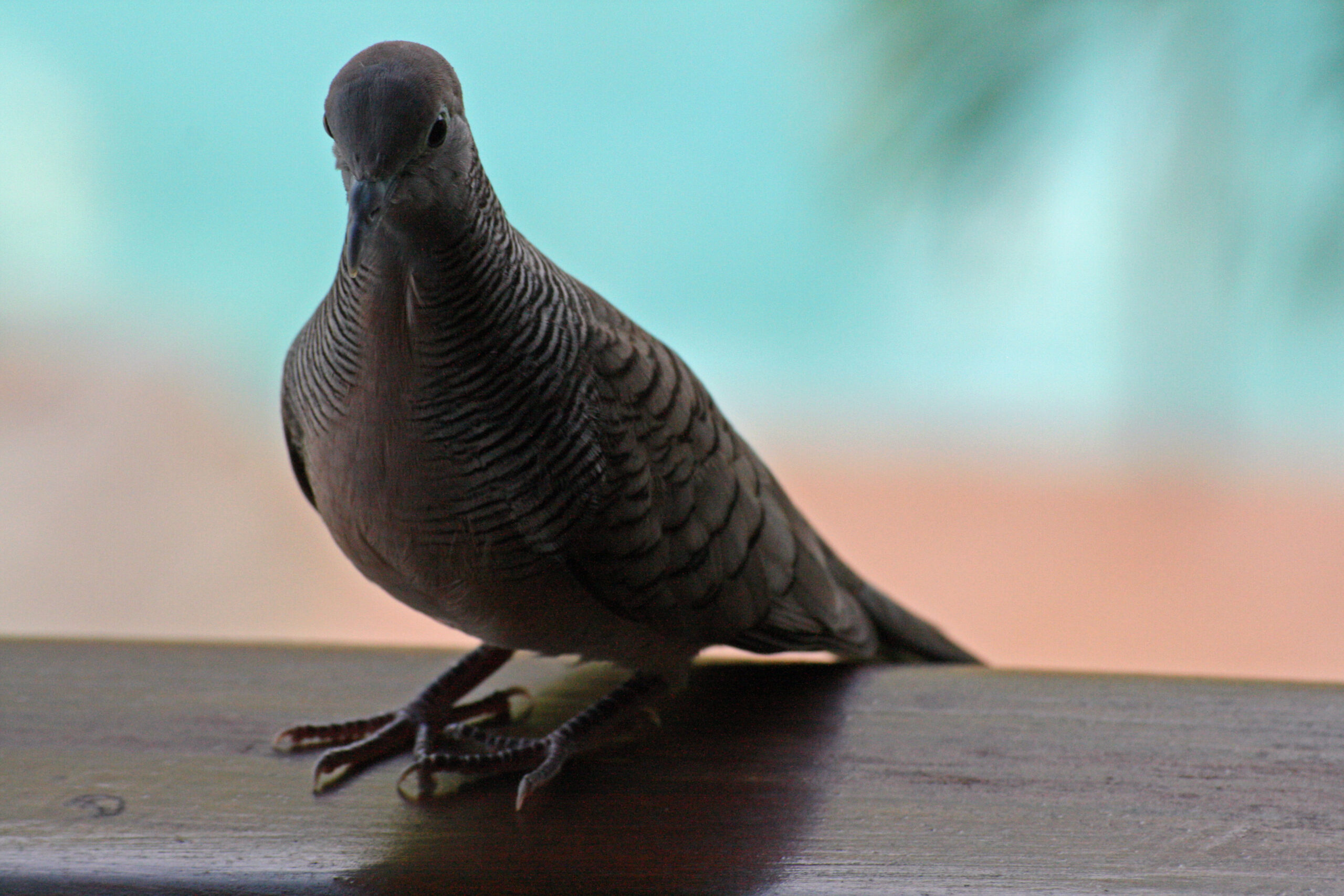
Zebra Dove (Geopelia striata) is a small dove native to the Thai-Malay region and western Indonesian islands. It walks across lawns and bare ground gathering tiny seeds, often within metres of people, and has established introduced populations on tropical islands far outside its natural range. This guide separates well-supported biology from common assumptions and covers identification, range, habitat, diet, behavior, reproduction and conservation.
Identification
A slender dove with a small head, long graduated tail and short pinkish legs. The face and throat are pale blue-gray, with powder-blue bare skin around the eye and bill base. Brown-gray upperparts have dark feather edges, while narrow black bars cross the neck sides, breast flanks and wings. The center of the breast is warm pinkish buff. White tips flash along the outer tail during flight. Juveniles are duller and browner with less blue around the eye. Males and females look very similar. Males may average slightly larger and show stronger pink color on the breast, but song and courtship behavior are often more useful than plumage for sexing.
Identification should combine body shape, markings, size, voice or movement, and location. One feature by itself can overlap with a related animal, a juvenile, or an individual in unusual light.
Photographs are most useful when they preserve scale and show several diagnostic features. Handling or repositioning a wild zebra dove for identification can cause stress and is unnecessary.
Size and physical adaptations
Zebra Dove typically measures about 20–23 cm and weighs about 50–65 g. It is smaller and more delicate than the Spotted Dove that often shares Southeast Asian parks.
Its useful adaptations include short bill efficiently picks tiny seeds, long tail provides control during rapid low flight, crop stores food before digestion, powerful breast muscles launch the bird from the ground, cryptic barring breaks up the outline in dry grass, pigeon crop milk nourishes newly hatched squabs. These traits work together in the animal’s normal setting rather than serving as isolated curiosities.
Published measurements may use different methods, life stages or sample locations. Comparing figures responsibly means checking what was measured rather than selecting the largest number available.
Range and distribution
Native from southern Myanmar through the Thai-Malay Peninsula to Sumatra, Java and nearby western Indonesian islands. Human introductions and escapes established populations elsewhere in Southeast Asia and on islands including Hawaii, Seychelles, Mauritius and Réunion. The native range includes Myanmar, Thailand, Malaysia, Singapore, Brunei, Indonesia.
A country-level map indicates broad distribution, not continuous occupation. Climate, elevation, water, vegetation, prey, breeding sites, barriers and survey effort all affect where records occur.
Records near the edge of the range deserve careful documentation because they may reflect natural movement, improved survey coverage, accidental transport or a genuine distribution change.
Habitat
Open woodland, scrub, grassland, farms, village edges, gardens, parks, roadsides and other sunny places with short vegetation and scattered trees.
The dove needs open ground for feeding and bushes, palms or trees for nesting and roosting. Closely cut lawns, paths and roadsides expose small seeds, which explains its success in towns. It avoids the interior of dense forest but readily uses forest edges and clearings. In dry weather individuals gather at puddles, fountains and shallow water. Introduced island populations occupy many of the same human-shaped settings. Protecting a population therefore requires the feeding, shelter and breeding features that make a site usable, along with connections that allow movement.
Microhabitat matters. Shade, soil, current, moisture, shelter or host plants can determine whether a small area is usable even when the surrounding landscape appears suitable.
Diet and feeding
Zebra Dove is a mainly granivorous ground forager. Important foods include grass seeds, weed seeds, rice and small grains, herb seeds, small fallen fruit fragments, occasional ants, beetles and other tiny invertebrates. The bird walks rather than hops, lowering its head to pick individual seeds from soil or short grass. It often feeds alone, as a pair or in a loose group, with larger gatherings where grain or water is concentrated. Food can be stored temporarily in the crop, then softened and processed by the muscular gizzard. Small stones swallowed as grit help grind hard seed coats. Natural feeding is safer than bread or salty human scraps.
Diet changes with age, season, location and food supply. A dramatic prey record does not establish what most individuals eat most of the time; repeated field observations provide a stronger picture.
Feeding opportunities also create risk. An animal focused on prey may be less alert to predators, traffic or people, while contaminated prey can transfer pollutants through the food web.
Behavior and communication
Diurnal, with conspicuous ground feeding and calling especially in the cooler morning and late afternoon. Zebra doves spend much of the day walking quietly, pausing to scan before resuming a steady search for seeds. When alarmed they spring into fast direct flight and expose white tail corners. Pairs remain close, preen each other and defend a small nesting area, but feeding birds tolerate neighbors. They frequently perch on wires, roofs and exposed branches to deliver a soft, accelerating series of coos.
The characteristic song is a gentle sequence of short coos that may accelerate or fall in pitch. Males repeat it from perches to advertise and court. A bowing display, raised tail, wing flicks and close following add visual information. Mates use softer contact notes and mutual preening, while chicks give begging calls at the nest. Behavior should be interpreted in context: alarm, courtship, feeding and temperature regulation can produce very different actions from the same animal.
Daily schedules are flexible responses, not rigid rules. Weather, breeding condition, disturbance, tides or food can move activity into a different part of the day.
Reproduction and development
Breeding timing follows local rain and food, and tropical city populations may nest through much of the year. A displaying male bows, coos and raises his tail while approaching a female. Both partners collect material and build, although their platform can be so thin that eggs are visible from below. The pair shares incubation and chick care. Usually 2 smooth white eggs Newly hatched squabs are nearly naked, blind and dependent. For the first days both parents feed crop milk, a secretion rich in fat and protein produced by the crop lining. Seeds are gradually mixed into later meals. Chicks grow quickly and leave the nest after roughly two weeks, though parents continue feeding them while flight skills develop.
Young animals face different risks and may use different microhabitats or food than adults. Breeding success depends on adult condition, suitable sites and the survival of offspring through vulnerable early stages.
Counts of eggs or young describe reproductive output, not the number expected to reach adulthood. Mortality is normally greatest during eggs, larval or juvenile stages.
Predators and ecological role
By consuming abundant grass and weed seeds, zebra doves influence plant recruitment in open habitats. They also move energy into hawks, falcons, snakes and urban predators. Their eggs and chicks support nest predators, while discarded nest material and droppings recycle nutrients. Where introduced, the species is a common part of urban bird communities, although managers must distinguish simple non-native presence from demonstrated ecological harm. Documented or likely predators include Peregrine Falcon, Shikra, Reticulated Python, Monitor Lizards, Domestic Cat, Rats.
This animal is both a consumer and a food source. Its influence comes through many repeated interactions, so ecological claims should be based on measured populations rather than assumptions drawn from appearance.
Predator and prey relationships differ among places. A species can be ecologically influential without being abundant everywhere, and its role can change across its range.
Relationship with people
The calm song makes this dove culturally valued and popular in cage-bird traditions, including organized song contests. That demand has encouraged trapping and releases, so responsible keeping must rely on legal captive breeding rather than wild capture. In cities, people sometimes feed dense flocks; concentrated grain and dirty water can spread trichomoniasis and other infections. Clean landscapes, reduced pesticide use, indoor cats and leaving nests undisturbed support healthy urban birds.
Zebra doves pose little danger. Do not handle sick or dead birds with bare hands, and clean feeders and water dishes regularly. Avoid feeding bread or creating large crowded flocks. If a chick is fully feathered and hopping near its nest, parents are usually still caring for it; keep cats and people back rather than taking it indoors. Responsible observation means keeping an appropriate distance, avoiding capture or feeding, protecting habitat and following local wildlife or invasive-species guidance.
Wildlife guidance should come from the responsible local agency because collection rules, reporting requests and appropriate responses differ between native and introduced ranges.
Conservation
The IUCN lists the Zebra Dove as Least Concern. It is common in much of its native and introduced range, including heavily modified habitats, although local trapping for the songbird trade requires monitoring. The reported global trend is Generally stable or increasing in many urban and introduced populations.
Important pressures include local trapping for the cage-bird trade, cat predation, collisions with vehicles and glass, disease at crowded feeding sites, pesticide exposure, removal of nesting shrubs. Global status can hide local decline or recovery, so current regional monitoring and habitat management remain necessary.
The most useful conservation action follows the documented pressure. Protecting breeding sites, reducing road deaths or limiting pollutants can require different tools in different populations.