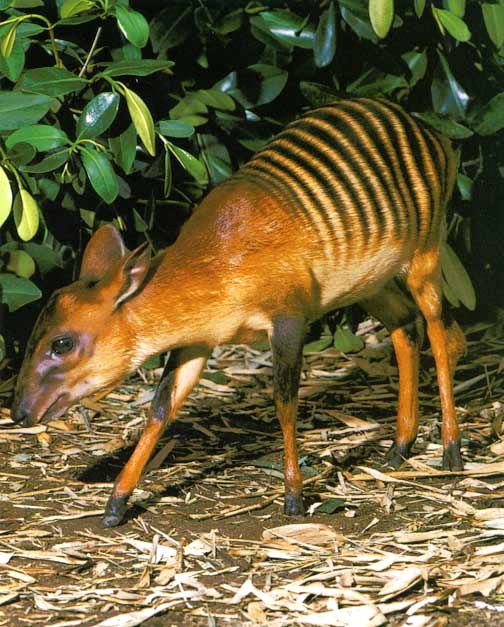
Zebra Duiker (Cephalophula zebra) is a rare duiker restricted to the Upper Guinean forests of West Africa. Its golden back carries a series of black vertical bands, while a reinforced forehead helps it open hard fruit that other small antelopes cannot exploit. This guide separates well-supported biology from common assumptions and covers identification, range, habitat, diet, behavior, reproduction and conservation.
Identification
The shoulders, neck, head and legs are rich chestnut or reddish brown. Across the cream-to-golden mid-back run roughly 12–15 dark vertical bands. The underside is pale, the muzzle dark, and black markings occur near the lower legs. Both sexes carry short, smooth horns angled backward, though a female’s horns may be slightly longer. The body is barrel-shaped on short strong legs, ideal for pushing through dense undergrowth. Females average larger and heavier than males, an unusual but not unique pattern among duikers. Both sexes have horns and the same striped coat.
Identification should combine body shape, markings, size, voice or movement, and location. One feature by itself can overlap with a related animal, a juvenile, or an individual in unusual light.
Photographs are most useful when they preserve scale and show several diagnostic features. Handling or repositioning a wild zebra duiker for identification can cause stress and is unnecessary.
Size and physical adaptations
Zebra Duiker typically measures head–body length about 85–90 cm; shoulder height 40–50 cm and weighs about 15–20 kg. Field measurements are limited because the species is secretive and rarely observed alive.
Its useful adaptations include bold bands disrupt the body outline in forest shadow, short powerful legs accelerate through thick cover, wedge-shaped body slips between stems, thickened frontal skull helps break hard fruits, large eyes and ears detect movement in dim forest, preorbital glands leave scent marks. These traits work together in the animal’s normal setting rather than serving as isolated curiosities.
Published measurements may use different methods, life stages or sample locations. Comparing figures responsibly means checking what was measured rather than selecting the largest number available.
Range and distribution
Restricted to the Upper Guinean forest zone of far western Africa, principally Liberia, western Côte d’Ivoire and eastern Sierra Leone, with records in neighboring southeastern Guinea. The remaining range is fragmented by farms, roads, mines and logged forest. The native range includes Côte d’Ivoire, Guinea, Liberia, Sierra Leone.
A country-level map indicates broad distribution, not continuous occupation. Climate, elevation, water, vegetation, prey, breeding sites, barriers and survey effort all affect where records occur.
Records near the edge of the range deserve careful documentation because they may reflect natural movement, improved survey coverage, accidental transport or a genuine distribution change.
Habitat
Lowland primary rainforest and mature secondary forest from river valleys to forested hills, especially where dense understory and fruiting trees remain.
Zebra duikers move through dense cover beneath a closed canopy and often follow quiet runways between feeding and resting sites. Forest shade, fallen fruit and thick escape vegetation occur together. They may use recovering forest near intact blocks, but heavily cleared land exposes them and removes the large fruiting trees on which their diet depends. Streams and damp valleys can concentrate food during dry periods. Protecting a population therefore requires the feeding, shelter and breeding features that make a site usable, along with connections that allow movement.
Microhabitat matters. Shade, soil, current, moisture, shelter or host plants can determine whether a small area is usable even when the surrounding landscape appears suitable.
Diet and feeding
Zebra Duiker is a fruit-specialist browser with leaves and shoots as supplements. Important foods include fallen rainforest fruit, hard-shelled nuts and seeds, tender leaves, shoots and buds, occasional fungi, rare small animal matter. The duiker searches the forest floor for fruit dropped naturally or dislodged by monkeys, hornbills and fruit bats. It may wait beneath a productive canopy or return after hearing feeding animals overhead. Strong jaws and a reinforced forehead help open hard husks: the animal can butt a fruit against firm ground, then eat the exposed pulp or seed. Browsed leaves and shoots sustain it when fruit is scarce.
Diet changes with age, season, location and food supply. A dramatic prey record does not establish what most individuals eat most of the time; repeated field observations provide a stronger picture.
Feeding opportunities also create risk. An animal focused on prey may be less alert to predators, traffic or people, while contaminated prey can transfer pollutants through the food web.
Behavior and communication
Probably most active by day and around dawn or dusk, with timing adjusted to people, heat and food. Direct observation is difficult, so some details remain uncertain. Individuals are usually seen alone or as a bonded pair and retreat immediately into cover. The common name duiker comes from an Afrikaans word for “diver,” describing this plunge into vegetation. Each animal uses scent glands in front of the eyes to mark twigs and boundaries. Its striped back becomes surprisingly inconspicuous among vertical stems and broken forest light.
Scent is central in dense vegetation where sight lines are short. Preorbital gland secretions identify an individual and advertise territory or reproductive condition. Partners also use soft contact sounds, posture and touch. A sharp alarm bark or whistle can warn a mate or young before the animal bolts into cover. Behavior should be interpreted in context: alarm, courtship, feeding and temperature regulation can produce very different actions from the same animal.
Daily schedules are flexible responses, not rigid rules. Weather, breeding condition, disturbance, tides or food can move activity into a different part of the day.
Reproduction and development
Very little reproduction has been studied in wild zebra duikers. Like other forest duikers, a male and female may maintain a long-term pair within overlapping territory. Breeding may occur through much of the year when fruit supports the female, with local rainfall producing seasonal peaks. Courtship relies on scent investigation and close following. Usually 1 calf The calf is born well developed but spends its first weeks concealed in dense vegetation. Its mother returns to nurse and groom it, reducing scent and movement around the hiding site. As it grows, the youngster follows the female and samples leaves and fruit. The striped coat is present early and provides disruptive camouflage.
Young animals face different risks and may use different microhabitats or food than adults. Breeding success depends on adult condition, suitable sites and the survival of offspring through vulnerable early stages.
Counts of eggs or young describe reproductive output, not the number expected to reach adulthood. Mortality is normally greatest during eggs, larval or juvenile stages.
Predators and ecological role
Fruit feeding makes the duiker both seed predator and seed disperser. Some seeds are crushed, while others pass through or are carried away from the parent tree before being dropped. Its dependence on fruit falling from monkeys, bats and birds links several forest layers. Leopards and large pythons gain prey, and the duiker’s browsing shapes understory plants. Loss of the species would simplify these ecological connections in an already fragmented biodiversity hotspot. Documented or likely predators include Leopard, African Rock Python, Crowned Eagle, African Golden Cat, Humans.
This animal is both a consumer and a food source. Its influence comes through many repeated interactions, so ecological claims should be based on measured populations rather than assumptions drawn from appearance.
Predator and prey relationships differ among places. A species can be ecologically influential without being abundant everywhere, and its role can change across its range.
Relationship with people
Communities within the range depend on forests for food and income, and zebra duikers are caught in the bushmeat trade. Snares set for several species can remove animals even from logged forest that still looks suitable. Industrial logging, cocoa expansion, mining and roads fragment populations and open access to hunters. Conservation must combine protected forest, wildlife law, snare removal, sustainable livelihoods and community rights rather than treating local people only as a threat.
Zebra duikers avoid people and are not dangerous in normal encounters. Never chase, trap or handle one. A cornered antelope can kick or jab with its horns, while carcasses and raw bushmeat can expose people to pathogens. Report wildlife trafficking or snaring to local authorities and support observation only through trained guides. Responsible observation means keeping an appropriate distance, avoiding capture or feeding, protecting habitat and following local wildlife or invasive-species guidance.
Wildlife guidance should come from the responsible local agency because collection rules, reporting requests and appropriate responses differ between native and introduced ranges.
Conservation
The most recent widely used IUCN assessment under the older name Cephalophus zebra lists the Zebra Duiker as Vulnerable. Modern taxonomy places it in Cephalophula, which has not yet received a separate reassessment. Forest loss and hunting continue across its small range. The reported global trend is Decreasing.
Important pressures include primary-forest loss, commercial logging, cocoa and other farm expansion, mining and roads, bushmeat hunting, wire snares, population fragmentation. Global status can hide local decline or recovery, so current regional monitoring and habitat management remain necessary.
The most useful conservation action follows the documented pressure. Protecting breeding sites, reducing road deaths or limiting pollutants can require different tools in different populations.