
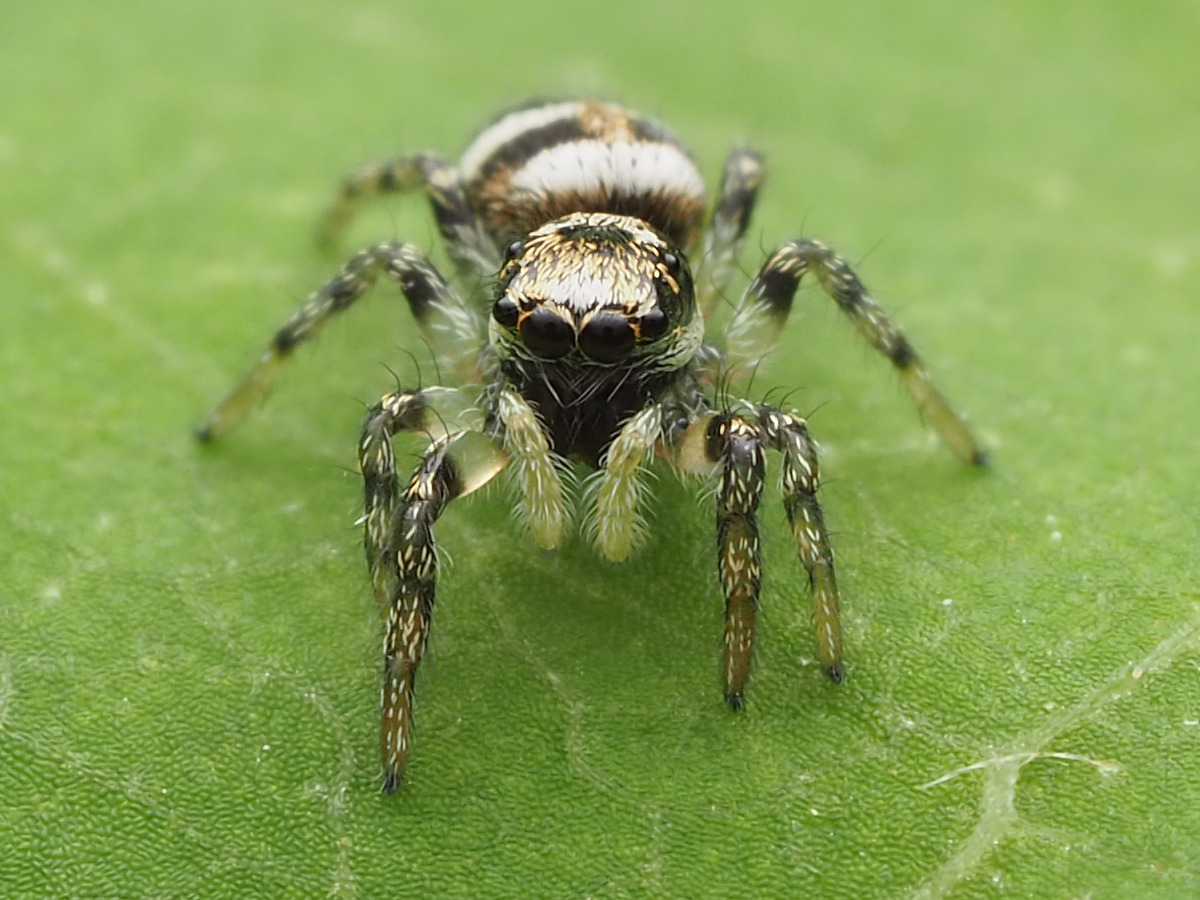
The zebra spider (Salticus scenicus) is a tiny jumping spider whose bold dark-and-pale bands make it unusually easy to notice on a sunny wall. It does not build a prey-catching web. Instead, it watches, stalks, and pounces, using acute vision and a silk safety line to hunt across stone, bark, fences, and window frames. The familiar name refers to one species in the jumping-spider family Salticidae, rather than to every striped jumping spider.
Identification and appearance
Adult zebra spiders are compact animals only about 4–7 mm long. The abdomen carries three or four pale transverse bands against a dark background; some bands may be broken rather than complete. The cephalothorax is broad, the legs are relatively short, and the body is clothed in fine hairs and scales that create the contrasting pattern. Females are generally larger, while adult males have proportionally larger chelicerae that project forward and more conspicuous patterning on the legs.
Like other salticids, this species has eight eyes. The exceptionally large forward-facing principal pair gives the face its alert appearance and supplies detailed, binocular vision. The remaining eyes broaden the field of view and help the spider detect movement around and above it. Dense pads of microscopic hairs on the feet provide adhesion on smooth vertical surfaces, which is why zebra spiders can cross glass and painted walls without slipping.
Range and habitat
Salticus scenicus is native across much of Europe and the western Palearctic. It is now established across large parts of temperate North America, where authoritative biodiversity records treat it as introduced. Records also extend eastward across northern Eurasia. Individual database records outside this main range should be interpreted cautiously because small striped jumping spiders can be misidentified from photographs.
Zebra spiders favor open surfaces warmed by sunlight. They are frequently found on masonry, fences, sheds, tree trunks, rocks, windows, and garden furniture. They also occur in meadows, woodland edges, and other places where exposed hunting surfaces overlook concentrations of small insects. Buildings provide abundant crevices for shelter and egg sacs, so living near people does not by itself indicate an infestation.
Vision, movement, and hunting
This spider hunts during the day. When it detects a possible meal, it turns toward the target, advances in short stages, and judges distance before jumping. A dragline of silk remains attached to the surface, acting as a safety tether if the leap misses. Zebra spiders can also turn to follow a nearby person or camera; this is visual tracking, not aggression.
The principal eyes have movable internal structures that scan and focus, while the secondary eyes are especially useful for detecting motion. Together they allow the spider to choose a route, recognize prey, and coordinate a precise strike. Its common jerky gait reflects pauses for visual assessment between quick movements. Jumping is also an escape response when the spider is startled.
Diet and ecological role
Zebra spiders take small arthropods, especially flies, mosquitoes, aphids, small moths, and other spiders that can be subdued safely. They approach within striking distance, leap, grip the prey, and deliver venom through the chelicerae. The venom is adapted to immobilize tiny prey and is not considered medically significant to people.
As active hunters, zebra spiders contribute to the complex community of predators that limits small-insect populations in gardens and around buildings. They are themselves eaten by birds, lizards, larger spiders, and predatory or parasitoid wasps. Their reliance on vision means that bright daytime hunting surfaces and a varied supply of arthropod prey are more important than a permanent capture web.
Courtship and life cycle
Adult males locate females visually and through chemical cues associated with silk. Courtship includes deliberate movements of the forelegs, pedipalps, and body. These displays allow a female to distinguish a potential mate from prey, although approaching a larger predator always carries risk for the male. Mating involves the transfer of sperm with the male’s pedipalps.
A female produces a silken retreat in a protected crevice and places her eggs inside an egg sac. She remains near the sac during development. Spiderlings hatch as miniature hunters and pass through several molts as they grow. Development speed and seasonal timing vary with temperature, food, and latitude; in cool climates, immature spiders may overwinter in silk shelters before completing development.
Conservation and environmental pressures
The species is widespread and commonly encountered, but it does not have a single globally published IUCN category. Its presence in cities and gardens shows considerable tolerance of modified habitat. Local numbers can still fall when pesticide use removes both spiders and their prey, or when renovation eliminates sunny, sheltered microhabitats.
A wildlife-friendly garden can support zebra spiders by retaining structural variety, reducing unnecessary insecticide use, and allowing some undisturbed crevices near sunny surfaces. Because the species is introduced in parts of North America, observations there should be recorded accurately rather than described automatically as evidence of native range.
Living safely with zebra spiders
Zebra spiders are not dangerous household spiders. They are small, reluctant to bite, and usually escape by running or jumping. A bite is unlikely unless a spider is trapped against skin, and reported effects are generally minor and local. Anyone with severe or worsening symptoms after any suspected bite should seek medical advice because visual identification can be mistaken and individual reactions differ.
There is rarely a reason to kill one found indoors. Place a cup over the spider, slide a card underneath, and release it onto a sheltered outdoor wall or vegetation if conditions are suitable. Avoid handling it with bare fingers. Keeping window screens sound and sealing unnecessary gaps can reduce indoor encounters without broad pesticide treatment.
How it differs from similar spiders
Several jumping spiders have black-and-white markings, so stripes alone do not prove an identification. Zebra spiders combine the characteristic banded abdomen with their small adult size, compact build, and the structures used by arachnologists to distinguish Salticus scenicus from close relatives. Location can help, but photographs of the dorsal pattern may be insufficient for certainty.
Unlike orb-weavers, zebra spiders do not sit in a circular web, and unlike cobweb spiders they do not depend on an irregular sticky snare. They do use silk for safety lines, retreats, molting chambers, and egg protection. That distinction explains why an animal seen repeatedly on the same wall can be hunting there even when no web is visible.
