
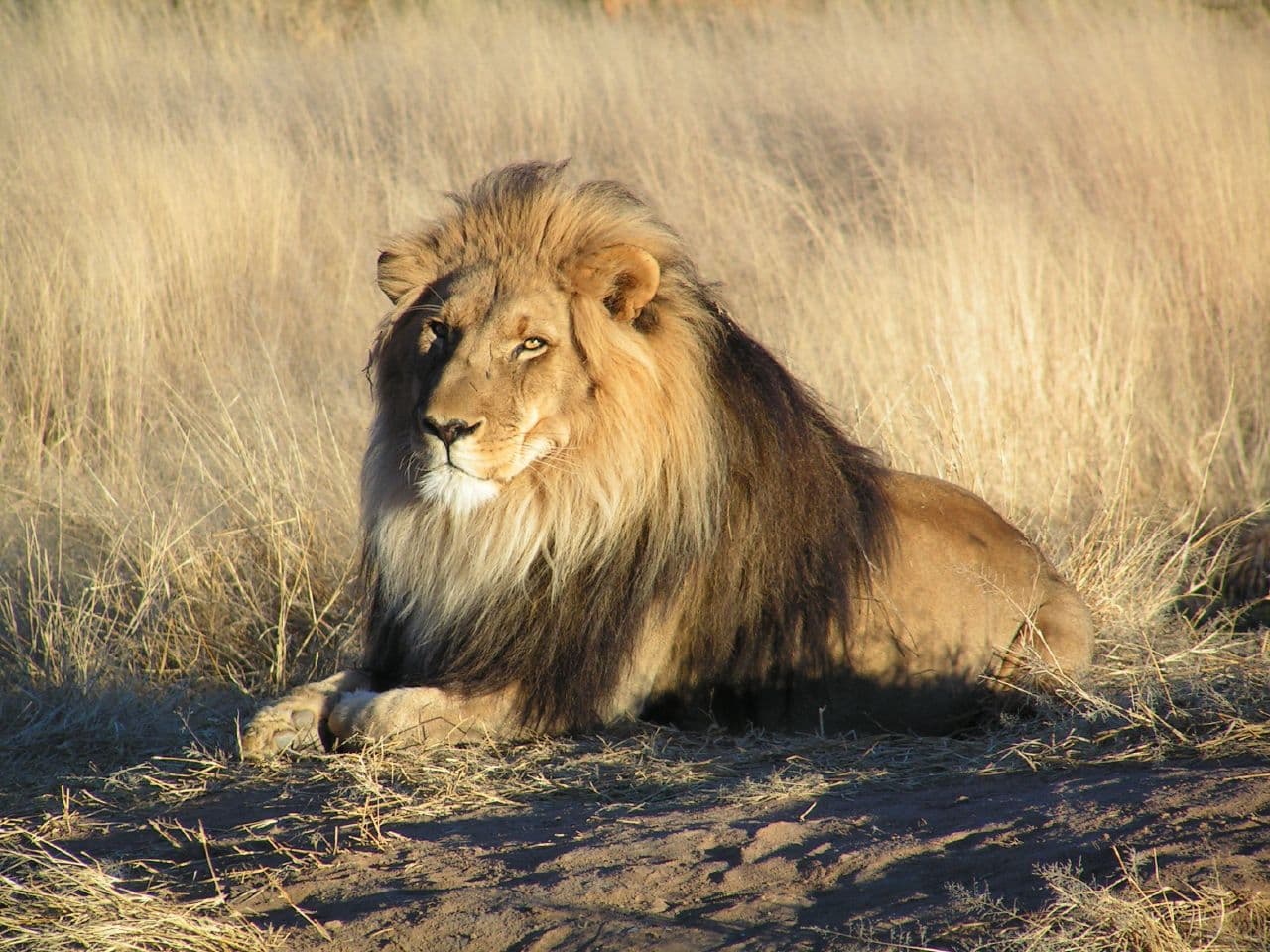
The African lion is the African population of the lion species Panthera leo. Lions once ranged across much of Africa, southwest Asia and parts of Europe. Today, African populations survive mainly in fragmented areas south of the Sahara, while the last wild Asian population lives in India. Lions are unusual among cats because related females live and raise young together in social groups called prides.
Calling the African lion a separate species would be misleading: all living lions belong to Panthera leo. Modern taxonomy commonly recognizes two subspecies whose ranges cross the old “African versus Asiatic” division. Panthera leo leo includes lions in West and Central Africa as well as India, while Panthera leo melanochaita occurs in East and Southern Africa.
Size and appearance
Lions are powerfully built cats with deep chests, muscular forelimbs, rounded heads and tails ending in dark tufts. Adult coat colour varies from pale buff to tawny brown. Cubs are born with spots that usually fade as they mature, although faint markings can remain on some adults.
Males are substantially larger than females and typically develop a mane around the head, neck and shoulders. Mane colour and size vary with age, genetics, hormones, climate and condition; not every healthy adult male carries a long, dark mane. A mane can make a male appear larger during displays, but describing it as proven armour or a direct score of fighting ability goes beyond the evidence.
Measurements differ among regions. Adult males commonly weigh around 150–250 kilograms (330–551 pounds), while females often weigh about 110–180 kilograms (243–397 pounds). Head-and-body length is roughly 1.7–2.5 metres (5.6–8.2 feet), excluding the tail. Exceptional records should not be presented as normal size.
Where African lions live
Remaining wild lions occur in scattered populations across West, Central, East and Southern Africa. Strongholds include parts of Tanzania, Kenya, Botswana, Namibia, South Africa, Zambia and Zimbabwe, but important populations also survive elsewhere. Their current distribution is only a small fraction of the species’ historical range.
Lions use savannas, grasslands, open woodlands, shrublands and some semi-arid habitats. They need sufficient prey, access to water or moisture from prey, cover for stalking and space with tolerable levels of human pressure. Dense tropical forest and the driest open desert are generally unsuitable, although lions can live in surprisingly dry landscapes.
Prides and social life
A pride is usually centred on related adult females, their cubs and young lions. One or more adult males may associate with and defend access to the pride. Pride size and composition change with prey, habitat, births, deaths and competition; the familiar image of one male ruling a fixed group does not describe every population.
Females often remain near their natal area, whereas young males usually disperse. Males may travel alone or form coalitions, sometimes with brothers or other relatives. Coalitions can compete for territories and access to females. When new males take over a pride, cubs may be killed, although outcomes vary and females actively defend their young.
Lions maintain bonds through head rubbing, grooming, resting together and vocal communication. Roaring advertises presence and territory and helps pride members locate one another. Claims about a universal decibel level or a fixed maximum hearing distance depend heavily on measurement conditions, so this profile does not present them as exact species constants.
Hunting and diet
Lions are obligate carnivores. Across Africa they take many prey species, especially medium and large hoofed mammals such as wildebeest, zebra, buffalo, antelope and warthog. Diet changes by location and opportunity. Lions also scavenge, steal kills and occasionally eat smaller mammals, birds, reptiles or fish.
Females conduct many cooperative hunts, but males also hunt. Group hunting can help lions tackle larger or more difficult prey, yet not every hunt involves a perfectly assigned set of roles. Individuals respond to terrain, darkness, cover, wind, prey behaviour and the positions of other lions.
Lions stalk close before accelerating because they cannot sustain a long chase. Published top-speed figures are often repeated without a traceable method and should be treated as rough estimates. Their success depends more on concealment, timing, short-range acceleration and cooperation than on a single maximum-speed number.
Reproduction and cub development
Lions can breed throughout the year. Gestation lasts about 109–110 days, and a litter commonly contains two or three cubs, although one to six has been recorded. A lioness usually gives birth in a sheltered place away from the pride and moves the cubs between den sites before introducing them to the group.
Cubs are born with closed eyes and depend completely on their mother. Lionesses with cubs of similar ages may form a crèche and sometimes nurse one another’s young. Weaning generally occurs during the first year, but young lions remain dependent on adults for food, protection and learning well beyond that point.
Mortality is high. Starvation, disease, accidents, predation and attacks during pride takeovers all kill cubs. Females may live into their mid-to-late teens in the wild, whereas males often have shorter lives because dispersal and competition expose them to injury and food stress. Lifespan varies greatly among populations and individuals.
Ecological role
As large predators, lions influence the behaviour and survival of herbivores and compete with spotted hyenas, leopards, cheetahs and African wild dogs. Their effects depend on prey density and the wider predator community. Describing lions as automatically “preventing overgrazing” everywhere is too simple; African ecosystems are also shaped by rainfall, fire, disease, human land use and other predators.
Lion kills provide food for scavengers, from hyenas and jackals to vultures and insects. Lions also lose carcasses to other carnivores. These interactions link them to a broad food web rather than placing them outside it.
Conservation status
The IUCN lists the lion as Vulnerable. Its amended 2024 global assessment suspected a population reduction of about 34% over three generations, linked to decline in habitat and range. The IUCN Cat Specialist Group reports roughly 22,000–25,000 adult and subadult lions in Africa, but this is not a precise census of every lion and local trends differ sharply.
Major threats include habitat loss and fragmentation, depletion of wild prey, killing after livestock losses, indiscriminate snares and poisoning, illegal trade in body parts and poorly regulated hunting. Small isolated populations also face demographic and genetic risks. Some populations are stable or recovering where protection, prey and community support are strong, while others continue to shrink.
African lions are listed in CITES Appendix II, which regulates international commercial trade. The Asiatic lion population is listed in Appendix I. National laws, protected areas and cross-border conservation agreements add other layers of protection.
Living alongside lions
Lions are capable of killing people and livestock. Visitors should remain inside vehicles where required, never approach lions on foot without qualified guidance, avoid blocking their path and follow local wildlife-authority instructions. Feeding or attracting lions creates danger for both people and animals.
For communities sharing lion landscapes, coexistence requires practical measures: stronger livestock enclosures, attentive herding, rapid response to attacks, fair compensation or insurance where workable, secure prey populations and meaningful local benefits from conservation. No single technique fits every region.
African lion questions
Do male lions hunt?
Yes. Females perform many well-known cooperative hunts, but males also hunt alone or with coalition partners, particularly when they are away from a pride.
Are lions “kings of the jungle”?
The phrase is cultural rather than biological. Most African lions live in savannas, grasslands, shrublands and open woodlands, not dense rainforest.
Is a pride always led by one male?
No. A pride’s stable core is generally related females. It may be associated with one male or a coalition, and membership changes over time.