
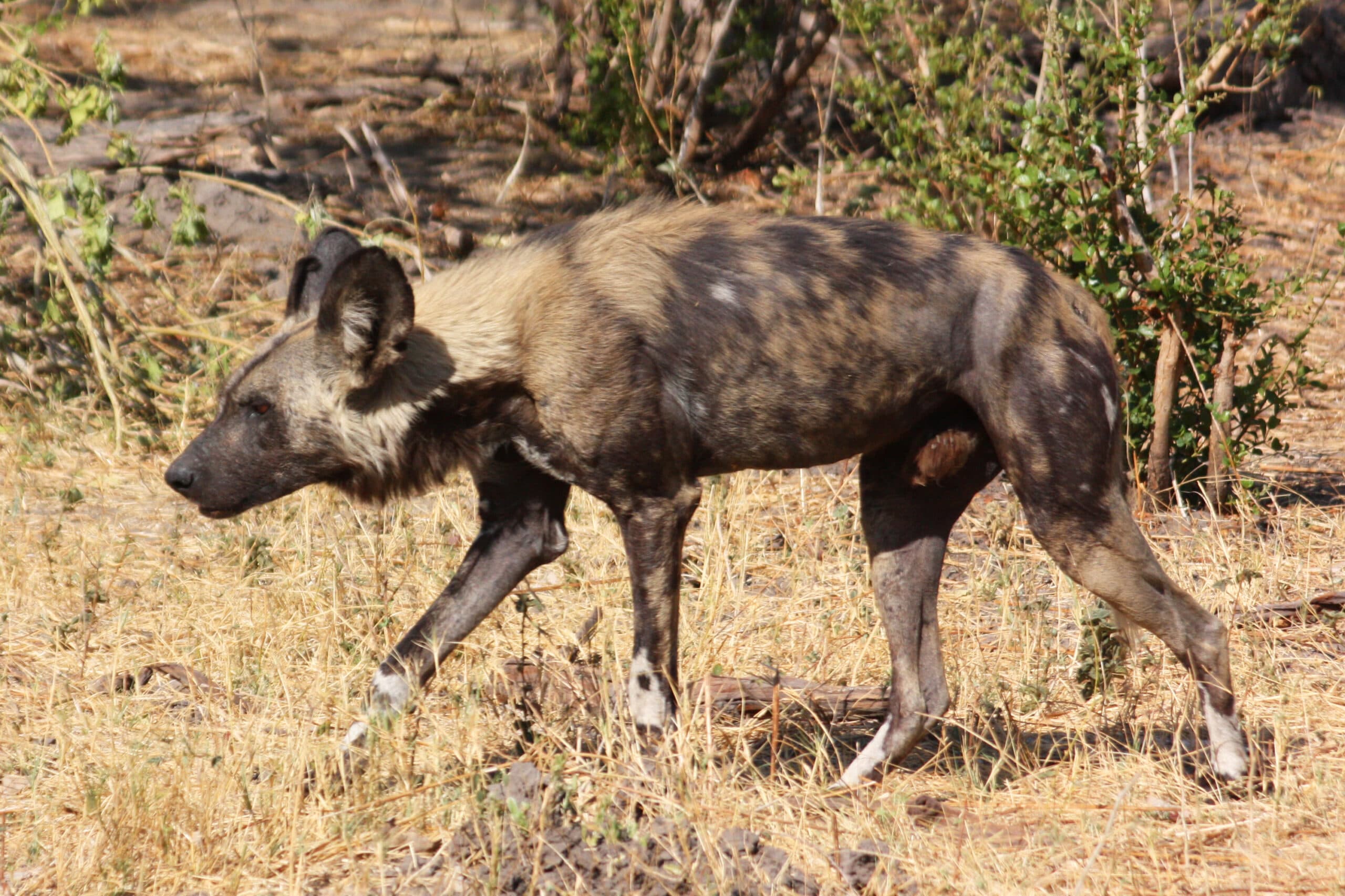
African Wild Dog (Lycaon pictus) is the only living species in the genus Lycaon. It is neither a feral domestic dog nor a hyena. This long-legged canid survives in scattered sub-Saharan populations, where packs range across large landscapes and cooperate in hunting, pup rearing and care of injured members. This guide separates well-supported biology from common assumptions and covers identification, range, habitat, diet, behavior, reproduction and conservation.
Identification
A lean body, deep chest, narrow waist, long legs and very large rounded ears create a distinctive outline. Short fur forms an irregular mosaic of black, tan, yellow, brown and white; no two adults carry exactly the same pattern. The muzzle is usually dark, and the bushy tail commonly ends in white, helping pack members follow one another through vegetation. The feet have four functional toes and lack the dewclaw typical of many other canids. Males and females overlap strongly in size and coat color. Males average slightly heavier in some populations, but sex cannot be identified reliably from coat pattern or body size alone.
Identification should combine body shape, markings, size, voice or movement, and location. One feature by itself can overlap with a related animal, a juvenile, or an individual in unusual light.
Photographs are most useful when they preserve scale and show several diagnostic features. Handling or repositioning a wild african wild dog for identification can cause stress and is unnecessary.
Size and physical adaptations
African Wild Dog typically measures about 75–110 cm head and body, plus a 30–40 cm tail and weighs about 18–36 kg. Body size varies among regions and individuals. Long legs make the animal appear taller and lighter than many similarly weighted canids.
Its useful adaptations include large ears radiate heat and detect pack calls, long legs support sustained pursuit, a mottled coat breaks up the body outline, four-toed feet suit efficient running, specialized carnassial teeth slice meat rapidly, pack cooperation enables pursuit of larger prey, a white tail tip acts as a visual signal in cover. These traits work together in the animal’s normal setting rather than serving as isolated curiosities.
Published measurements may use different methods, life stages or sample locations. Comparing figures responsibly means checking what was measured rather than selecting the largest number available.
Range and distribution
Historically widespread across most of sub-Saharan Africa outside dense rainforest and true desert, the species now occupies a severely fragmented fraction of that range. The largest connected populations persist in southern and eastern Africa, including northern Botswana, western Zimbabwe, eastern Namibia, Zambia, Tanzania and northern Mozambique. Small, isolated or uncertain populations occur elsewhere, and presence changes as packs disperse across borders. The native range includes Botswana, Tanzania, Mozambique, Zimbabwe, Namibia, South Africa, Zambia, Kenya, Ethiopia, South Sudan, Angola, Malawi, Eswatini, Senegal, Burkina Faso, Niger, Chad, Cameroon, Central African Republic.
A country-level map indicates broad distribution, not continuous occupation. Climate, elevation, water, vegetation, prey, breeding sites, barriers and survey effort all affect where records occur.
Records near the edge of the range deserve careful documentation because they may reflect natural movement, improved survey coverage, accidental transport or a genuine distribution change.
Habitat
Savannas, grasslands, open woodlands, shrublands, semi-desert and some montane or forest-edge landscapes with adequate prey and room to range.
Habitat structure matters less than access to prey, water and connected space. Packs travel over home ranges that can cover hundreds or even thousands of square kilometers, using roads, game trails and open ground for efficient movement. During denning they become temporarily centered on a burrow, often one excavated by an aardvark. Outside that period they are mobile and rarely defend a fixed territory. Fences, farms and busy roads can turn apparently suitable habitat into dangerous fragments. Protecting a population therefore requires the feeding, shelter and breeding features that make a site usable, along with connections that allow movement.
Microhabitat matters. Shade, soil, current, moisture, shelter or host plants can determine whether a small area is usable even when the surrounding landscape appears suitable.
Diet and feeding
African Wild Dog is a carnivore. Important foods include impala and other medium antelope, gazelles, wildebeest calves, warthog piglets, hares, rodents, birds. Packs usually hunt around dawn and dusk, locating prey visually and approaching before beginning a coordinated chase. Different dogs respond to the prey’s turns rather than following a rigid assigned role. Long legs and stamina allow sustained pursuit, while cutting teeth help them consume a carcass quickly before larger competitors arrive. Prey varies by region and pack size, from hares to antelope heavier than one dog. Carrion is a minor part of the diet compared with fresh kills.
Diet changes with age, season, location and food supply. A dramatic prey record does not establish what most individuals eat most of the time; repeated field observations provide a stronger picture.
Feeding opportunities also create risk. An animal focused on prey may be less alert to predators, traffic or people, while contaminated prey can transfer pollutants through the food web.
Behavior and communication
Primarily diurnal and crepuscular, with hunting concentrated in cool mornings and evenings; bright moonlight can support night activity. African wild dogs live in cohesive packs often numbering about seven to fifteen adults and young, though groups can be smaller or much larger. A dominant pair usually produces the litter, while the whole pack guards, feeds and escorts the pups. Greetings include excited squeaks, tail movements and close contact. Packs are generally tolerant internally. Females more often leave their birth pack, while related males frequently remain together. Wide-ranging travel allows dogs to follow shifting prey but also exposes them to roads, livestock areas and hostile people.
High-pitched contact calls, squeals, barks, growls, scent marks and visual gestures coordinate life in the pack. A far-carrying hoo call can reunite separated animals. Close greetings reinforce bonds before travel or hunting. Researchers have also documented sneezes during pre-departure rallies; their frequency can contribute to whether a resting pack gets up and moves, although social status also matters. Behavior should be interpreted in context: alarm, courtship, feeding and temperature regulation can produce very different actions from the same animal.
Daily schedules are flexible responses, not rigid rules. Weather, breeding condition, disturbance, tides or food can move activity into a different part of the day.
Reproduction and development
A dominant female and male usually account for most reproduction in a pack. After a gestation of roughly ten weeks, the female gives birth in an underground den, often an abandoned aardvark burrow. African wild dogs produce unusually large litters for a canid. For the first weeks the mother stays close while other adults return with regurgitated meat. Once pups emerge, every pack member helps guard, feed and teach them. Usually about 6–12 pups, with documented litters ranging from 2 to about 20 Pups are born blind and dependent. They open their eyes, explore the den entrance and begin eating regurgitated food over the following weeks. Weaning often occurs between five and twelve weeks. As the pack resumes travel, pups initially remain at rendezvous sites with a babysitter, then join hunts and learn through pursuit and play. Survival depends heavily on pack size, food supply, disease and protection of the den.
Young animals face different risks and may use different microhabitats or food than adults. Breeding success depends on adult condition, suitable sites and the survival of offspring through vulnerable early stages.
Counts of eggs or young describe reproductive output, not the number expected to reach adulthood. Mortality is normally greatest during eggs, larval or juvenile stages.
Predators and ecological role
As coursing predators, African wild dogs influence the abundance, movement and vigilance of medium-sized herbivores. They share prey landscapes with lions, leopards, cheetahs, spotted hyenas and people. Lions kill both adults and pups and are a major natural source of mortality, while hyenas often attempt to steal kills. The dogs’ need for huge connected ranges makes them indicators of landscape-scale ecological health. Documented or likely predators include Lion, Spotted Hyena, Nile Crocodile, Humans.
This animal is both a consumer and a food source. Its influence comes through many repeated interactions, so ecological claims should be based on measured populations rather than assumptions drawn from appearance.
Predator and prey relationships differ among places. A species can be ecologically influential without being abundant everywhere, and its role can change across its range.
Relationship with people
The species rarely threatens people, but historic fear and conflict with livestock led to shooting, poisoning and exclusion from ranches. Today, conservation programs work with communities on livestock husbandry, compensation, education, veterinary barriers and rapid response. Wildlife tourism can make living packs economically valuable. Domestic dogs near reserves remain a serious source of rabies and canine distemper.
Observe only from a vehicle or with trained guides and never approach a den, pups or a feeding pack. Keep domestic dogs vaccinated and leashed near wild-dog landscapes. Livestock owners should use locally recommended corrals and herding practices rather than poison or snares. Report an injured or unusually behaving animal to wildlife authorities and never attempt capture. Responsible observation means keeping an appropriate distance, avoiding capture or feeding, protecting habitat and following local wildlife or invasive-species guidance.
Wildlife guidance should come from the responsible local agency because collection rules, reporting requests and appropriate responses differ between native and introduced ranges.
Conservation
The IUCN Red List classifies Lycaon pictus as Endangered. The species remains fragmented, and even large protected areas may be too small for wide-ranging packs without connected surrounding land. The reported global trend is Decreasing.
Important pressures include habitat fragmentation and loss of connectivity, conflict and deliberate killing, road collisions, incidental capture in wire snares, rabies and canine distemper from domestic dogs, competition and killing by larger carnivores, small isolated population effects. Global status can hide local decline or recovery, so current regional monitoring and habitat management remain necessary.
The most useful conservation action follows the documented pressure. Protecting breeding sites, reducing road deaths or limiting pollutants can require different tools in different populations.
African Wild Dogs use cooperative pursuit and communal pup care; compare their pack life with the Asian Dhole.