
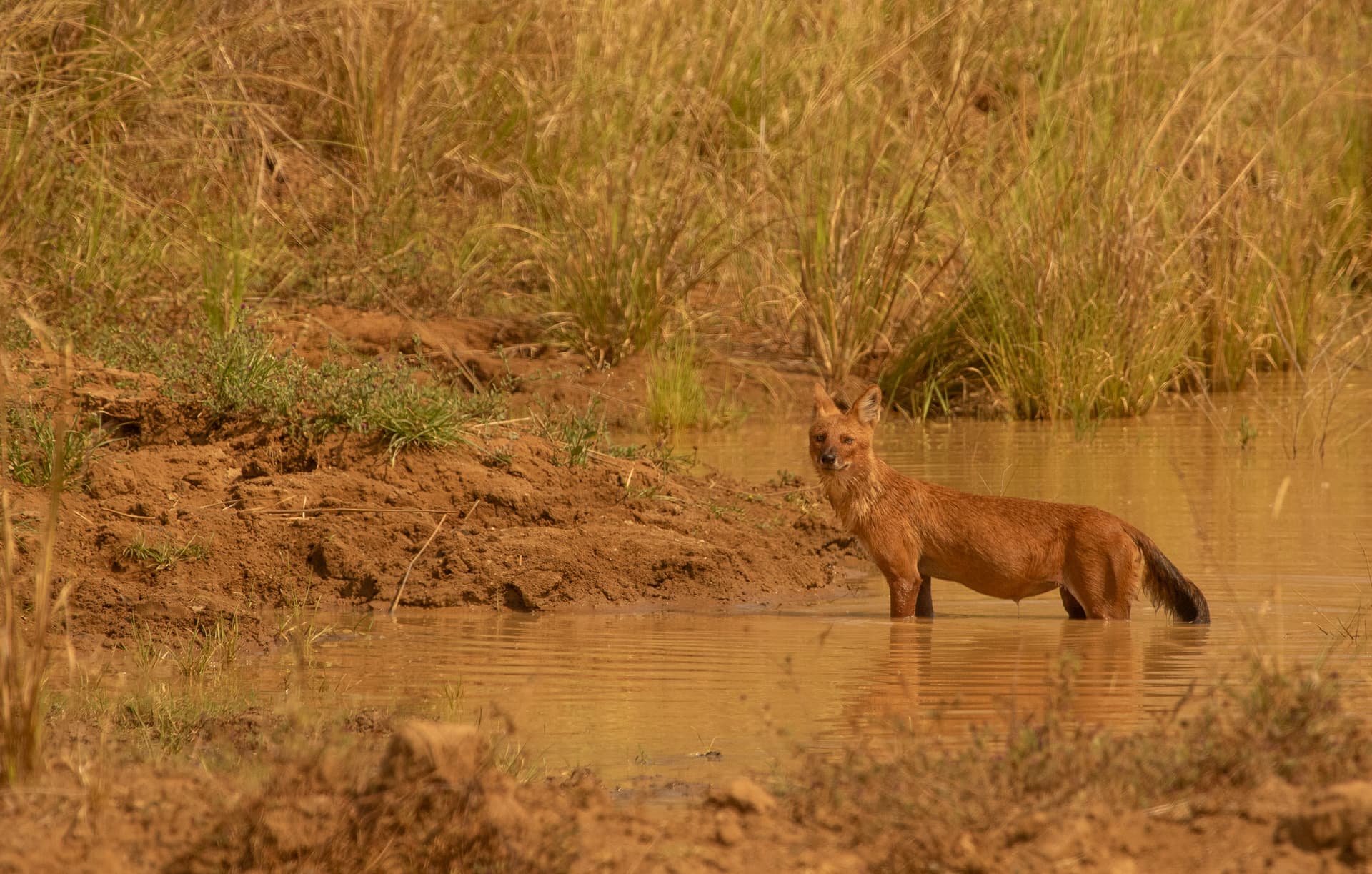
Dhole (Cuon alpinus) is a social wild canid of South, East and Southeast Asia. It resembles a red fox crossed with a lean domestic dog, yet belongs to its own genus and has a distinctive skull and reduced number of molar teeth. Dholes live in packs, communicate with piercing whistles and depend on large connected landscapes containing abundant hoofed prey. This guide separates well-supported biology from common assumptions and covers identification, range, habitat, diet, behavior, reproduction and conservation.
Identification
A Dhole has a broad rounded muzzle, large upright ears, long legs and a thick tail. The adult coat is usually rusty red to tawny with paler throat, chest and belly; northern animals grow longer and grayer winter fur. The tail is bushy and commonly dark brown or black at the tip. Pups are born sooty brown. Compared with wolves, the head is shorter and the body lighter. Males average somewhat heavier than females, but the sexes look similar and lack conspicuous external differences.
Identification should combine body shape, markings, size, voice or movement, and location. One feature by itself can overlap with a related animal, a juvenile, or an individual in unusual light.
Photographs are most useful when they preserve scale and show several diagnostic features. Handling or repositioning a wild dhole for identification can cause stress and is unnecessary.
Size and physical adaptations
Dhole typically measures about 75–110 cm head and body and weighs commonly 12–21 kg. Northern Dholes tend to be larger and more heavily furred than tropical populations.
Its useful adaptations include pack cooperation allows pursuit of deer and wild pigs, flexible ankles and strong legs support long chases, piercing whistles carry through dense forest, broad sectorial teeth slice meat efficiently, large litters supported by cooperative helpers, rust coat blends with leaf litter and dry grass, wide diet buffers seasonal changes in prey. These traits work together in the animal’s normal setting rather than serving as isolated curiosities.
Published measurements may use different methods, life stages or sample locations. Comparing figures responsibly means checking what was measured rather than selecting the largest number available.
Range and distribution
Formerly ranged across much of temperate and tropical Asia from the Russian Far East and Central Asia to India, China and Southeast Asia. Today it survives in scattered strongholds, especially India and parts of mainland Southeast Asia, with small or uncertain populations in several northern and island regions. The native range includes Bangladesh, Bhutan, Cambodia, China, India, Indonesia, Kazakhstan, Kyrgyzstan, Laos, Malaysia, Myanmar, Nepal, Russia, Tajikistan, Thailand, Vietnam.
A country-level map indicates broad distribution, not continuous occupation. Climate, elevation, water, vegetation, prey, breeding sites, barriers and survey effort all affect where records occur.
Records near the edge of the range deserve careful documentation because they may reflect natural movement, improved survey coverage, accidental transport or a genuine distribution change.
Habitat
Tropical and temperate forest, dry deciduous woodland, evergreen forest, forest-grassland mosaics, alpine meadow, scrub and montane steppe with prey and water.
Dholes need extensive connected habitat rather than one vegetation type. Packs travel along forest roads, ridges, riverbeds and game trails, using open patches to rest and coordinate. They den in earth banks, rock cavities or abandoned burrows near water. Pure desert and heavily settled open country are generally unsuitable because prey, cover and safe den sites are scarce. Protecting a population therefore requires the feeding, shelter and breeding features that make a site usable, along with connections that allow movement.
Microhabitat matters. Shade, soil, current, moisture, shelter or host plants can determine whether a small area is usable even when the surrounding landscape appears suitable.
Diet and feeding
Dhole is a carnivore. Important foods include sambar deer, chital, muntjac, wild pigs, gaur calves, hares, rodents, occasional reptiles, insects and fruit. A pack locates prey by scent and sight, separates a vulnerable animal and pursues it in relays through forest or across water. Dholes can take prey larger than themselves but also hunt hares and rodents alone. Feeding order is unusually tolerant for a canid: pups and nursing females often receive priority, and adults carry or regurgitate meat to animals waiting at the den.
Diet changes with age, season, location and food supply. A dramatic prey record does not establish what most individuals eat most of the time; repeated field observations provide a stronger picture.
Feeding opportunities also create risk. An animal focused on prey may be less alert to predators, traffic or people, while contaminated prey can transfer pollutants through the food web.
Behavior and communication
Mostly diurnal, with peak hunting in cool mornings; activity shifts with people, prey and climate. Packs are cohesive extended families, often containing 5–12 animals although temporary groups can be larger. Members greet with wagging tails, licking and soft calls, hunt together and help raise young. Aggression within stable packs is usually limited. Packs defend space from other Dholes, while avoiding tigers and leopards when possible. Individuals rest near water and may sit or play in shallow pools after feeding.
The best-known call is a high-pitched whistle that travels through vegetation and helps a moving pack reunite. Dholes also squeal, chatter, growl, yelp and whine, but seldom bark like domestic dogs. Facial expression, tail position, play bows and body contact regulate social interactions. Urine, feces and glandular odors mark routes and pack boundaries. Behavior should be interpreted in context: alarm, courtship, feeding and temperature regulation can produce very different actions from the same animal.
Daily schedules are flexible responses, not rigid rules. Weather, breeding condition, disturbance, tides or food can move activity into a different part of the day.
Reproduction and development
Most packs have a principal breeding pair, while other adults help provision and guard the litter. Birth timing varies with latitude but often falls in the cool dry season when prey is predictable. The pregnant female uses a protected den system that may contain multiple entrances and chambers. Pack members bring food to her before and after birth. Usually 4–8 pups, with larger litters recorded Pups are born blind with dark woolly coats. Their eyes open after roughly two weeks, and they begin emerging from the den within the first month. Adults regurgitate meat, guard the nursery and allow pups early access at kills. Young join hunts gradually, learning routes, prey choice and pack coordination through play and experience.
Young animals face different risks and may use different microhabitats or food than adults. Breeding success depends on adult condition, suitable sites and the survival of offspring through vulnerable early stages.
Counts of eggs or young describe reproductive output, not the number expected to reach adulthood. Mortality is normally greatest during eggs, larval or juvenile stages.
Predators and ecological role
Dholes influence deer and wild-pig populations and compete with tigers, leopards, wolves and other carnivores. Tigers can kill Dholes and steal prey, yet all depend on intact prey-rich habitat. Carcasses left by packs feed vultures, ravens and smaller scavengers. Disease transmitted from unvaccinated domestic dogs can move through depleted packs and threaten recovery. Documented or likely predators include Tiger, Leopard, Human, Domestic Dog.
This animal is both a consumer and a food source. Its influence comes through many repeated interactions, so ecological claims should be based on measured populations rather than assumptions drawn from appearance.
Predator and prey relationships differ among places. A species can be ecologically influential without being abundant everywhere, and its role can change across its range.
Relationship with people
Dholes almost never threaten people, but have been persecuted after livestock losses and historically poisoned as competitors for game. Their future depends on prey recovery, connected reserves and coexistence around forest villages. Vaccinating village dogs, improving livestock enclosures, compensating verified losses and stopping indiscriminate snares protect Dholes and many other carnivores at once.
Observe from a vehicle or a long distance, never approach a den or a kill and do not feed pack members. Keep domestic dogs vaccinated and under control near reserves. Report snares, injured animals or disease signs to wildlife authorities. A wild pack normally avoids people but deserves the same space as any medium-sized predator. Responsible observation means keeping an appropriate distance, avoiding capture or feeding, protecting habitat and following local wildlife or invasive-species guidance.
Wildlife guidance should come from the responsible local agency because collection rules, reporting requests and appropriate responses differ between native and introduced ranges.
Conservation
The IUCN lists the Dhole as Endangered. Remaining populations are small and fragmented, with continuing decline driven by habitat loss, prey depletion, persecution and disease from domestic dogs. The reported global trend is Decreasing.
Important pressures include loss and fragmentation of forest, depletion of deer and wild-pig prey, snaring, poisoning and retaliation, rabies and canine distemper from domestic dogs, competition with larger carnivores in small reserves, roads and expanding settlements. Global status can hide local decline or recovery, so current regional monitoring and habitat management remain necessary.
The most useful conservation action follows the documented pressure. Protecting breeding sites, reducing road deaths or limiting pollutants can require different tools in different populations.
The Asian Dhole is a social pack hunter; compare its ecology with the African African Wild Dog and larger Gray Wolf.