
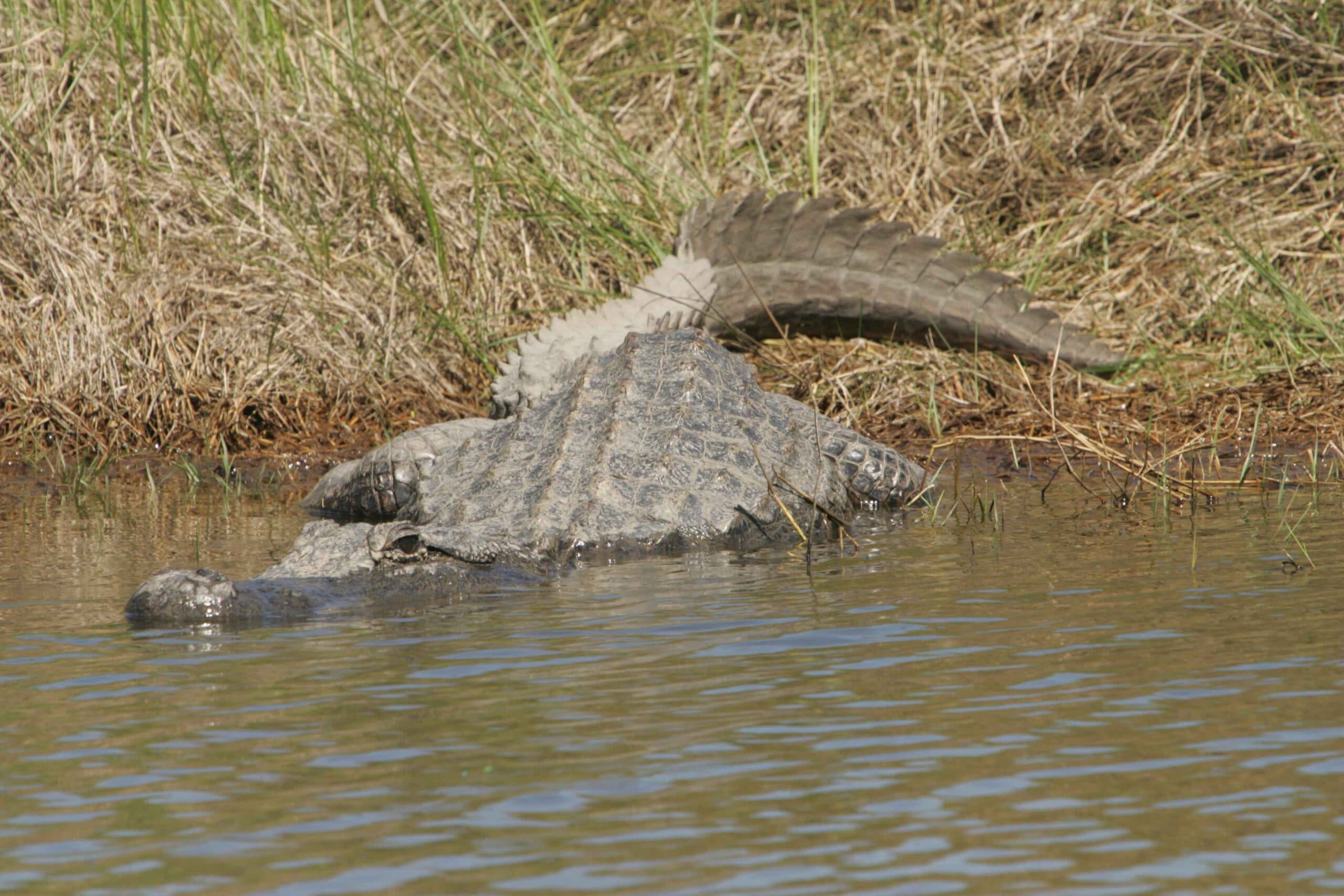
An alligator is an armored, semiaquatic reptile in the genus Alligator. The two living species are the American alligator (Alligator mississippiensis) and the much smaller Chinese alligator (Alligator sinensis). Both belong to Alligatoridae, the family that also includes caimans. True crocodiles belong to a different family, Crocodylidae. Species names; family relationships.
That distinction matters: an American alligator in a Florida marsh and a Chinese alligator in an eastern Chinese wetland do not share the same adult size or conservation situation. This guide identifies which species each fact describes.
Alligator facts at a glance
| Feature | American alligator | Chinese alligator |
|---|---|---|
| Scientific name | Alligator mississippiensis | Alligator sinensis |
| Native range | Southeastern United States | Lower Yangtze region, eastern China |
| Adult length | Average reported by Smithsonian: females about 8.2 ft; males about 11.2 ft | Usually about 5 ft (1.5 m) |
| Habitat | Freshwater rivers, lakes, marshes and swamps | Slow freshwater, ponds and wetland habitats |
| Diet | Animal prey; prey size changes as the alligator grows | Snails, crustaceans, insects, fish and other small animals |
Sources: Smithsonian profiles of the American alligator and Chinese alligator. Lengths describe adults, not hatchlings or record-sized individuals.
What does an alligator look like?
The American alligator has a broad snout, a strong swimming tail and bony plates embedded in its skin. Its eyes and nostrils sit high on the head, allowing much of its body to remain submerged. Young animals have conspicuous yellow markings that become less obvious as they mature. Smithsonian National Zoo.
The Chinese species has additional armor: bony plates occur on its eyelids and belly as well. Its smaller size is not simply a sign of youth; it is a different species with a different adult build. Smithsonian National Zoo.
Alligator or crocodile: which features help?
When comparing Florida’s American alligator with its American crocodile, look for a broad, rounded snout versus a more tapered one. The crocodile’s large fourth lower tooth remains visible with its mouth closed. In the alligator, that tooth is concealed, although upper teeth can still be visible. Color is another clue: American alligators tend to look darker. Florida Fish and Wildlife Conservation Commission.
Use photographs or binoculars to examine these features. An identification question is never a reason to approach the animal.
Where do alligators live?
American alligators occupy wetlands from the southeastern United States westward into eastern Texas and southeastern Oklahoma. Fresh water is their main habitat, but they also enter brackish areas. Finding an animal near slightly salty water therefore does not automatically make it a crocodile. FWC alligator facts.
Chinese alligators have a much more restricted native distribution in eastern China. They excavate complex burrows and spend substantial periods underground, including during cold weather. Their wetland habitat and access to suitable shelter are both important parts of their lives. Smithsonian National Zoo.
What do alligators eat?
American alligators take available prey rather than following a fixed menu. Juveniles eat insects, small fish, amphibians and other small animals. Larger alligators can capture turtles, snakes, birds and mammals. An adult’s diet should not be used as a description of what a newly hatched alligator eats. FWC food-habits guidance.
Eggs, hatchlings and parental care
In Florida, female American alligators build mound nests from vegetation, soil and debris. FWC reports average clutches of 32–46 eggs. Timing varies with location; Florida’s breeding calendar should not be applied to every alligator population. FWC reproduction facts.
After hatching, young American alligators can remain near their mother in groups. Females respond to distress calls, providing protection during a stage when fish, birds and other alligators can prey on the young. Parental care does not eliminate those risks. Everglades National Park.
Why alligator holes matter
An alligator changes its surroundings as well as hunting in them. In the Everglades, the depressions it excavates can retain water as nearby wetlands dry. Fish and other wildlife use these refuges, although they may also encounter predators there. This helps explain the American alligator’s role as a keystone species: its influence extends beyond the animals it eats. National Park Service.
Are alligators endangered?
The answer depends on the species. American alligators recovered after severe historical declines, while the Chinese alligator remains critically endangered. Those are different conservation stories, so a single status badge cannot accurately describe the entire genus. American species profile; Chinese species profile.
Watching alligators safely
Keep your distance, never feed them, and keep pets away from the water’s edge. Feeding can teach alligators to associate people with food. FWC advises swimming only in designated areas during daylight and keeping pets out of fresh or brackish water in alligator country. Follow local signs and wildlife-agency guidance. FWC alligator safety advice.
Frequently asked questions
Do alligators hibernate?
They become much less active in cold weather and may shelter in dens. American alligators can emerge to bask during warm spells; cold-season dormancy does not mean they remain asleep without interruption. FWC thermoregulation facts.
How long do alligators live?
Smithsonian reports about 50 years in the wild for American alligators. That is a species-specific estimate, not a guaranteed lifespan for every individual. Smithsonian National Zoo.
Are all alligators American?
No. The Chinese alligator is a separate living species native to eastern China. Chinese alligator profile.