
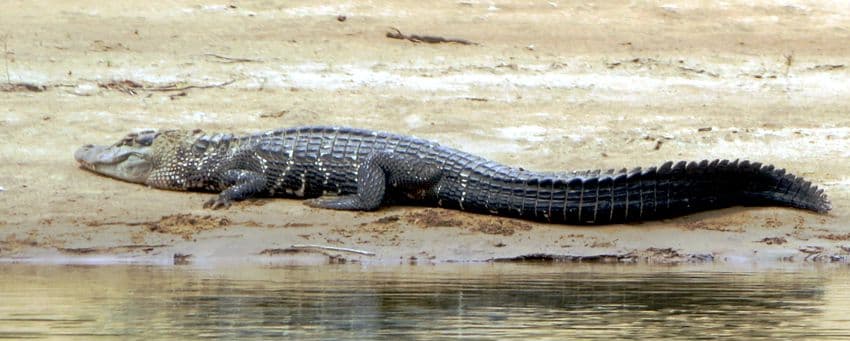
Black Caiman (Melanosuchus niger) is a large crocodilian native to the Amazon Basin. Adults occupy rivers, oxbow lakes, flooded forests and seasonal wetlands, where they prey on fish and other vertebrates. The nearly black back, pale banding on young animals and bony ridge between the eyes help distinguish this species. Black Caimans were heavily hunted for their skins during the twentieth century, but protection allowed recovery in many regions. This guide separates well-supported biology from common assumptions and covers identification, range, habitat, diet, behavior, reproduction and conservation.
Identification
Adults have a broad, heavy head, dark charcoal to black dorsal scales and a paler lower jaw marked with gray or brown. A bony ridge runs between and above the eyes. Juveniles are black with bright yellow or cream crossbands that fade with age. The eyes and nostrils sit high on the skull, allowing the animal to watch and breathe while nearly submerged. Males grow substantially larger and heavier than females, although both sexes share the same dark pattern and armored body.
Identification should combine body shape, markings, size, voice or movement, and location. One feature by itself can overlap with a related animal, a juvenile, or an individual in unusual light.
Photographs are most useful when they preserve scale and show several diagnostic features. Handling or repositioning a wild black caiman for identification can cause stress and is unnecessary.
Size and physical adaptations
Black Caiman typically measures Females commonly 2.5–3.5 m; large males 4–5 m, with exceptional individuals reported larger and weighs Large males may weigh several hundred kilograms. Reliable measurements of the largest wild individuals are scarce, so extreme size claims should be treated cautiously.
Its useful adaptations include eyes and nostrils high on the skull, powerful laterally flattened swimming tail, armored osteoderms protect the back, dark coloration camouflages in blackwater, palatal valve protects the airway underwater, sensitive facial organs detect water movement, replaceable conical teeth grip prey, slow metabolism permits long fasting. These traits work together in the animal’s normal setting rather than serving as isolated curiosities.
Published measurements may use different methods, life stages or sample locations. Comparing figures responsibly means checking what was measured rather than selecting the largest number available.
Range and distribution
Widespread in the Amazon Basin and connected drainages of northern South America. Confirmed native range includes Bolivia, Brazil, Colombia, Ecuador, French Guiana, Guyana and Peru; presence in Venezuela is less certain in current global mapping. The native range includes Bolivia, Brazil, Colombia, Ecuador, French Guiana, Guyana, Peru.
A country-level map indicates broad distribution, not continuous occupation. Climate, elevation, water, vegetation, prey, breeding sites, barriers and survey effort all affect where records occur.
Records near the edge of the range deserve careful documentation because they may reflect natural movement, improved survey coverage, accidental transport or a genuine distribution change.
Habitat
Slow rivers, oxbow lakes, freshwater marshes, blackwater swamps, flooded forest and seasonally inundated savanna.
Water level strongly shapes movement. During the wet season, Black Caimans spread through flooded forest and savanna to feed. As water falls, they concentrate in permanent lakes, channels and deep pools. Adults often occupy large open water bodies, while juveniles use vegetated margins that offer cover. Steep banks and floating vegetation provide resting and nesting sites. Protecting a population therefore requires the feeding, shelter and breeding features that make a site usable, along with connections that allow movement.
Microhabitat matters. Shade, soil, current, moisture, shelter or host plants can determine whether a small area is usable even when the surrounding landscape appears suitable.
Diet and feeding
Black Caiman is a carnivore. Important foods include fish, catfish, piranhas, mollusks, crabs, water birds, turtles, capybaras, smaller caimans. Young Black Caimans begin with insects, crustaceans, mollusks and small fish. As the jaws and body grow, prey size increases to larger fish, birds, turtles and mammals. Adults usually ambush from water, accelerating with the tail and seizing prey in conical teeth. They may drown large prey and tear pieces by rolling. Hunting is most active at night, though opportunities are taken at any hour.
Diet changes with age, season, location and food supply. A dramatic prey record does not establish what most individuals eat most of the time; repeated field observations provide a stronger picture.
Feeding opportunities also create risk. An animal focused on prey may be less alert to predators, traffic or people, while contaminated prey can transfer pollutants through the food web.
Behavior and communication
Mostly nocturnal ambush predator, with seasonal movements linked to flooding. Black Caimans spend much of the day basking, resting at the surface or lying concealed near banks. At night they patrol shorelines and open water. Individuals aggregate when dry-season pools shrink but normally maintain space through posture, splashing and calls. Like other crocodilians, they can travel over land between water bodies and navigate back to familiar habitat.
Crocodilians are among the most vocal reptiles. Adults use low-frequency bellows, growls and water vibrations during courtship and territorial encounters. Hatchlings call from inside eggs and after emerging, stimulating the mother to uncover the nest and remain nearby. Head slaps, bubbles, body posture and scent provide additional signals. Behavior should be interpreted in context: alarm, courtship, feeding and temperature regulation can produce very different actions from the same animal.
Daily schedules are flexible responses, not rigid rules. Weather, breeding condition, disturbance, tides or food can move activity into a different part of the day.
Reproduction and development
Courtship and mating occur in water, with timing varying across the immense range. Females build mound nests from soil and vegetation near water as levels fall. Decomposing plant material helps warm the eggs. The female stays nearby, defends the nest and later opens it when hatchlings call. Roughly 30–60 eggs, varying with female size and locality Hatchlings emerge with bright yellow bands and remain in shallow nursery areas. The mother may carry young gently in her mouth and guards the pod from predators. Sex is influenced by incubation temperature, as in other crocodilians. Growth depends on food, temperature and water conditions; maturity takes many years, and survival rises sharply after the vulnerable juvenile stage.
Young animals face different risks and may use different microhabitats or food than adults. Breeding success depends on adult condition, suitable sites and the survival of offspring through vulnerable early stages.
Counts of eggs or young describe reproductive output, not the number expected to reach adulthood. Mortality is normally greatest during eggs, larval or juvenile stages.
Predators and ecological role
As a top freshwater predator, the Black Caiman influences fish, turtle, bird and mammal communities and moves nutrients between water and land. Nest mounds and excavated sites alter shoreline microhabitats. Eggs and hatchlings feed lizards, birds, fish and mammals, while large adults have few natural enemies beyond people and possibly Jaguars. Documented or likely predators include Jaguar, Green Anaconda, Tegu, Human.
This animal is both a consumer and a food source. Its influence comes through many repeated interactions, so ecological claims should be based on measured populations rather than assumptions drawn from appearance.
Predator and prey relationships differ among places. A species can be ecologically influential without being abundant everywhere, and its role can change across its range.
Relationship with people
Black Caimans were killed on a vast scale for hides, and populations collapsed across much of the Amazon during the leather trade. Legal protection, enforcement and regulated management supported recovery in several areas. The species remains important to Indigenous and river communities, wildlife tourism and wetland food webs. Coexistence requires protecting nesting shores while managing fishing waste and livestock practices that attract large animals near people.
A large Black Caiman is capable of killing a person. Never swim, wade or clean fish near occupied water, especially at night. Keep well back from banks, supervise children, leash dogs and follow local guides. Do not feed crocodilians or approach nests and hatchlings. Attacks are uncommon relative to human use of Amazon waters, but the consequences can be severe. Responsible observation means keeping an appropriate distance, avoiding capture or feeding, protecting habitat and following local wildlife or invasive-species guidance.
Wildlife guidance should come from the responsible local agency because collection rules, reporting requests and appropriate responses differ between native and introduced ranges.
Conservation
The current IUCN assessment lists the Black Caiman as Least Concern after recovery across substantial parts of its wide range, although the older public assessment history used a conservation-dependent category. Local populations still differ, and illegal killing, habitat change, fire, pollution and poorly controlled harvest can reverse gains. The reported global trend is Recovered in many areas but variable and locally uncertain.
Important pressures include illegal hunting, wetland drainage and dams, mercury and other pollution, fire and drought, retaliatory killing, unsustainable local harvest, loss of nesting shoreline. Global status can hide local decline or recovery, so current regional monitoring and habitat management remain necessary.
The most useful conservation action follows the documented pressure. Protecting breeding sites, reducing road deaths or limiting pollutants can require different tools in different populations.
The Black Caiman is the largest living alligatorid; compare it with the more broadly defined Caiman guide.