
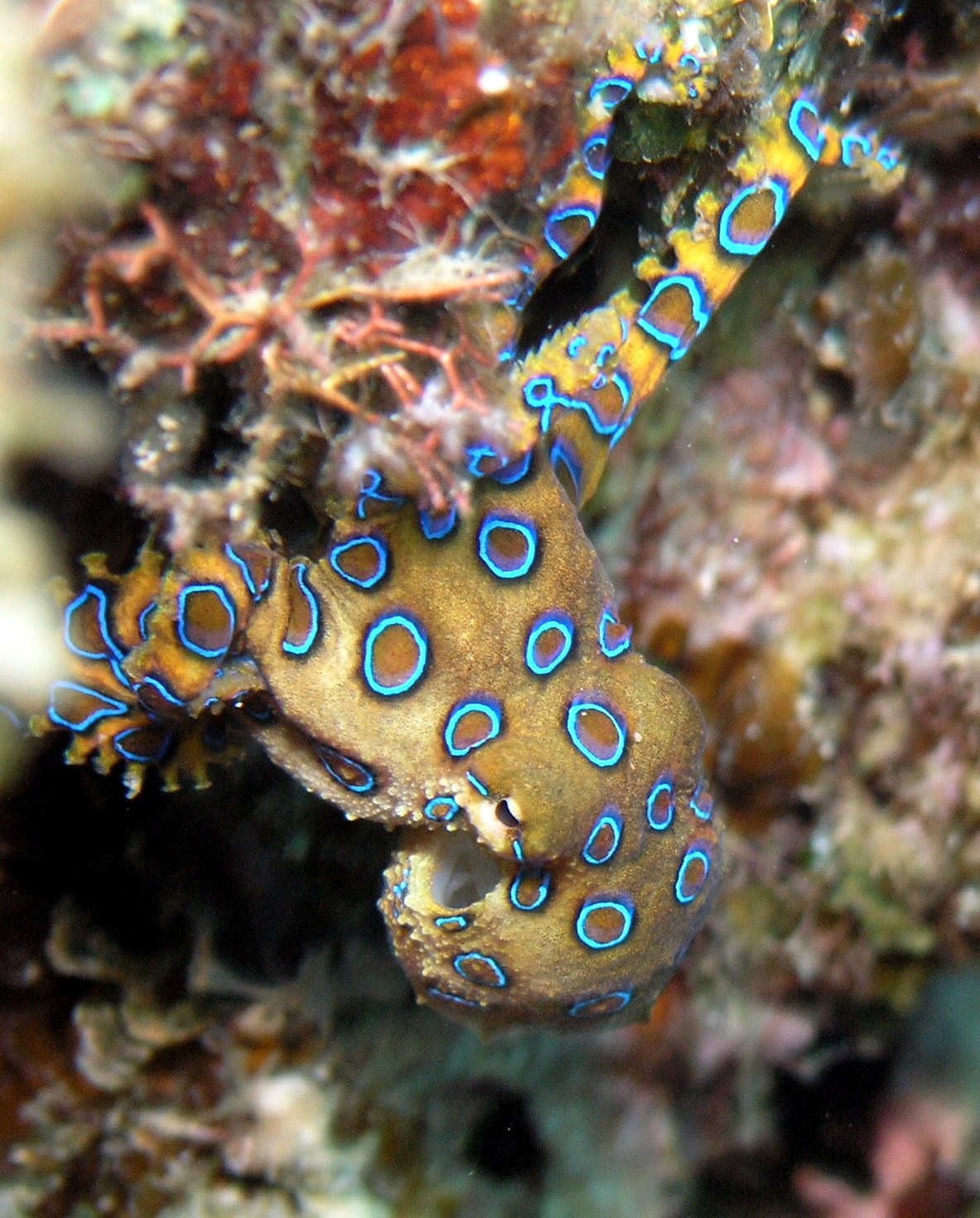
Greater Blue-ringed Octopus (Hapalochlaena lunulata) is a small venomous octopus of shallow tropical reefs in the western Pacific. At rest it can blend into sand, rubble and shells, but when alarmed dozens of rings flash intense blue against yellow-brown skin. The warning is serious: saliva contains tetrodotoxin capable of stopping human breathing. The animal is shy rather than aggressive, and most danger begins when someone picks it up or traps it in a tide pool. This guide separates well-supported biology from common assumptions and covers identification, range, habitat, diet, behavior, reproduction and conservation.
Identification
A compact mantle supports eight short, tapering arms. The background is cream, yellow or tan with dark patches, while roughly 50–60 conspicuous blue rings cover the mantle and arms. When disturbed, muscles and pigment cells darken the ring margins so the iridescent blue appears to pulse. The body is only several centimeters long, and a hard beak is hidden where the arms meet. Females become larger and heavier than males. A mature male has a hectocotylized third right arm for transferring sperm.
Identification should combine body shape, markings, size, voice or movement, and location. One feature by itself can overlap with a related animal, a juvenile, or an individual in unusual light.
Photographs are most useful when they preserve scale and show several diagnostic features. Handling or repositioning a wild greater blue-ringed octopus for identification can cause stress and is unnecessary.
Size and physical adaptations
Greater Blue-ringed Octopus typically measures Body usually up to about 10 cm, with arms extending total span to roughly 20 cm and weighs Usually under 100 g. Size varies with sex and maturity; the small body can fit inside shells, cans and narrow crevices.
Its useful adaptations include electric-blue rings provide a warning display, chromatophores create rapid camouflage, tetrodotoxin immobilizes prey and deters predators, flexible boneless body enters narrow shelters, suckers taste and grip surfaces, beak pierces crustacean exoskeleton, jet propulsion enables quick escape, arms regenerate after injury. These traits work together in the animal’s normal setting rather than serving as isolated curiosities.
Published measurements may use different methods, life stages or sample locations. Comparing figures responsibly means checking what was measured rather than selecting the largest number available.
Range and distribution
Tropical western Pacific waters from northern Australia through Indonesia, Papua New Guinea and the Philippines, with records extending into nearby island groups and southern Japan. Published boundaries vary because several similar Hapalochlaena species were historically confused, so verified specimen records are more dependable than broad popular maps. The native range includes Australia, Indonesia, Papua New Guinea, Philippines, Malaysia, Japan, Palau, Micronesia, Solomon Islands.
A country-level map indicates broad distribution, not continuous occupation. Climate, elevation, water, vegetation, prey, breeding sites, barriers and survey effort all affect where records occur.
Records near the edge of the range deserve careful documentation because they may reflect natural movement, improved survey coverage, accidental transport or a genuine distribution change.
Habitat
Shallow coral and rocky reefs, tide pools, rubble, seagrass edges and sandy bottoms with shells or debris for shelter.
During daylight the octopus hides beneath rocks, in empty shells, coral rubble, bottles or cans. A pile of crab shell fragments outside a crevice may reveal a feeding den. It emerges to hunt across the bottom, often in low light. Its soft body allows entry through very small openings, making discarded containers especially attractive but hazardous hiding places for beach visitors. Protecting a population therefore requires the feeding, shelter and breeding features that make a site usable, along with connections that allow movement.
Microhabitat matters. Shade, soil, current, moisture, shelter or host plants can determine whether a small area is usable even when the surrounding landscape appears suitable.
Diet and feeding
Greater Blue-ringed Octopus is a carnivore. Important foods include small crabs, shrimp, other crustaceans, small fish, marine worms, occasionally small mollusks. The octopus stalks bottom-dwelling prey, pounces and encloses it with the arm web. It may bite through a crab’s shell or inject saliva into the prey. Tetrodotoxin blocks nerve signals and quickly immobilizes the animal, allowing the beak and radula to remove soft tissue. Shell fragments are discarded near the den, creating a midden useful to researchers.
Diet changes with age, season, location and food supply. A dramatic prey record does not establish what most individuals eat most of the time; repeated field observations provide a stronger picture.
Feeding opportunities also create risk. An animal focused on prey may be less alert to predators, traffic or people, while contaminated prey can transfer pollutants through the food web.
Behavior and communication
Mostly secretive and crepuscular or nocturnal, with daytime activity possible when hunting or disturbed. This octopus relies first on concealment. Chromatophores match mottled reef rubble, and the animal crawls rather than exposing itself in open water. When threatened, it may flatten, darken and flash its blue rings before jetting away. The display is a warning, not an invitation to approach. Individuals occupy shelters alone and may change dens when prey becomes scarce or a better cavity appears.
Blue-ring displays communicate danger to predators and probably to other octopuses. Changes in background color, mantle pattern, posture and arm position provide additional close-range signals. Touch and chemical cues are important during courtship because vision alone does not always prevent males from approaching other males. Suckers chemically sample water and surfaces as the animal explores. Behavior should be interpreted in context: alarm, courtship, feeding and temperature regulation can produce very different actions from the same animal.
Daily schedules are flexible responses, not rigid rules. Weather, breeding condition, disturbance, tides or food can move activity into a different part of the day.
Reproduction and development
A male inserts his specialized hectocotylus beneath the female’s mantle and transfers sperm packets. Females may resist prolonged mating and can store sperm. After laying a small clutch of relatively large eggs, the female carries them beneath her arms, continually cleaning and aerating them. She stops feeding during brooding and dies after the young hatch. Roughly 50–100 relatively large eggs Hatchlings emerge as small benthic octopuses rather than spending a long planktonic stage. They begin hunting tiny crustaceans and grow rapidly. Venom is present early in life, reflecting the close association between the octopus and toxin-producing bacteria or biochemical pathways. Survivors mature within months and complete the life cycle in roughly two years.
Young animals face different risks and may use different microhabitats or food than adults. Breeding success depends on adult condition, suitable sites and the survival of offspring through vulnerable early stages.
Counts of eggs or young describe reproductive output, not the number expected to reach adulthood. Mortality is normally greatest during eggs, larval or juvenile stages.
Predators and ecological role
The species controls small crabs, shrimp and fishes in reef and tide-pool food webs. It is prey for larger fishes, eels and other octopuses, although the warning rings and toxin discourage many attacks. Abandoned dens and prey remains provide food for scavengers. Because it uses both natural crevices and litter, coastal cleanup can reduce entanglement while leaving rocks and shells undisturbed. Documented or likely predators include Moray Eel, Grouper, Larger Octopus, Human.
This animal is both a consumer and a food source. Its influence comes through many repeated interactions, so ecological claims should be based on measured populations rather than assumptions drawn from appearance.
Predator and prey relationships differ among places. A species can be ecologically influential without being abundant everywhere, and its role can change across its range.
Relationship with people
Encounters occur when people turn rocks, collect shells, handle tide-pool animals or pick up containers occupied by an unseen octopus. The bite can be painless and leave little evidence, yet paralysis may develop rapidly. Public education focuses on hands-off observation and emergency breathing support. Researchers study tetrodotoxin, warning displays and toxin ecology, but collecting live animals requires specialist permits and containment.
Never touch, chase or pick up any small octopus, even if it appears calm or dead. Do not put hands into reef holes, shells, cans or bottles. If a bite is possible, call emergency services immediately, keep the person still, apply pressure immobilization according to local medical guidance and begin rescue breathing or CPR if breathing stops. There is no specific antivenom; continuous breathing support can be lifesaving until toxin effects wear off. Responsible observation means keeping an appropriate distance, avoiding capture or feeding, protecting habitat and following local wildlife or invasive-species guidance.
Wildlife guidance should come from the responsible local agency because collection rules, reporting requests and appropriate responses differ between native and introduced ranges.
Conservation
The Greater Blue-ringed Octopus has no current global IUCN Red List assessment. Its tropical range is broad, but population size and trend are not measured. Reef degradation, polluted runoff, destructive collecting and loss of shallow shelter may affect local populations without appearing in a global index. The reported global trend is Unknown.
Important pressures include coral reef degradation, coastal pollution and sedimentation, collection for the aquarium trade, removal of shells and reef rubble, marine heat waves, plastic and fishing debris. Global status can hide local decline or recovery, so current regional monitoring and habitat management remain necessary.
The most useful conservation action follows the documented pressure. Protecting breeding sites, reducing road deaths or limiting pollutants can require different tools in different populations.
The Greater Blue-ringed Octopus is small but highly venomous; compare it with the much larger, nonvenomous Giant Pacific Octopus.