
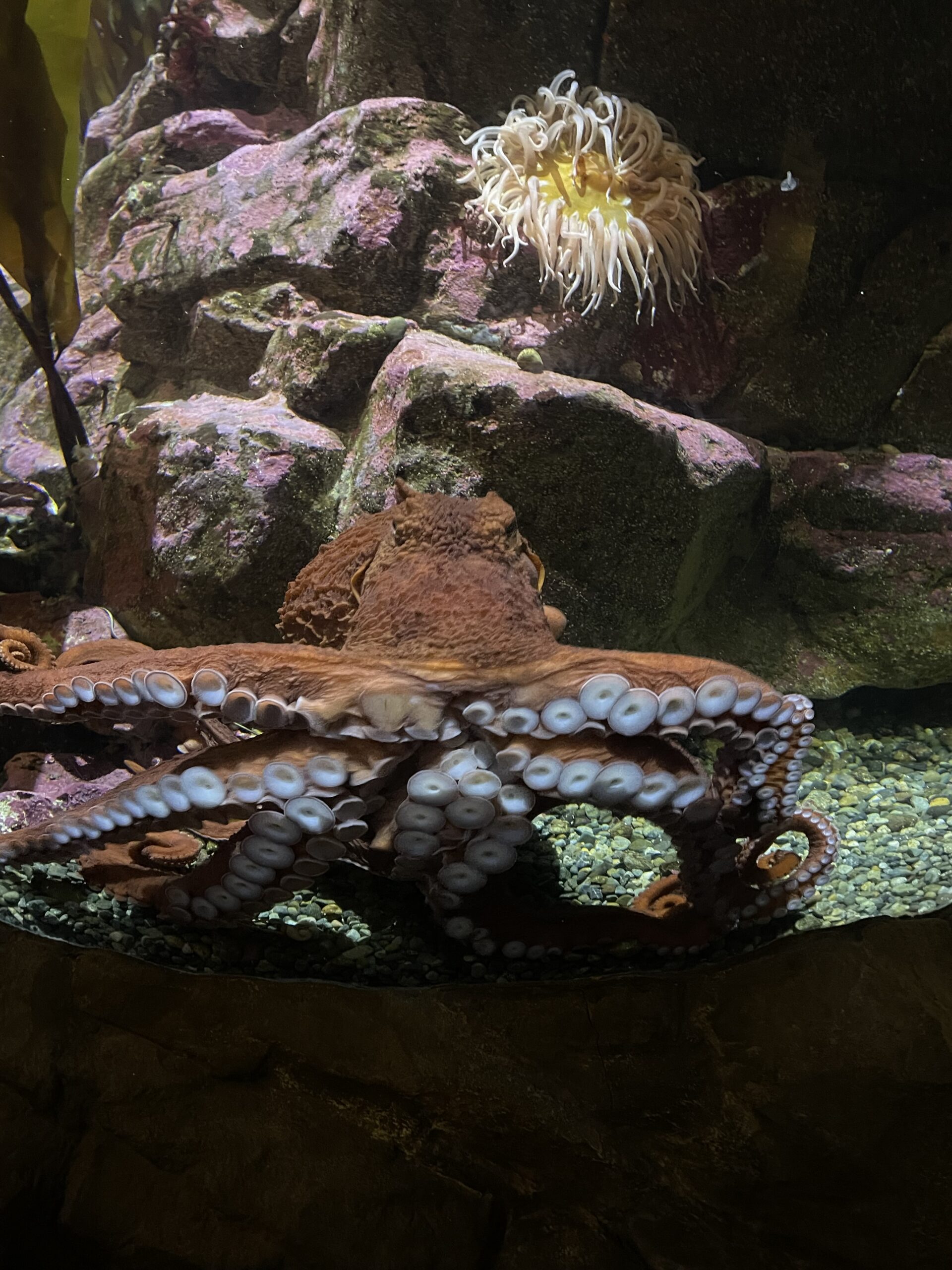
Giant Pacific Octopus (Enteroctopus dofleini) is a large, intelligent cephalopod of the cold North Pacific. It has no bones or external shell, allowing its soft body to pour through openings little wider than its beak. Thousands of suckers taste and grip the surroundings, while skin cells change color and texture in seconds. Despite its size and formidable beak, this octopus usually avoids people and spends much of its short life alone among rocky dens. This guide separates well-supported biology from common assumptions and covers identification, range, habitat, diet, behavior, reproduction and conservation.
Identification
A Giant Pacific Octopus has a rounded mantle, eight muscular arms joined by a web and two rows of suckers along each arm. Its skin is usually reddish brown but may become pale, dark red, mottled or nearly white. Raised papillae can make the surface look rough and rocklike. The eyes are large with horizontal pupils, and a hard parrotlike beak lies where the arms meet. Adults lack fins and an external shell. Females can become larger than males. A mature male has a modified third right arm, the hectocotylus, used to transfer sperm packets.
Identification should combine body shape, markings, size, voice or movement, and location. One feature by itself can overlap with a related animal, a juvenile, or an individual in unusual light.
Photographs are most useful when they preserve scale and show several diagnostic features. Handling or repositioning a wild giant pacific octopus for identification can cause stress and is unnecessary.
Size and physical adaptations
Giant Pacific Octopus typically measures Commonly 3–4.3 m arm span; exceptional individuals may be larger and weighs Often 15–50 kg, with exceptional records much heavier. Published maximum records vary, so ordinary adult ranges are more useful than sensational historical claims.
Its useful adaptations include chromatophores change skin color rapidly, papillae alter skin texture for camouflage, boneless body squeezes through narrow gaps, suckers grip, taste and investigate objects, three hearts circulate copper-based blue blood, jet propulsion provides rapid escape, ink confuses predators, arms can regenerate after injury. These traits work together in the animal’s normal setting rather than serving as isolated curiosities.
Published measurements may use different methods, life stages or sample locations. Comparing figures responsibly means checking what was measured rather than selecting the largest number available.
Range and distribution
Coastal North Pacific waters from northern Japan and eastern Russia across the Aleutian Islands and Alaska, then south along western Canada and the United States to Baja California. It occurs from the intertidal zone to depths of at least several hundred meters, with local movements influenced by temperature, prey and reproduction. The native range includes United States, Canada, Mexico, Russia, Japan.
A country-level map indicates broad distribution, not continuous occupation. Climate, elevation, water, vegetation, prey, breeding sites, barriers and survey effort all affect where records occur.
Records near the edge of the range deserve careful documentation because they may reflect natural movement, improved survey coverage, accidental transport or a genuine distribution change.
Habitat
Rocky reefs, boulder fields, caves, kelp forests, cobble bottoms and soft-bottom areas with suitable shelters in cold, oxygen-rich marine water.
An individual occupies a den beneath a rock, inside a crevice or among human-made debris. Shells and crab remains often accumulate outside the entrance as a midden. The octopus may remain near a productive shelter for days, then move when prey declines or conditions change. Juveniles use shallower protected habitat, while adults also occur on deep continental-shelf bottoms. Protecting a population therefore requires the feeding, shelter and breeding features that make a site usable, along with connections that allow movement.
Microhabitat matters. Shade, soil, current, moisture, shelter or host plants can determine whether a small area is usable even when the surrounding landscape appears suitable.
Diet and feeding
Giant Pacific Octopus is a carnivore. Important foods include crabs, clams and other bivalves, shrimp, snails, fish, squid, smaller octopuses. The octopus searches by extending its arms into crevices and tasting surfaces with its suckers. It can seize a crab, pull apart a shell with muscular arms or drill a small hole using its radula and chemicals from the salivary glands. A sharp beak cuts food into manageable pieces. Hard remains are carried out of the den, producing a midden that reveals recent meals.
Diet changes with age, season, location and food supply. A dramatic prey record does not establish what most individuals eat most of the time; repeated field observations provide a stronger picture.
Feeding opportunities also create risk. An animal focused on prey may be less alert to predators, traffic or people, while contaminated prey can transfer pollutants through the food web.
Behavior and communication
Mostly crepuscular or nocturnal, though activity varies with habitat, tide and individual experience. Giant Pacific Octopuses are solitary, curious and capable problem solvers. They investigate unfamiliar objects, remember useful locations and can learn by experience. Camouflage is their first defense: color, pattern, posture and skin texture can match rock or algae. If discovered, an octopus may flatten into a crevice, release ink or force water through its siphon for jet-propelled escape. Arms also crawl independently while remaining coordinated by the nervous system.
Most signals are visual and close-range. Changes in skin color, contrast, papillae, body posture and arm position can indicate alarm, aggression or courtship. Touch becomes important during mating. Water-borne chemical cues may help an octopus recognize food, predators and reproductive condition, while its sensitive skin and suckers continually sample nearby currents and surfaces. Behavior should be interpreted in context: alarm, courtship, feeding and temperature regulation can produce very different actions from the same animal.
Daily schedules are flexible responses, not rigid rules. Weather, breeding condition, disturbance, tides or food can move activity into a different part of the day.
Reproduction and development
The species breeds once and then dies, a life history called semelparity. A male uses his hectocotylized arm to place spermatophores inside the female mantle cavity. The female can store sperm before selecting a protected den. She attaches strings containing tens of thousands of small white eggs to the ceiling and spends months cleaning and aerating them. She stops feeding and dies after hatching. Usually tens of thousands of eggs, often about 20,000–100,000 Hatchlings enter the plankton as tiny paralarvae and drift while feeding on small crustaceans. Survivors later settle to the seafloor, adopt dens and grow rapidly. Juveniles face heavy predation. Maturity is reached in only a few years, and reproduction marks the final stage of the adult life cycle.
Young animals face different risks and may use different microhabitats or food than adults. Breeding success depends on adult condition, suitable sites and the survival of offspring through vulnerable early stages.
Counts of eggs or young describe reproductive output, not the number expected to reach adulthood. Mortality is normally greatest during eggs, larval or juvenile stages.
Predators and ecological role
As a large benthic predator, the Giant Pacific Octopus links shellfish, crustaceans and fish in coastal food webs. Its abandoned dens and shell middens create small habitat patches used by other organisms. Eggs and paralarvae feed fishes and planktonic predators. Adults are eaten by large fishes, seals, sea lions and toothed whales. The species can shift prey and den use as coastal conditions change. Documented or likely predators include Harbor Seal, Steller Sea Lion, Pacific Halibut, Killer Whale, Human.
This animal is both a consumer and a food source. Its influence comes through many repeated interactions, so ecological claims should be based on measured populations rather than assumptions drawn from appearance.
Predator and prey relationships differ among places. A species can be ecologically influential without being abundant everywhere, and its role can change across its range.
Relationship with people
The species supports directed fisheries in parts of its range and is also caught in traps and other gear aimed at crabs or groundfish. It is a major aquarium ambassador because visitors can see flexible movement, camouflage and problem solving. Coastal Indigenous communities have long included octopuses in food traditions and ecological knowledge. Sustainable management needs local catch information because abundance can vary by region.
A wild octopus should be watched without touching, blocking its den or offering food. Its beak can inflict a painful bite, saliva may irritate tissue and powerful suckers can hold firmly. Divers should keep hands out of unseen crevices and never attempt to pull an animal from shelter. Bites are uncommon when people leave the animal space. Responsible observation means keeping an appropriate distance, avoiding capture or feeding, protecting habitat and following local wildlife or invasive-species guidance.
Wildlife guidance should come from the responsible local agency because collection rules, reporting requests and appropriate responses differ between native and introduced ranges.
Conservation
The Giant Pacific Octopus has not been given a global IUCN Red List category. Regional catch, bycatch and habitat conditions therefore provide more useful management signals than a single worldwide label. Its broad range does not eliminate local risks, especially where harvest data are incomplete. The reported global trend is No reliable range-wide trend; local abundance and catches vary.
Important pressures include directed harvest and unreported catch, bycatch in crab and groundfish gear, warming and marine heat waves, declining oxygen in deeper water, pollution and coastal habitat disturbance, changes in shellfish prey. Global status can hide local decline or recovery, so current regional monitoring and habitat management remain necessary.
The most useful conservation action follows the documented pressure. Protecting breeding sites, reducing road deaths or limiting pollutants can require different tools in different populations.
Unlike the open-water Giant Squid, the Giant Pacific Octopus occupies dens on the seafloor and broods a single large clutch.