
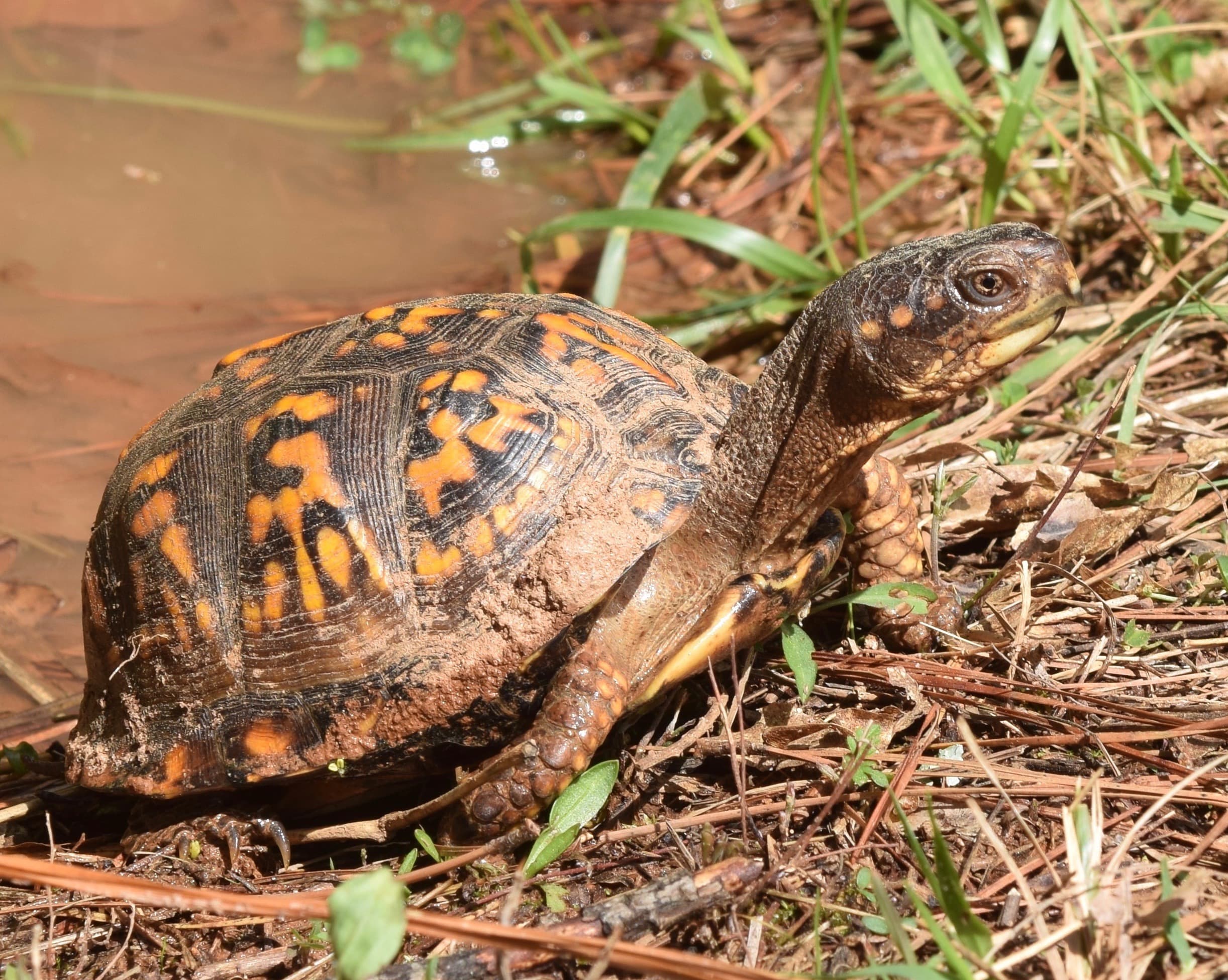
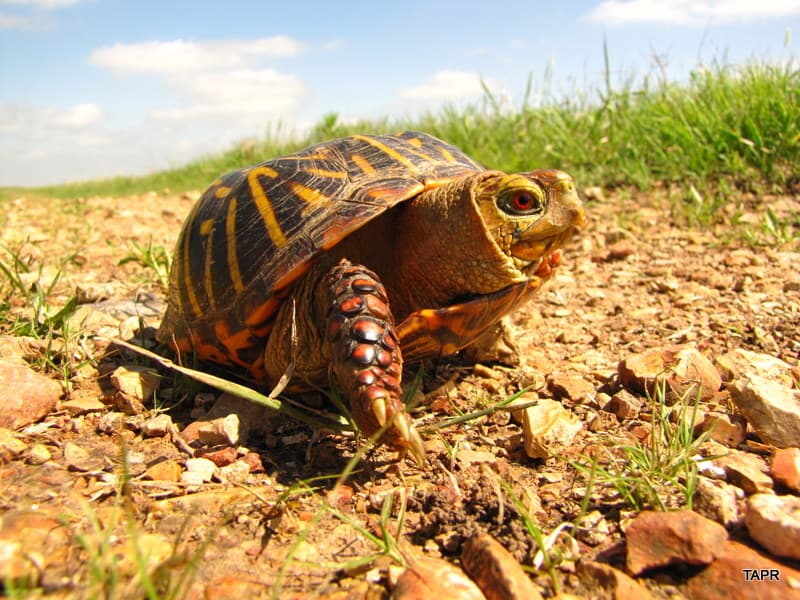
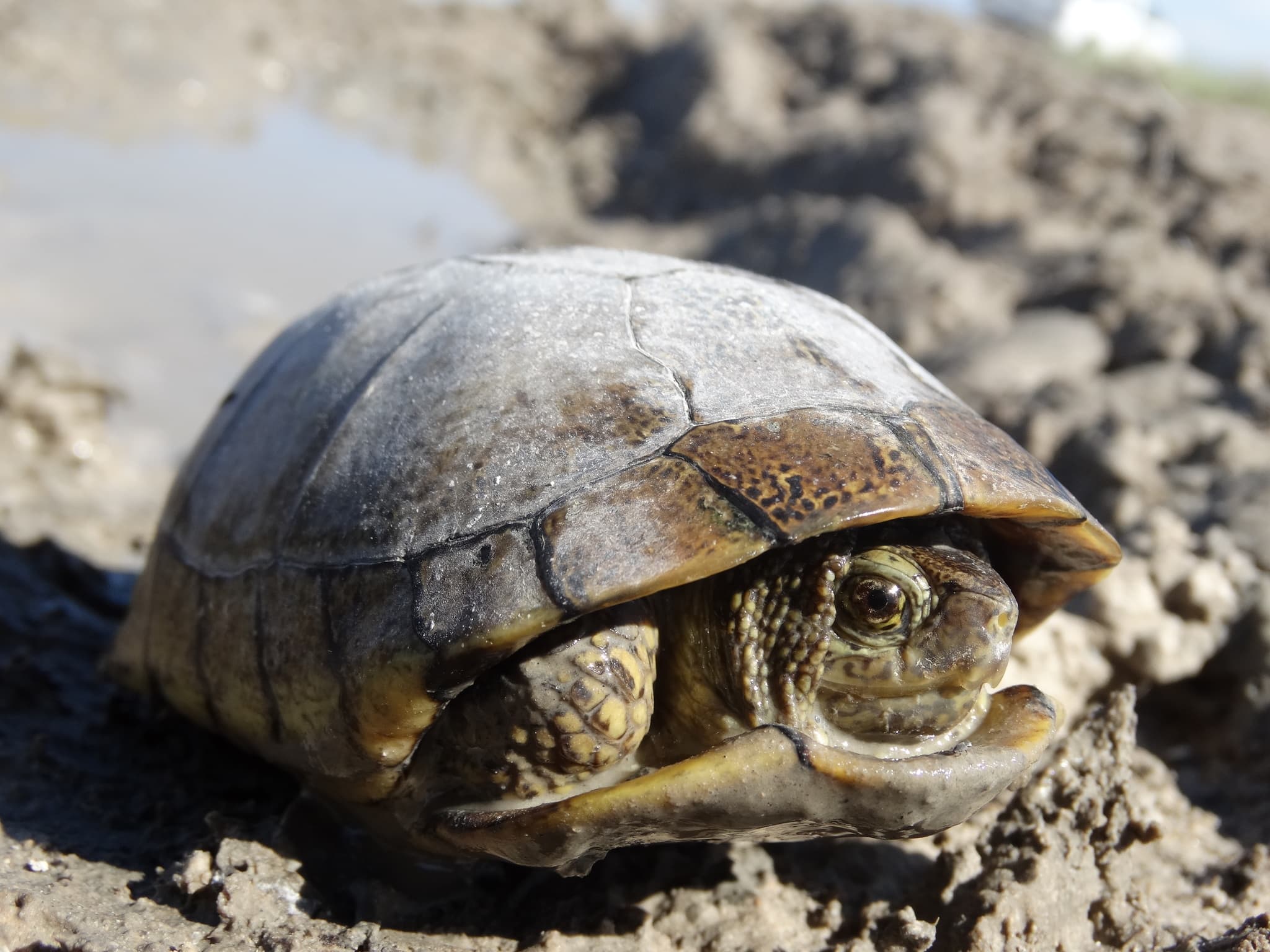
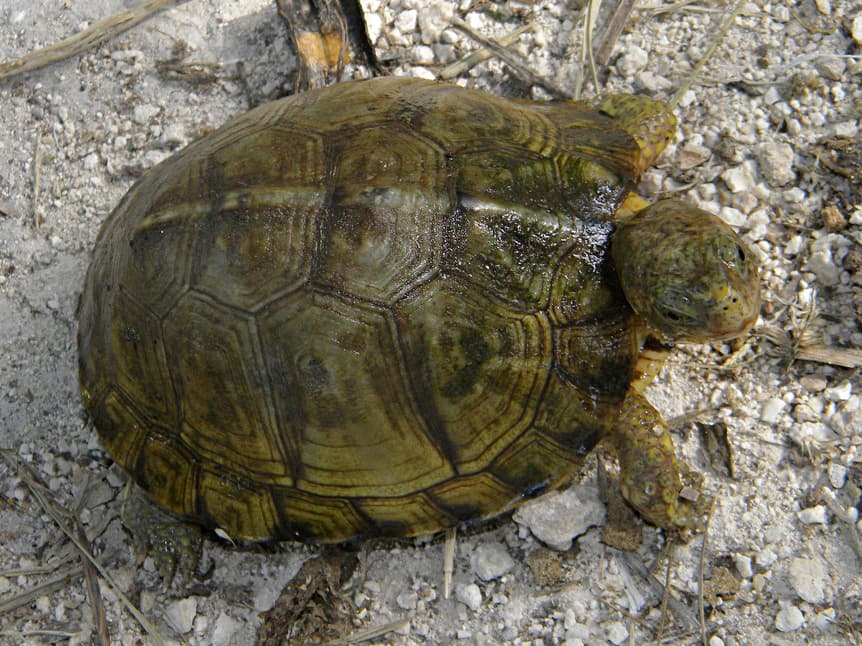
Box Turtle (Terrapene) refers here to the seven living species currently recognized in the genus Terrapene. These mostly terrestrial emydid turtles occur from the United States into Mexico. Their best-known defense is a hinged lower shell, or plastron, that lets many individuals pull in the head and limbs and close the shell tightly. Species occupy forests, prairies, scrub, desert grasslands and, in the case of the Coahuilan box turtle, spring-fed wetlands. Because this is a genus profile, size, habitat, conservation status and behavior must be interpreted species by species. This guide separates well-supported biology from common assumptions and covers identification, range, habitat, diet, behavior, reproduction and conservation. The Eastern Box Turtle profile provides a subspecies-level example.
Identification
Box turtles have a high-domed carapace, a strongly hinged plastron and a hooked upper jaw. When threatened, an adult can withdraw the head, legs and tail, then raise the hinged plastral lobes to protect the openings. Shell pattern differs greatly: eastern and ornate box turtles may carry yellow or orange spots, streaks or radiating lines, while Coahuilan and Yucatan species can appear plainer. Species identification requires location, shell proportions, foot and toe characters, color and current taxonomic references rather than pattern alone. In several species, males average a thicker tail and a more concave plastron, and may have red or orange eyes; females often have a flatter plastron. These traits overlap and are not identical across the genus.
Identification should combine body shape, markings, size, voice or movement, and location. One feature by itself can overlap with a related animal, a juvenile, or an individual in unusual light.
Photographs are most useful when they preserve scale and show several diagnostic features. Handling or repositioning a wild box turtle for identification can cause stress and is unnecessary.
Size and physical adaptations
Box Turtle typically measures Commonly around 10–20 cm shell length, depending on species and population and weighs Dependent on species, age and condition. Shell length is the most useful standard measure. Genus-wide figures do not describe every species, and individuals should not be aged by counting shell rings.
Its useful adaptations include hinged plastron that closes against the carapace, high-domed shell resistant to many predators, strong claws for digging shelters and nests, slightly webbed feet in several species, seasonal dormancy during cold or dry conditions, homing ability and familiarity with a local home range. These traits work together in the animal’s normal setting rather than serving as isolated curiosities.
Published measurements may use different methods, life stages or sample locations. Comparing figures responsibly means checking what was measured rather than selecting the largest number available.
Range and distribution
The genus is native to North America. Species occur through much of the eastern and central United States, parts of the Southwest and several regions of Mexico, including the Cuatro Ciénegas basin and Yucatan Peninsula. The seven species have different and sometimes restricted distributions, so the two-country map shows the combined genus range rather than continuous occupancy. The native range includes United States, Mexico.
A country-level map indicates broad distribution, not continuous occupation. Climate, elevation, water, vegetation, prey, breeding sites, barriers and survey effort all affect where records occur.
Records near the edge of the range deserve careful documentation because they may reflect natural movement, improved survey coverage, accidental transport or a genuine distribution change.
Habitat
Deciduous and mixed woodland, forest edges, moist meadows, prairie, scrub, sandy grassland, seasonal wetlands and spring-fed marshes, depending on species.
Most box turtles move between feeding patches, shaded retreats, shallow water and nesting ground within a familiar home range. Leaf litter and loose soil provide cover and humidity, while sunny openings allow basking and egg development. Rain often stimulates movement. Coahuilan box turtles are unusually aquatic and use permanent spring-fed wetlands, showing why one habitat description cannot be applied to the whole genus. Protecting a population therefore requires the feeding, shelter and breeding features that make a site usable, along with connections that allow movement.
Microhabitat matters. Shade, soil, current, moisture, shelter or host plants can determine whether a small area is usable even when the surrounding landscape appears suitable.
Diet and feeding
Box Turtle is a omnivorous. Important foods include earthworms, slugs and snails, insects and other invertebrates, fallen fruit and berries, mushrooms and tender plant matter, carrion, occasionally eggs or small vertebrates. Box turtles forage on the ground, especially after rain when soft-bodied invertebrates are active. Young animals often take a larger share of animal food, while adults commonly eat a broad mixture of invertebrates, fruit, fungi and plant material. They may help move seeds and fungal spores. Diet differs with species, season and local availability, so a dramatic feeding observation should not be treated as a universal menu.
Diet changes with age, season, location and food supply. A dramatic prey record does not establish what most individuals eat most of the time; repeated field observations provide a stronger picture.
Feeding opportunities also create risk. An animal focused on prey may be less alert to predators, traffic or people, while contaminated prey can transfer pollutants through the food web.
Behavior and communication
Mostly active by day, often in cool morning hours or after rain A box turtle usually walks slowly through cover, pausing to forage, bask or soak. It can remember a small home area and may attempt to return after displacement. When danger approaches, it withdraws and closes the shell rather than fleeing far. In cold regions turtles overwinter in soil or leaf litter; in hot or dry periods they may shelter underground. Roads are especially dangerous because the defensive response does not protect against vehicles.
Box turtles rely on scent, touch and visual cues. Courtship includes circling, nudging, biting at the shell edge and mounting. They can detect vibrations and chemical information in their surroundings, but they do not maintain complex vocal social groups. Behavior should be interpreted in context: alarm, courtship, feeding and temperature regulation can produce very different actions from the same animal.
Daily schedules are flexible responses, not rigid rules. Weather, breeding condition, disturbance, tides or food can move activity into a different part of the day.
Reproduction and development
Mating often occurs in spring or after warm rains, though timing differs across the range. A female digs a flask-shaped nest in sunny, well-drained soil and lays a small clutch. Stored sperm can allow fertilization long after mating. Incubation temperature influences development, and hatchlings receive no parental care. Usually a small clutch of several eggs; exact number depends on species and female size Hatchlings emerge with a softening egg tooth and a small residual yolk reserve. Their hinge is not fully functional at first, and their thin shells offer less protection than an adult shell. They hide in litter or shallow soil and mature slowly over years.
Young animals face different risks and may use different microhabitats or food than adults. Breeding success depends on adult condition, suitable sites and the survival of offspring through vulnerable early stages.
Counts of eggs or young describe reproductive output, not the number expected to reach adulthood. Mortality is normally greatest during eggs, larval or juvenile stages.
Predators and ecological role
Box turtles link forest floors, grasslands and wetlands. They consume invertebrates and carrion, eat fruit and fungi, and can disperse seeds and spores. Eggs and young are taken by raccoons, skunks, foxes, snakes, birds and other predators. Adults gain protection from the closing shell but remain vulnerable to vehicles, mowers, dogs, fire and collecting. Their slow maturity means that repeated loss of adults can reduce a population even when hatchlings are still seen. Documented or likely predators include Raccoons, Skunks, Foxes, Birds and snakes.
This animal is both a consumer and a food source. Its influence comes through many repeated interactions, so ecological claims should be based on measured populations rather than assumptions drawn from appearance.
Predator and prey relationships differ among places. A species can be ecologically influential without being abundant everywhere, and its role can change across its range.
Relationship with people
People often find box turtles crossing roads or gardens. The safest help is usually to move a road-crossing turtle only a short distance in the direction it was already traveling, when this can be done without personal danger and local guidance allows it. Never relocate one to a distant park: strong homing behavior may prompt risky attempts to return. Wild collection can damage local populations and may be illegal. Gardeners can reduce harm by checking before mowing and avoiding pesticides and deep window wells.
Box turtles are not dangerous, but a frightened animal may bite or scratch. Wild turtles can carry Salmonella even when they look healthy. Observe without handling, keep hands away from the mouth and wash thoroughly after unavoidable contact. Responsible observation means keeping an appropriate distance, avoiding capture or feeding, protecting habitat and following local wildlife or invasive-species guidance.
Wildlife guidance should come from the responsible local agency because collection rules, reporting requests and appropriate responses differ between native and introduced ranges.
Conservation
The genus has no single conservation category. Species range from comparatively widespread to highly restricted, and the Coahuilan box turtle faces severe wetland pressure. Assessments and legal protections must be checked for each species and region. The reported global trend is No single genus-wide trend.
Important pressures include road mortality, habitat loss and fragmentation, collection for the pet trade, mowing and agricultural machinery, predation by subsidized urban predators, wetland depletion and drought. Global status can hide local decline or recovery, so current regional monitoring and habitat management remain necessary.
The most useful conservation action follows the documented pressure. Protecting breeding sites, reducing road deaths or limiting pollutants can require different tools in different populations.