
Eastern Box Turtle Overview
The Eastern Box Turtle (Terrapene carolina carolina) is the nominate subspecies of the Common Box Turtle. This profile covers that subspecies rather than every population historically placed in Terrapene carolina. It is a living, mostly terrestrial turtle native to the eastern United States. The high-domed shell, bright yellow or orange markings and hinged lower shell make it one of the region’s most recognizable reptiles. For the broader genus and its seven living species, see the Box Turtle profile.
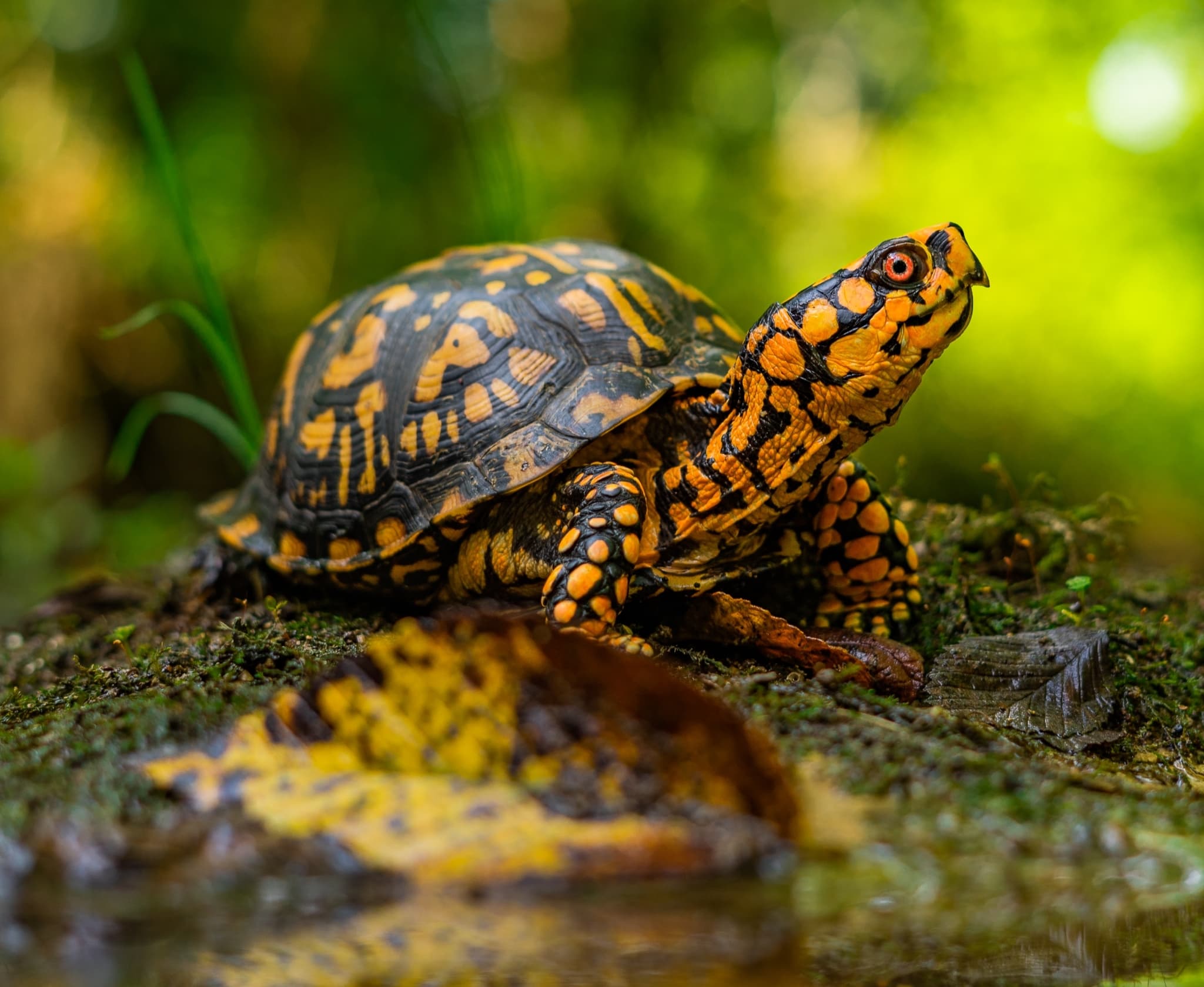
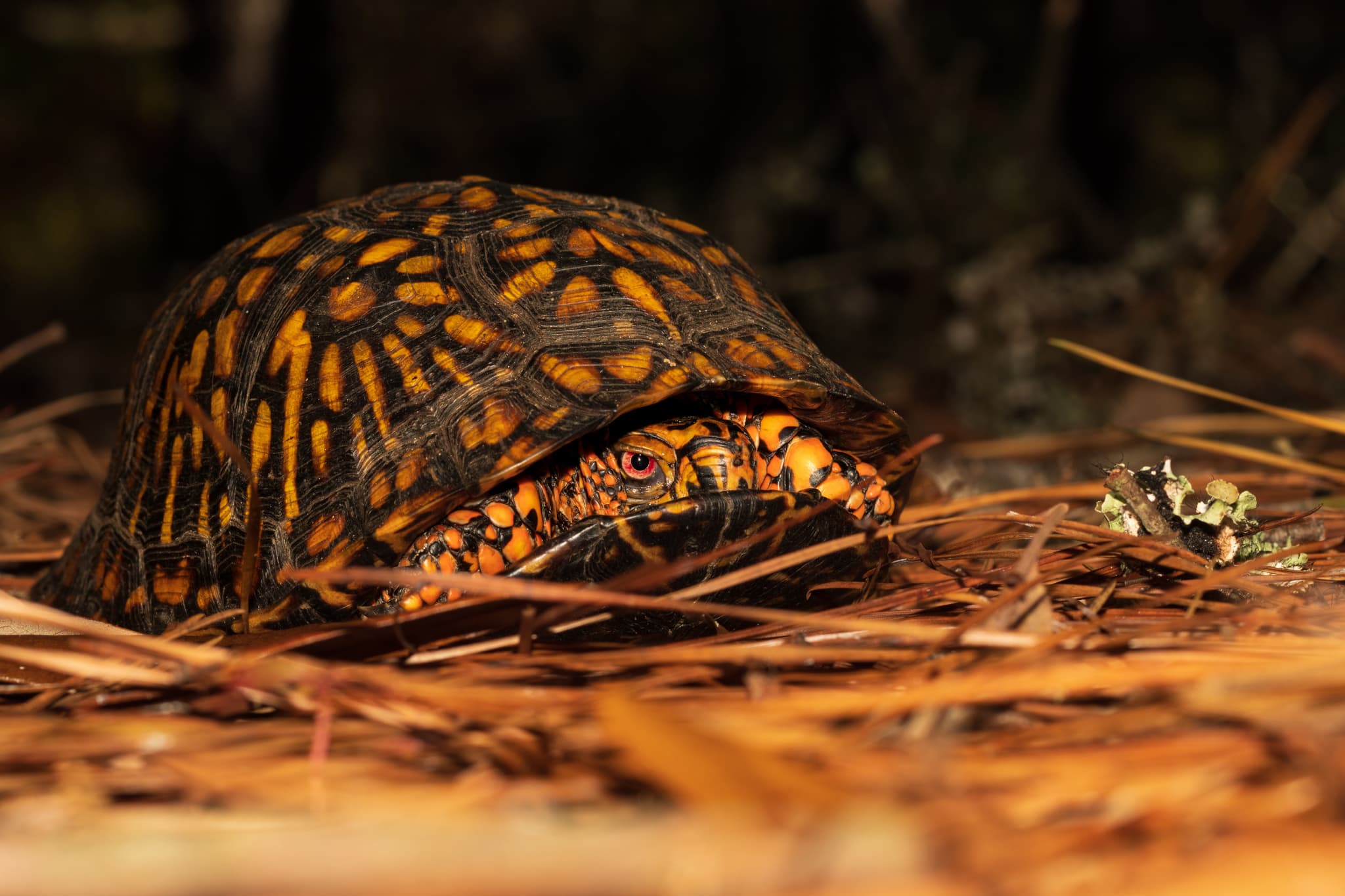
Unlike a tortoise, it belongs to the pond-turtle family Emydidae, even though adults spend much of their time on land. Its plastron has a flexible hinge that can pull the front and rear lobes tightly against the carapace after the head, legs and tail withdraw. The resulting “box” protects a patient animal that cannot escape danger through speed. Shell color varies greatly among individuals, from mostly dark brown to intricate orange and yellow radiating lines or blotches.
Range and Habitat
The Eastern Box Turtle occupies a broad part of the eastern United States, from portions of New England and the Great Lakes region south through the Mid-Atlantic, Appalachians and Southeast. Its boundaries meet those of other box-turtle forms in parts of the South and interior, where identification can be complicated by geographic variation and interbreeding. For this reason, a location and several anatomical features are more reliable than color alone when identifying a subspecies.
It uses deciduous and mixed forest, shrubby edges, old fields, marshy meadows and other landscapes that combine cover with moisture. Leaf litter, fallen logs and loose soil provide feeding sites and shelter. During heat or drought, a turtle may bury itself in damp soil, hide beneath vegetation or soak in shallow water. It usually occupies a modest home range and can retain a detailed familiarity with local feeding, nesting and overwintering sites. Moving an adult far from where it was found can separate it from those resources and provoke risky attempts to return.
Shell, Color and Senses
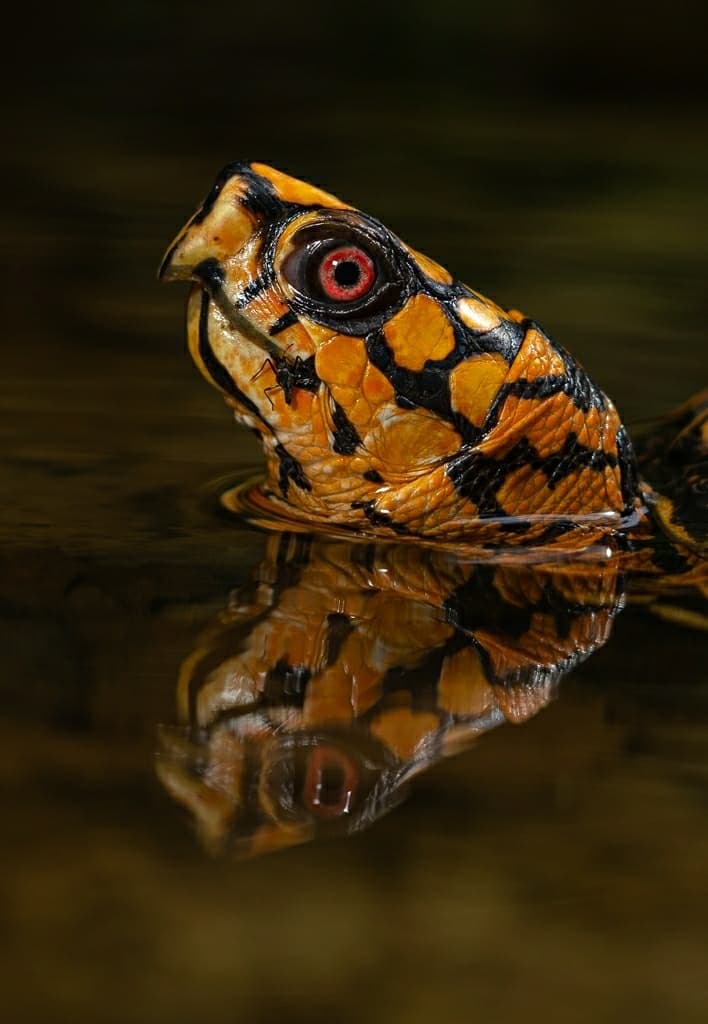
An adult’s carapace is tall and rounded, often with a weak central keel. The upper jaw is slightly hooked, and the eastern subspecies generally has four toes on each hind foot. Males tend to have a concave rear plastron, thicker tail and often red or orange irises, while females more often have a flatter plastron and brownish eyes. These tendencies overlap, so eye color alone does not determine sex.
The shell is living bone covered by keratin scutes. Growth lines can be visible, but counting them does not reliably reveal age because growth changes with food, weather and wear. Box turtles see color, detect odors and respond to ground vibration. Their bold pattern is not merely decorative: in broken forest light, yellow and orange markings disrupt the outline among fallen leaves. When camouflage fails, the hinged plastron becomes the principal defense.
Diet and Daily Activity
Eastern Box Turtles are omnivores. They eat earthworms, slugs, snails, insects and carrion as well as mushrooms, berries, tender vegetation and fallen fruit. Young turtles often take a larger share of animal food, while adults continue to use both plant and animal resources. Feeding on fruit and fungi can help move seeds and fungal spores across the forest floor, while predation on invertebrates connects the turtle to decomposition and soil food webs.
Activity is strongest in mild, humid conditions, especially after rain. Turtles forage by day and often pause in cover during the hottest hours. Seasonal activity varies with latitude. In colder parts of the range they spend winter buried below leaf litter or in loose soil, sometimes using the same general hibernation area in successive years. They emerge in spring as soil temperatures rise. Because their movements are slow, roads cut across daily routes and seasonal journeys with lethal consequences.
Reproduction and Longevity
Courtship and mating can occur from spring into autumn. Females may store sperm and can produce fertile eggs after a long interval without a recent mating. When ready to nest, a female selects open soil, digs a flask-shaped chamber with her hind feet and lays a small clutch. Incubation depends heavily on temperature and moisture. Like many turtles, developing embryos experience temperature-influenced sex determination rather than sex chromosomes operating alone.
Hatchlings receive no parental care and begin life with a flatter shell and a vulnerable body. Eggs and young are eaten by raccoons, skunks, foxes, snakes and other predators. Survivors mature slowly, and adults can live for many decades. That life-history pattern makes adult survival especially important. A population cannot quickly replace turtles killed on roads, removed for pets or lost when a familiar home range becomes housing or pavement.
Conservation Status and Threats
The IUCN assessment applies to the species Terrapene carolina, not separately to the Eastern Box Turtle subspecies. It classifies the species as Vulnerable following evidence of a widespread, persistent decline. The subspecies therefore should not be presented as having an independent global IUCN assessment. Local status also differs among states, with several jurisdictions treating box turtles as protected wildlife or species of conservation concern.
Habitat loss and fragmentation remove moist forest-floor conditions and divide populations. Road mortality, lawn equipment, fire, disease, collection and subsidized predators add further pressure. International trade in Terrapene is regulated under CITES Appendix II. A turtle seen crossing a road should only be helped when it is safe for the person to stop; move it a short distance in the direction it was already traveling, never to a distant “better” habitat. Do not take it home.
Living Alongside Box Turtles
Landowners can protect box turtles by retaining leaf litter, logs and connected woodland, checking tall grass before mowing and avoiding pesticides that reduce invertebrate prey. Dogs should be supervised where turtles occur. Garden mesh and open pits can trap them, while steep curbs and solid fences can block familiar routes. Wildlife-friendly passages and roadside fencing can reduce repeated crossings at known mortality sites.
Observation should be brief and hands-off. Photographs made at ground level can document shell pattern without lifting or repositioning the animal. Report injured turtles to a licensed wildlife rehabilitator, and record healthy sightings through an appropriate biodiversity project without exposing sensitive locations. The Eastern Box Turtle’s long life depends on adults surviving ordinary encounters year after year; small choices by drivers, landowners and hikers can therefore have effects that last for decades.
Sources
- U.S. National Park Service: Eastern Box Turtle identification and habitat
- U.S. Fish and Wildlife Service: Terrapene carolina carolina
- IUCN SSC Tortoise and Freshwater Turtle Specialist Group: Terrapene carolina
- Animal Diversity Web: Terrapene carolina natural history
- U.S. Fish and Wildlife Service: U.S. turtle species in the CITES Appendices