
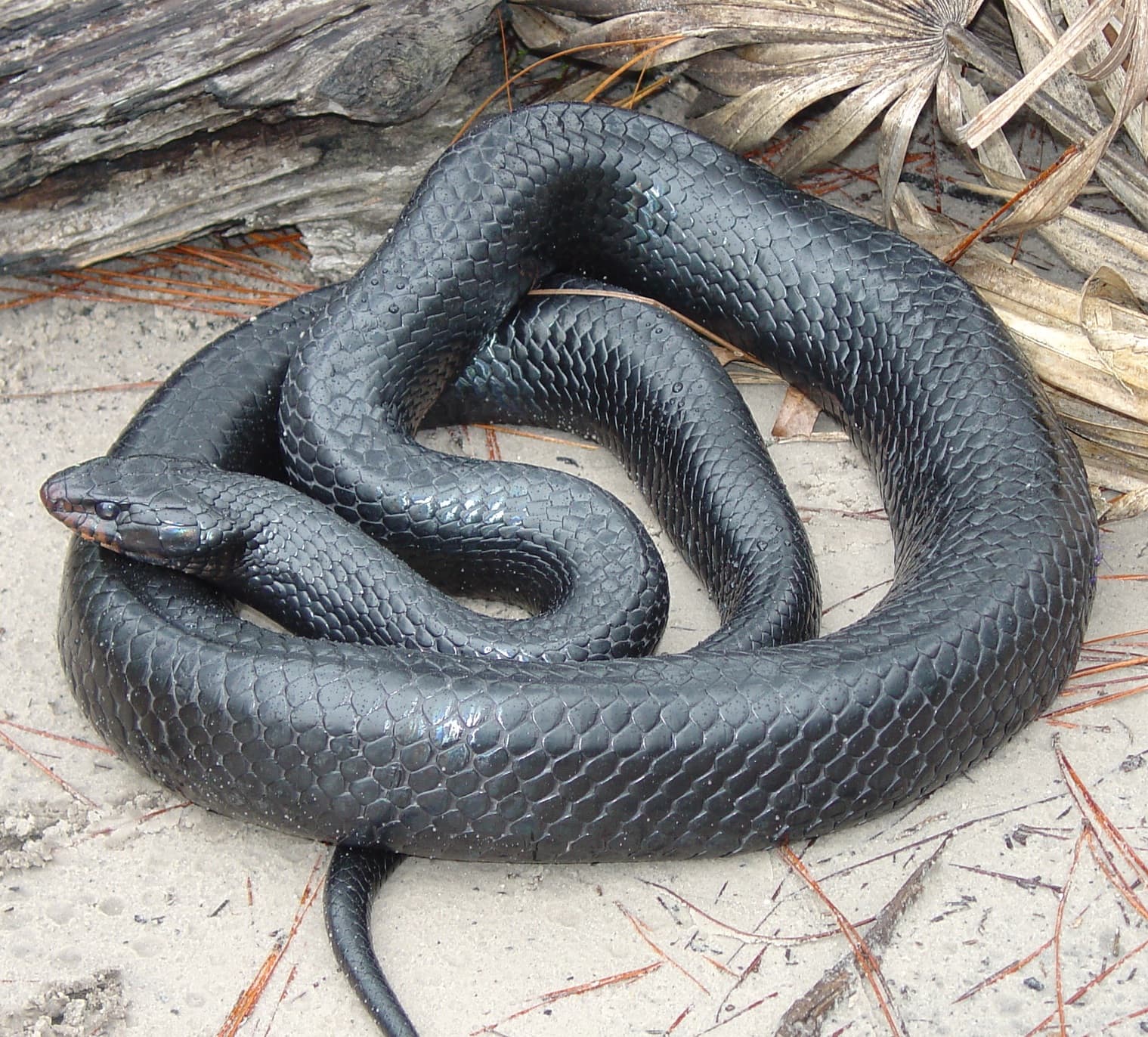
Eastern Indigo Snake (Drymarchon couperi) is a massive nonvenomous predator of the southeastern United States. Its glossy blue-black scales and red-orange chin are distinctive, but its ecological needs are even more unusual: northern populations move through large landscapes and rely heavily on gopher tortoise burrows for winter shelter. Habitat fragmentation has made the species federally threatened. This guide separates well-supported biology from common assumptions and covers identification, range, habitat, diet, behavior, reproduction and conservation.
Identification
Adults are moderately heavy-bodied and almost uniformly iridescent blue-black. The chin, cheeks and throat are usually red, orange-brown or cream, although some individuals are dark throughout. Scales are smooth except for slight keels on a few anterior rows in mature males. The head is broad but not triangular and the pupils are round. Males grow longer and heavier, with broader heads and slight keels on the middle front scale rows. Females are generally smaller and retain smooth scales.
Identification should combine body shape, markings, size, voice or movement, and location. One feature by itself can overlap with a related animal, a juvenile, or an individual in unusual light.
Photographs are most useful when they preserve scale and show several diagnostic features. Handling or repositioning a wild eastern indigo snake for identification can cause stress and is unnecessary.
Size and physical adaptations
Eastern Indigo Snake typically measures average adults about 1.5–2 m; record near 2.63 m and weighs roughly 0.9–4.5 kg, with exceptional adults heavier. This is the longest snake native to the United States; males account for most extreme lengths.
Its useful adaptations include large body overpowers diverse vertebrate prey, smooth scales reduce friction in burrows, strong jaws hold other snakes, tolerance of rattlesnake venom improves snake predation, wide-ranging movement connects habitat patches, dark scales absorb winter sun, gopher tortoise burrows provide thermal refuge. These traits work together in the animal’s normal setting rather than serving as isolated curiosities.
Published measurements may use different methods, life stages or sample locations. Comparing figures responsibly means checking what was measured rather than selecting the largest number available.
Range and distribution
Current populations persist mainly in peninsular Florida and southern Georgia, with smaller restored or remnant populations in parts of Alabama and the Florida Panhandle. Historically the species ranged through Florida and the coastal plains of Georgia, Alabama and Mississippi. The native range includes United States.
A country-level map indicates broad distribution, not continuous occupation. Climate, elevation, water, vegetation, prey, breeding sites, barriers and survey effort all affect where records occur.
Records near the edge of the range deserve careful documentation because they may reflect natural movement, improved survey coverage, accidental transport or a genuine distribution change.
Habitat
Longleaf pine sandhill, pine flatwoods, scrub, oak hammock, coastal dune, tropical hardwood hammock, wet prairie and wetland edge.
Northern snakes use gopher tortoise burrows as winter refuges, then move between uplands and wetlands as seasons change. Southern Florida snakes remain active through more of the year and use a wider range of natural and altered cover. Adults need connected mosaics spanning hundreds or thousands of acres, making roads and development major barriers. Protecting a population therefore requires the feeding, shelter and breeding features that make a site usable, along with connections that allow movement.
Microhabitat matters. Shade, soil, current, moisture, shelter or host plants can determine whether a small area is usable even when the surrounding landscape appears suitable.
Diet and feeding
Eastern Indigo Snake is a generalist vertebrate predator with a strong preference for other snakes. Important foods include snakes, frogs, toads, turtles, lizards, small mammals, birds. The snake actively hunts by day, following chemical trails through burrows, leaf litter and wetland margins. Other snakes, including venomous species, are important prey. It also takes frogs, toads, lizards, turtles, fish, birds, eggs, rodents and occasionally very young alligators. Prey is seized, crushed against the ground or swallowed alive rather than killed by venom.
Diet changes with age, season, location and food supply. A dramatic prey record does not establish what most individuals eat most of the time; repeated field observations provide a stronger picture.
Feeding opportunities also create risk. An animal focused on prey may be less alert to predators, traffic or people, while contaminated prey can transfer pollutants through the food web.
Behavior and communication
Diurnal; most surface activity occurs in cooler seasons and mornings, with refuge use during extreme heat or cold. Eastern Indigo Snakes travel farther than many North American snakes. They explore tortoise burrows, fallen logs, wetlands and forest edges with the head raised. Individuals are usually calm and retreat when possible. A restrained snake may hiss, flatten the neck, vibrate the tail, bite or release musk, but it is not venomous.
Tongue flicks gather prey and mate scents for the vomeronasal organ. Males follow female pheromone trails during the cool-season breeding period and may engage in combat. Close body contact guides courtship. Defensive signals include hissing, neck flattening, tail vibration and musking. Behavior should be interpreted in context: alarm, courtship, feeding and temperature regulation can produce very different actions from the same animal.
Daily schedules are flexible responses, not rigid rules. Weather, breeding condition, disturbance, tides or food can move activity into a different part of the day.
Reproduction and development
Courtship and mating peak from autumn through winter, unusually early for a North American snake. Males range widely to locate females and may wrestle competitors. Females can store sperm for years before fertilizing eggs. A single clutch is deposited in spring, often within a burrow, stump or protected cavity. Usually 4–12 eggs; up to 14 reported The very large eggs develop in warm humid refuges. Hatchlings emerge in late summer and are independent. Young snakes feed on small reptiles, amphibians and mammals, grow slowly and take several years to mature. Delayed maturity and infrequent reproduction limit recovery after adult mortality.
Young animals face different risks and may use different microhabitats or food than adults. Breeding success depends on adult condition, suitable sites and the survival of offspring through vulnerable early stages.
Counts of eggs or young describe reproductive output, not the number expected to reach adulthood. Mortality is normally greatest during eggs, larval or juvenile stages.
Predators and ecological role
As a top reptile predator, the Eastern Indigo Snake consumes snakes, amphibians, turtles, small mammals and birds and helps structure longleaf-pine food webs. Its reliance on gopher tortoise burrows links its survival to that ecosystem engineer. Large home ranges make it an umbrella species: protecting enough connected habitat also benefits many fire-dependent plants and animals. Documented or likely predators include Red-Tailed Hawk, Bobcat, American Alligator, Feral Pig, Human.
This animal is both a consumer and a food source. Its influence comes through many repeated interactions, so ecological claims should be based on measured populations rather than assumptions drawn from appearance.
Predator and prey relationships differ among places. A species can be ecologically influential without being abundant everywhere, and its role can change across its range.
Relationship with people
The species is federally protected as threatened. It must never be collected, handled, sold or killed without authorization. Drivers should watch for large dark snakes crossing roads, especially near sandhills and wetlands. Landowners can support recovery by protecting gopher tortoise burrows, restoring longleaf pine with prescribed fire and maintaining habitat corridors.
Eastern Indigo Snakes are nonvenomous and generally avoid people. A large restrained animal can bite and scratch, so never attempt capture. Give it an open escape route and contact wildlife authorities if a protected snake is endangered by traffic or construction. Wash any accidental bite and seek care for deep injury. Responsible observation means keeping an appropriate distance, avoiding capture or feeding, protecting habitat and following local wildlife or invasive-species guidance.
Wildlife guidance should come from the responsible local agency because collection rules, reporting requests and appropriate responses differ between native and introduced ranges.
Conservation
The IUCN assesses Drymarchon couperi as Least Concern globally, but the United States lists it as federally Threatened because of severe habitat loss, fragmentation and regional disappearance. The reported global trend is Decreasing in much of the historic range.
Important pressures include habitat loss, road mortality, fragmentation, loss of gopher tortoise burrows, human persecution, illegal collection, fire suppression, sea-level rise. Global status can hide local decline or recovery, so current regional monitoring and habitat management remain necessary.
The most useful conservation action follows the documented pressure. Protecting breeding sites, reducing road deaths or limiting pollutants can require different tools in different populations.