
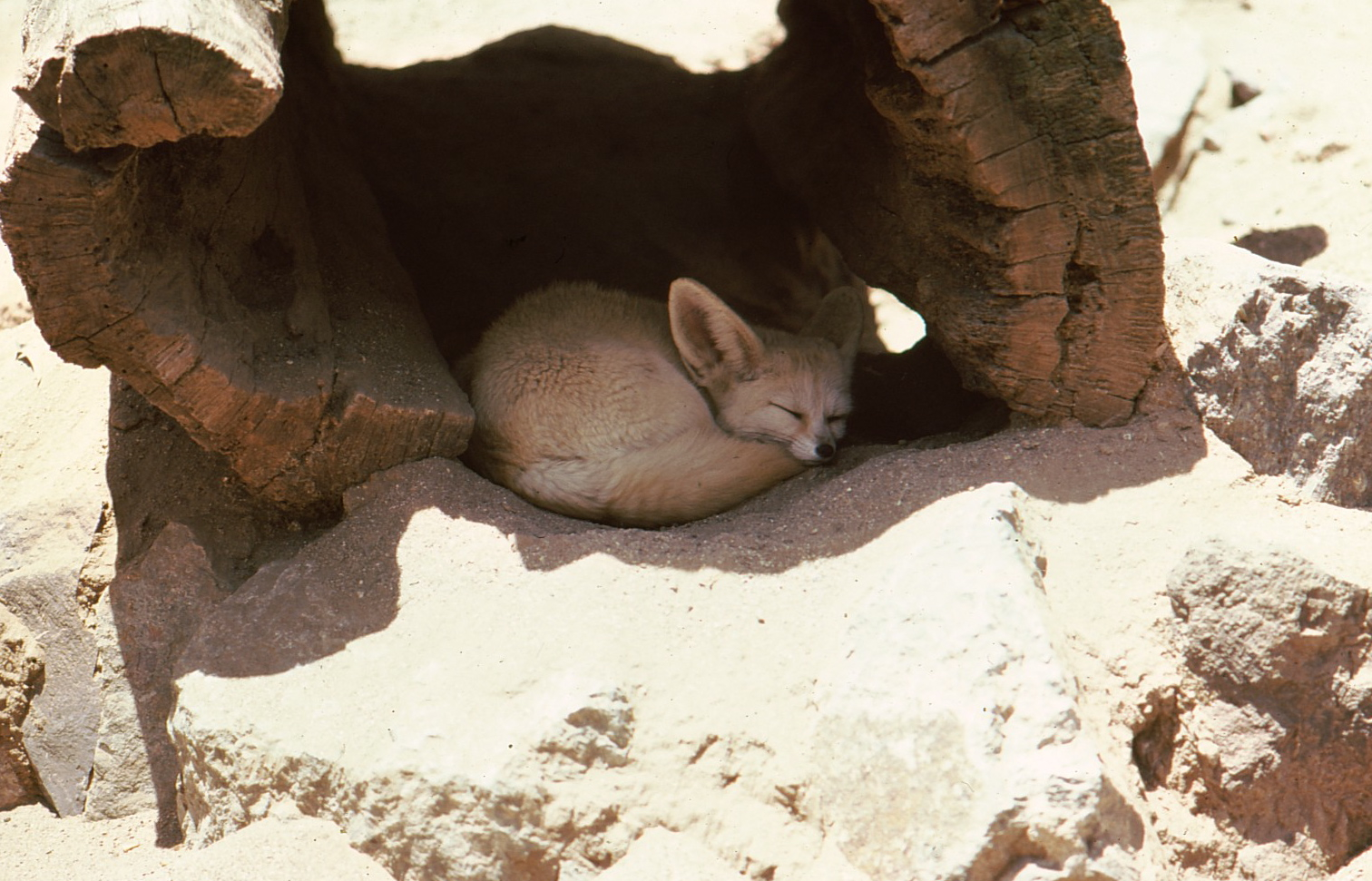
Fennec Fox (Vulpes zerda) is a tiny desert fox native to North Africa and parts of the Arabian region. Its outsized ears detect prey moving beneath sand and radiate body heat, while thick pale fur insulates it from hot days and cold nights. Fennecs spend daylight in deep burrows and emerge after dark to hunt alone while remaining part of a close family group. This guide separates well-supported biology from common assumptions and covers identification, range, habitat, diet, behavior, reproduction and conservation.
Identification
A Fennec has a small pointed muzzle, black nose and eyes, enormous triangular ears and a long bushy tail with a black tip. The silky coat is pale cream, buff or reddish fawn above and white below, blending with sand. Dense fur covers the foot pads. Young kits are paler and downier than adults. No other fox combines such tiny size with ears that may reach 15 centimeters. Males average slightly heavier than females, but the sexes have similar coats and proportions.
Identification should combine body shape, markings, size, voice or movement, and location. One feature by itself can overlap with a related animal, a juvenile, or an individual in unusual light.
Photographs are most useful when they preserve scale and show several diagnostic features. Handling or repositioning a wild fennec fox for identification can cause stress and is unnecessary.
Size and physical adaptations
Fennec Fox typically measures about 30–41 cm head and body and weighs about 0.8–1.5 kg. Even a large adult weighs less than many domestic cats.
Its useful adaptations include enormous ears detect underground prey, ear surfaces release excess body heat, pale coat reflects sunlight and camouflages on sand, thick fur insulates during cold desert nights, fur-covered soles protect against hot sand, efficient kidneys conserve water, rapid digging creates cool shelter and exposes prey. These traits work together in the animal’s normal setting rather than serving as isolated curiosities.
Published measurements may use different methods, life stages or sample locations. Comparing figures responsibly means checking what was measured rather than selecting the largest number available.
Range and distribution
Across the Sahara and adjacent arid regions of North Africa, from Morocco and Mauritania east through Algeria, Tunisia, Libya and Egypt and south into the Sahel. Records extend toward Sinai, while exact limits on the Arabian Peninsula are uncertain and sometimes confused with other small foxes. The native range includes Algeria, Chad, Egypt, Libya, Mali, Mauritania, Morocco, Niger, Nigeria, Sudan, Tunisia.
A country-level map indicates broad distribution, not continuous occupation. Climate, elevation, water, vegetation, prey, breeding sites, barriers and survey effort all affect where records occur.
Records near the edge of the range deserve careful documentation because they may reflect natural movement, improved survey coverage, accidental transport or a genuine distribution change.
Habitat
Sandy desert, dunes, arid scrub, desert grassland and sparsely vegetated semi-desert with stable soil for burrowing.
Fennecs excavate tunnel systems beneath dunes and vegetation, sometimes extending about 10 meters and containing several entrances. Roots stabilize the roof and provide concealment. The den buffers extreme surface temperature and shelters kits. Neighboring family dens may connect, creating a loose community, but hunting individuals spread across the surrounding night landscape. Protecting a population therefore requires the feeding, shelter and breeding features that make a site usable, along with connections that allow movement.
Microhabitat matters. Shade, soil, current, moisture, shelter or host plants can determine whether a small area is usable even when the surrounding landscape appears suitable.
Diet and feeding
Fennec Fox is a omnivore. Important foods include grasshoppers and locusts, beetles, small rodents, lizards, birds and eggs, snails, roots, tubers and fruit. At dusk a Fennec listens with independently rotating ears, triangulates scratching beneath the sand and digs rapidly with all four feet. It hunts alone even when living with a family. Insects and small vertebrates provide protein and moisture, while roots, fruits and leaves add water and energy. Surplus food may be cached in sand for later use.
Diet changes with age, season, location and food supply. A dramatic prey record does not establish what most individuals eat most of the time; repeated field observations provide a stronger picture.
Feeding opportunities also create risk. An animal focused on prey may be less alert to predators, traffic or people, while contaminated prey can transfer pollutants through the food web.
Behavior and communication
Strongly nocturnal, remaining below ground through the hottest daylight hours. Fennecs are more social than many foxes. A breeding pair and several young may share a den, and grown offspring sometimes remain with the family. At night each adult usually forages independently. They dig with extraordinary speed, jump roughly a meter from a standstill and use multiple escape tunnels when threatened. Territorial marking becomes intense around breeding.
The species has a surprisingly broad vocal repertoire: barks, chatters, growls, squeaks, shrieks, howls and soft whimpers. Calls maintain contact underground and signal alarm or excitement. Urine and feces mark the edge of a family range. Ear position, tail carriage, facial expression, play bows and close grooming organize social life inside the den. Behavior should be interpreted in context: alarm, courtship, feeding and temperature regulation can produce very different actions from the same animal.
Daily schedules are flexible responses, not rigid rules. Weather, breeding condition, disturbance, tides or food can move activity into a different part of the day.
Reproduction and development
Fennecs usually form a monogamous pair and breed once each year. Courtship occurs in winter, and the female is receptive for only a short period. The male becomes more territorial and supplies food while the female remains with newborn kits. A nursery chamber deep inside the burrow protects the litter from heat, cold and predators. Usually 2–5 kits Kits are born furred but blind, opening their eyes after about 8–11 days. They begin walking around two weeks, sample solid food after several weeks and are weaned near 2–3 months. Both parents defend and provision the den. Young reach adult size by roughly six months and sexual maturity around 9–11 months.
Young animals face different risks and may use different microhabitats or food than adults. Breeding success depends on adult condition, suitable sites and the survival of offspring through vulnerable early stages.
Counts of eggs or young describe reproductive output, not the number expected to reach adulthood. Mortality is normally greatest during eggs, larval or juvenile stages.
Predators and ecological role
Fennecs control desert insects, rodents and reptiles and disperse seeds from fruits. Their dens aerate soil and create shelter later used by invertebrates or small vertebrates. Eagle owls, jackals, hyenas and large raptors may take exposed animals, although nocturnal activity and burrows reduce risk. The fox’s survival depends on intact dune vegetation as much as open sand. Documented or likely predators include Eagle Owl, Golden Jackal, Striped Hyena, Human.
This animal is both a consumer and a food source. Its influence comes through many repeated interactions, so ecological claims should be based on measured populations rather than assumptions drawn from appearance.
Predator and prey relationships differ among places. A species can be ecologically influential without being abundant everywhere, and its role can change across its range.
Relationship with people
People encounter Fennecs through folklore, tourism and the exotic-animal trade. They are trapped for local exhibition, fur or sale, even though removal can empty family territories and transport causes stress. Responsible desert tourism avoids dens and animal products. Research remains limited because nocturnal foxes are hard to survey, so community knowledge and noninvasive cameras are important.
Observe only at a distance and never dig into a den, feed a fox or buy one from a market. A frightened Fennec can bite and scratch, and wild canids may carry rabies or parasites. Exotic-pet laws vary, but legality does not make a private home suitable. Contact licensed wildlife authorities about injured or trafficked animals. Responsible observation means keeping an appropriate distance, avoiding capture or feeding, protecting habitat and following local wildlife or invasive-species guidance.
Wildlife guidance should come from the responsible local agency because collection rules, reporting requests and appropriate responses differ between native and introduced ranges.
Conservation
The IUCN lists the Fennec Fox as Least Concern because it remains widespread, but population size is poorly measured. Local trapping, tourism disturbance and settlement expansion can reduce colonies even when the global category appears secure. The reported global trend is Considered stable overall, with uncertain local trends.
Important pressures include capture for exotic pets and tourist display, hunting for fur, disturbance or collapse of burrow systems, road construction and settlement expansion, loss of stabilizing desert vegetation, climate-driven changes in prey and dunes. Global status can hide local decline or recovery, so current regional monitoring and habitat management remain necessary.
The most useful conservation action follows the documented pressure. Protecting breeding sites, reducing road deaths or limiting pollutants can require different tools in different populations.
The Fennec Fox’s large ears and small body suit desert heat, unlike the compact, heavily insulated Arctic Fox.