
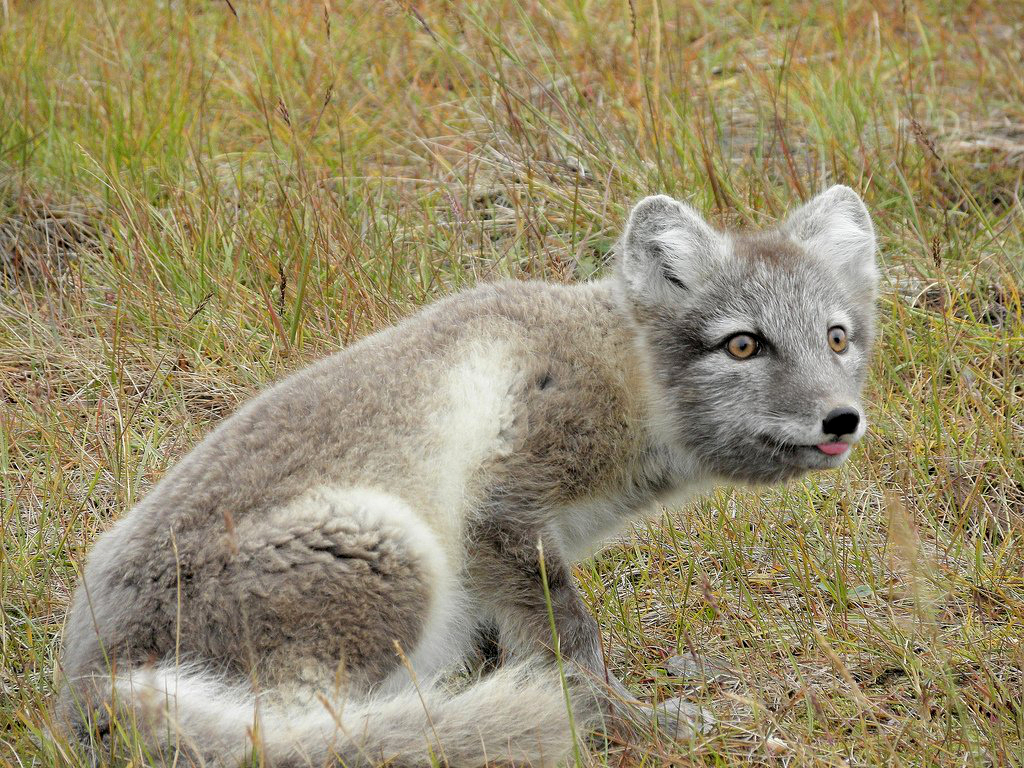
Arctic Fox (Vulpes lagopus) is a small fox native to the circumpolar tundra. Its thick winter coat covers even the paw pads, while short ears, a rounded body and bushy tail reduce heat loss. Some individuals turn white in winter; the blue color morph remains dark gray-brown all year. This guide separates well-supported biology from common assumptions and covers identification, range, habitat, diet, behavior, reproduction and conservation.
Identification
A rounded body, short muzzle, small ears, short legs and exceptionally bushy tail create a compact cold-adapted shape. The white morph is brown or gray in summer and becomes almost entirely white in winter. The blue morph ranges from charcoal to brown throughout the year. Fur covers the soles, inspiring the name lagopus, meaning hare-footed. The tail lacks the black tip typical of many red foxes. Males average slightly larger and heavier than females, but coat morph and seasonal color do not identify sex reliably.
Identification should combine body shape, markings, size, voice or movement, and location. One feature by itself can overlap with a related animal, a juvenile, or an individual in unusual light.
Photographs are most useful when they preserve scale and show several diagnostic features. Handling or repositioning a wild arctic fox for identification can cause stress and is unnecessary.
Size and physical adaptations
Arctic Fox typically measures about 46–68 cm head and body and weighs commonly about 2.5–8 kg. Mass changes strongly with sex, region, season and food supply. Foxes accumulate fat before winter and can lose it during lean periods.
Its useful adaptations include dense multilayer fur provides extreme insulation, fur-covered paw pads grip snow and limit heat loss, small ears reduce exposed surface area, a short muzzle and rounded body conserve warmth, seasonal coat color provides camouflage, a bushy tail wraps around the face while resting, food caching bridges periods of scarcity, fat reserves support winter survival. These traits work together in the animal’s normal setting rather than serving as isolated curiosities.
Published measurements may use different methods, life stages or sample locations. Comparing figures responsibly means checking what was measured rather than selecting the largest number available.
Range and distribution
Circumpolar Arctic tundra across Alaska, northern Canada, Greenland, Iceland, Svalbard and northern Eurasia, including Russia and the Scandinavian mountains. Sea ice historically linked islands and continental coasts, allowing long-distance movement. Some isolated island subspecies have much smaller distributions than the global map suggests. The native range includes United States, Canada, Greenland, Iceland, Norway, Sweden, Finland, Russia.
A country-level map indicates broad distribution, not continuous occupation. Climate, elevation, water, vegetation, prey, breeding sites, barriers and survey effort all affect where records occur.
Records near the edge of the range deserve careful documentation because they may reflect natural movement, improved survey coverage, accidental transport or a genuine distribution change.
Habitat
Treeless tundra, coastal cliffs, rocky uplands, barrier islands, pack ice and alpine tundra above the northern tree line.
Inland foxes follow lemming-rich tundra and den in well-drained mounds or slopes. Coastal animals forage along beaches, seabird colonies and sea ice, sometimes following polar bears for remains. Seasonal movement can cover hundreds or thousands of kilometers. Dens may contain many entrances and tunnel chambers and can be reused by generations for centuries, enriching surrounding vegetation with prey remains and waste. Protecting a population therefore requires the feeding, shelter and breeding features that make a site usable, along with connections that allow movement.
Microhabitat matters. Shade, soil, current, moisture, shelter or host plants can determine whether a small area is usable even when the surrounding landscape appears suitable.
Diet and feeding
Arctic Fox is a omnivore. Important foods include lemmings and voles, seabirds and eggs, fish and marine invertebrates, seal carcasses, reindeer carrion, insects, berries and seaweed. Arctic foxes listen for rodents beneath snow, leap and plunge headfirst through the crust. When lemmings are abundant, they hunt intensively and cache surplus prey around the den. Coastal foxes raid seabird colonies, search shorelines and scavenge carcasses left by polar bears or hunters. A flexible diet helps during winter, but severe prey crashes can still reduce survival and reproduction.
Diet changes with age, season, location and food supply. A dramatic prey record does not establish what most individuals eat most of the time; repeated field observations provide a stronger picture.
Feeding opportunities also create risk. An animal focused on prey may be less alert to predators, traffic or people, while contaminated prey can transfer pollutants through the food web.
Behavior and communication
Active by day and night throughout the year; does not hibernate. Pairs establish breeding territories around large dens, while nonbreeding foxes may travel widely and live more nomadically. Family groups can include a breeding pair, pups and occasionally a helper female. Foxes investigate scents, bury food and use elevated ground to scan the tundra. In winter they shelter behind terrain, inside dens or curled beneath the tail rather than entering true hibernation.
Barks, yelps, growls and whines carry information between mates, pups and rivals. Urine, feces and gland scents mark routes, food caches and breeding areas. Ear position, tail carriage and posture signal submission or threat at close range. Excellent hearing locates prey beneath snow, while smell guides scavenging over long distances. Behavior should be interpreted in context: alarm, courtship, feeding and temperature regulation can produce very different actions from the same animal.
Daily schedules are flexible responses, not rigid rules. Weather, breeding condition, disturbance, tides or food can move activity into a different part of the day.
Reproduction and development
Mating occurs in late winter. Pairs occupy a den as snow melts, and the female gives birth after roughly seven to eight weeks. Litter size responds strongly to prey supply: during a lemming peak, Arctic foxes can produce among the largest litters of any carnivore; after a crash, breeding may fail. Both parents deliver food and defend the den. Often 5–8 pups, but can exceed 15 in exceptional prey-rich years Pups are born blind and dark-furred inside the den. They open their eyes after roughly two weeks and emerge several weeks later. Adults cache small prey near entrances so pups practice handling food. Weaning occurs through summer, and juveniles disperse before or during autumn. Many young do not survive their first winter, especially when rodents are scarce.
Young animals face different risks and may use different microhabitats or food than adults. Breeding success depends on adult condition, suitable sites and the survival of offspring through vulnerable early stages.
Counts of eggs or young describe reproductive output, not the number expected to reach adulthood. Mortality is normally greatest during eggs, larval or juvenile stages.
Predators and ecological role
Arctic fox numbers can rise and fall with lemming cycles, affecting birds and other prey. Foxes move nutrients from coasts and carcasses to den soils, where vegetation often grows greener and richer than surrounding tundra. They compete with larger red foxes, which kill Arctic foxes and occupy dens. Polar bears, wolves, golden eagles and wolverines can also kill them. Documented or likely predators include Red Fox, Gray Wolf, Golden Eagle, Wolverine, Polar Bear, Humans.
This animal is both a consumer and a food source. Its influence comes through many repeated interactions, so ecological claims should be based on measured populations rather than assumptions drawn from appearance.
Predator and prey relationships differ among places. A species can be ecologically influential without being abundant everywhere, and its role can change across its range.
Relationship with people
Arctic fox fur supported Indigenous clothing traditions and later commercial trapping across the north. Fox farms and historic introductions altered some island ecosystems. Today, tourism and research value the species, while food conditioning near settlements creates conflict and disease risk. Scandinavian conservation uses supplementary feeding, red fox control and captive breeding to support critically small regional populations.
Never feed or approach an Arctic fox. Secure food and waste, keep dogs leashed and vaccinated, and give den sites a wide berth. A fox acting unusually tame, aggressive or uncoordinated may carry rabies in some regions; avoid contact and notify local authorities. Do not touch carcasses or handle trapped animals without professional equipment. Responsible observation means keeping an appropriate distance, avoiding capture or feeding, protecting habitat and following local wildlife or invasive-species guidance.
Wildlife guidance should come from the responsible local agency because collection rules, reporting requests and appropriate responses differ between native and introduced ranges.
Conservation
The IUCN lists the species globally as Least Concern because it remains widespread. This masks severe regional risk: the small Fennoscandian population has required intensive recovery work, and isolated island subspecies may face distinct threats. The reported global trend is Globally stable with strong regional and cyclical variation.
Important pressures include rapid arctic warming, northward expansion of red foxes, loss and thinning of sea ice, lemming-cycle disruption, disease and parasites, unsustainable harvest in some areas, small-population inbreeding on islands and in fennoscandia. Global status can hide local decline or recovery, so current regional monitoring and habitat management remain necessary.
The most useful conservation action follows the documented pressure. Protecting breeding sites, reducing road deaths or limiting pollutants can require different tools in different populations.
The Arctic Fox changes coat and behavior with tundra seasons; compare it with the desert-adapted Fennec Fox and widespread Red Fox.