
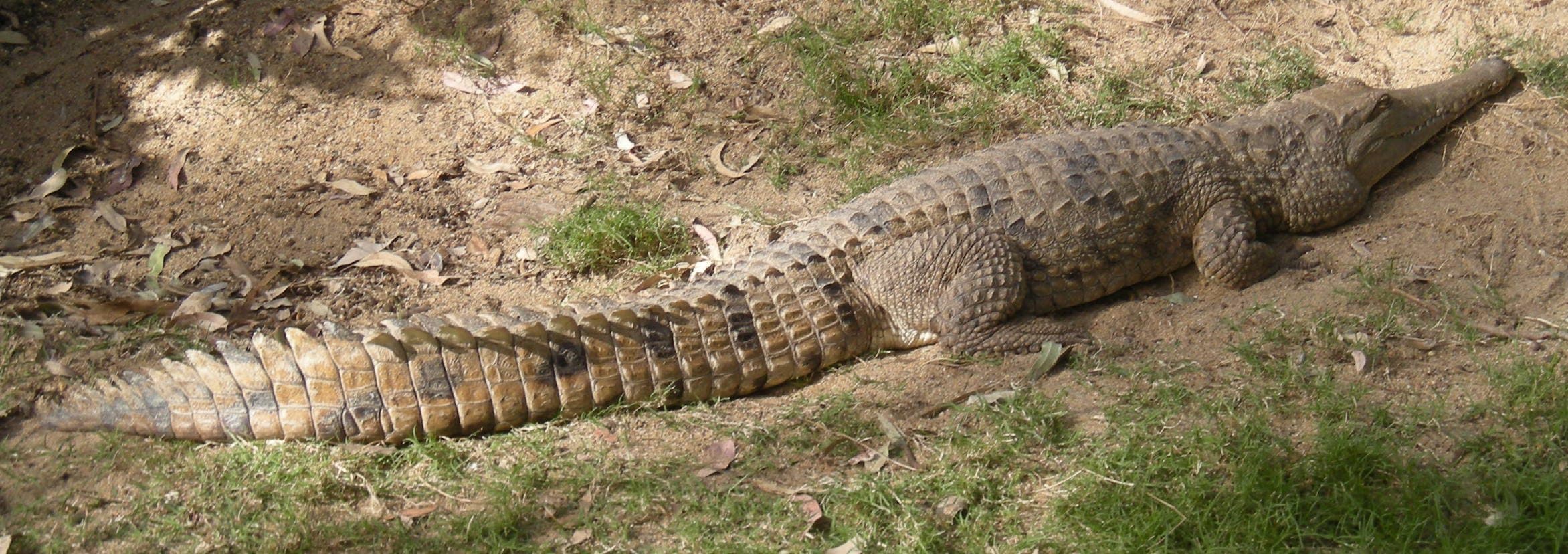
Freshwater Crocodile (Crocodylus johnstoni) is the species Crocodylus johnstoni, an Australian endemic adapted to seasonal freshwater. Smaller and lighter than the Saltwater Crocodile, it feeds mainly on fish and other modest prey. It remains a powerful wild predator and must always be given space. This guide separates well-supported biology from common assumptions and covers identification, range, habitat, diet, behavior, reproduction and conservation.
Identification
A long narrow snout, relatively small head and lightly built body distinguish this species from the broad, heavy Saltwater Crocodile. Adults are grey, olive or tan-brown with darker bands and blotches. Eyes and nostrils sit high on the head, and conical teeth remain visible when the jaws close. Raised scutes armor the back and the muscular tail forms nearly half the total length. Adult males grow markedly longer and heavier than females. The sexes otherwise share the same narrow snout, banded color pattern and armored body.
Identification should combine body shape, markings, size, voice or movement, and location. One feature by itself can overlap with a related animal, a juvenile, or an individual in unusual light.
Photographs are most useful when they preserve scale and show several diagnostic features. Handling or repositioning a wild freshwater crocodile for identification can cause stress and is unnecessary.
Size and physical adaptations
Freshwater Crocodile typically measures females commonly 1.8–2.1 m; males commonly 2.3–3 m and weighs adult females often 20–40 kg; large males roughly 60–100 kg. Exceptional males may exceed 3 m, but most animals are much smaller and more slender than adult saltwater crocodiles.
Its useful adaptations include long narrow jaws seize fish, high-set eyes and nostrils permit concealed watching, webbed hind feet aid maneuvering, muscular tail drives swimming, armored scutes protect the back, burrows provide dry-season shelter, strong homing returns adults to seasonal refuges. These traits work together in the animal’s normal setting rather than serving as isolated curiosities.
Published measurements may use different methods, life stages or sample locations. Comparing figures responsibly means checking what was measured rather than selecting the largest number available.
Range and distribution
The species is endemic to tropical northern Australia, from the Kimberley region of Western Australia across the Northern Territory to Cape York and parts of northwestern Queensland. Its distribution follows suitable river systems, floodplains and permanent dry-season pools. The native range includes Australia.
A country-level map indicates broad distribution, not continuous occupation. Climate, elevation, water, vegetation, prey, breeding sites, barriers and survey effort all affect where records occur.
Records near the edge of the range deserve careful documentation because they may reflect natural movement, improved survey coverage, accidental transport or a genuine distribution change.
Habitat
Freshwater rivers, creeks, billabongs, lagoons, swamps, floodplains, rocky gorges and occasionally brackish water.
Wet-season floods let crocodiles spread across connected floodplains. As water retreats, they gather in deeper pools and river reaches, often returning to the same dry-season refuge in successive years. Individuals bask on sandbanks and rocks, rest in shallow margins and may shelter in burrows beneath banks or tree roots. They tolerate some brackish water, despite the common name. Protecting a population therefore requires the feeding, shelter and breeding features that make a site usable, along with connections that allow movement.
Microhabitat matters. Shade, soil, current, moisture, shelter or host plants can determine whether a small area is usable even when the surrounding landscape appears suitable.
Diet and feeding
Freshwater Crocodile is a opportunistic carnivore centered on fish and aquatic prey. Important foods include fish, crustaceans, aquatic insects, frogs, small reptiles, birds, small mammals. Young animals take insects, tadpoles, crustaceans and small fish in shallow water. Adults sweep the narrow jaws sideways through fish schools, snap at frogs and seize prey at the bank. They may also take birds, reptiles and small mammals, but their slender jaws are built for quick modest prey rather than the very large animals handled by saltwater crocodiles.
Diet changes with age, season, location and food supply. A dramatic prey record does not establish what most individuals eat most of the time; repeated field observations provide a stronger picture.
Feeding opportunities also create risk. An animal focused on prey may be less alert to predators, traffic or people, while contaminated prey can transfer pollutants through the food web.
Behavior and communication
Mostly nocturnal feeding with daytime basking; activity shifts with temperature and water level. Freshwater Crocodiles bask to warm the body and cool by entering water or holding the mouth open. They are usually shy and retreat when approached, yet cornered animals defend themselves. Strong dry-season site fidelity coexists with wet-season dispersal. On land they can high-walk and briefly gallop, while in water the tail supplies most propulsion.
Adults use bellows, growls, hisses, head slaps and water vibration. Visual postures display body size and intent. Hatchlings call from the nest before emergence, prompting the female to excavate and guard them. Touch and close positioning matter during courtship, while chemical cues help animals interpret occupied habitat. Behavior should be interpreted in context: alarm, courtship, feeding and temperature regulation can produce very different actions from the same animal.
Daily schedules are flexible responses, not rigid rules. Weather, breeding condition, disturbance, tides or food can move activity into a different part of the day.
Reproduction and development
Courtship occurs as water levels fall. Females excavate a hole nest in sand or friable soil near water and lay hard-shelled eggs. Nest temperature influences embryo development and sex. Flooding, overheating, drying and predators cause heavy egg loss, so nesting position and seasonal timing strongly affect success. Usually about 4–20 eggs, often around 12 Hatchlings call before emerging. The female may open the nest and escort or carry young toward water, then guard the nursery area for a period. Juveniles grow on insects, crustaceans and small fish and suffer high predation. Survivors mature over many years, with males continuing to grow larger than females.
Young animals face different risks and may use different microhabitats or food than adults. Breeding success depends on adult condition, suitable sites and the survival of offspring through vulnerable early stages.
Counts of eggs or young describe reproductive output, not the number expected to reach adulthood. Mortality is normally greatest during eggs, larval or juvenile stages.
Predators and ecological role
This crocodile is a top or mid-level predator in northern Australian fresh waters. It regulates fish and other aquatic prey while eggs and hatchlings feed goannas, pigs, birds, turtles and larger crocodiles. Adults transfer nutrients between river, bank and floodplain habitats. Their persistence also signals connected seasonal waterways and secure dry-season refuges. Documented or likely predators include Saltwater Crocodile, Mertens Water Monitor, Feral Pig, White-bellied Sea Eagle, Human.
This animal is both a consumer and a food source. Its influence comes through many repeated interactions, so ecological claims should be based on measured populations rather than assumptions drawn from appearance.
Predator and prey relationships differ among places. A species can be ecologically influential without being abundant everywhere, and its role can change across its range.
Relationship with people
Freshwater Crocodiles feature in northern Australian ecosystems, Indigenous knowledge and wildlife tourism. They are generally less aggressive than saltwater crocodiles, but bites have occurred after people approached, handled or surprised them. People should obey local closure signs, keep away from banks and nests, supervise children and pets, and treat every crocodile habitat as wild.
Never swim or wade where authorities warn of crocodiles, and never feed or approach one. Keep well back from the water edge and do not assume a narrow-snouted crocodile is harmless. A defensive bite can cause severe laceration and infection. In northern Australia, follow ranger advice because saltwater crocodiles can enter the same freshwater systems. Responsible observation means keeping an appropriate distance, avoiding capture or feeding, protecting habitat and following local wildlife or invasive-species guidance.
Wildlife guidance should come from the responsible local agency because collection rules, reporting requests and appropriate responses differ between native and introduced ranges.
Conservation
The IUCN lists the Freshwater Crocodile as Least Concern, and legal protection allowed recovery after commercial hunting ended. Local populations still face invasive cane-toad poisoning, entanglement, habitat alteration, nest predation and conflict. Stable status does not eliminate the need for monitoring. The reported global trend is Generally stable overall, with serious declines or slow recovery in some cane-toad-affected populations.
Important pressures include cane toad poisoning, fishing-net entanglement, habitat alteration, feral pig nest predation, road mortality, illegal killing, climate-driven flood and nesting changes. Global status can hide local decline or recovery, so current regional monitoring and habitat management remain necessary.
The most useful conservation action follows the documented pressure. Protecting breeding sites, reducing road deaths or limiting pollutants can require different tools in different populations.