
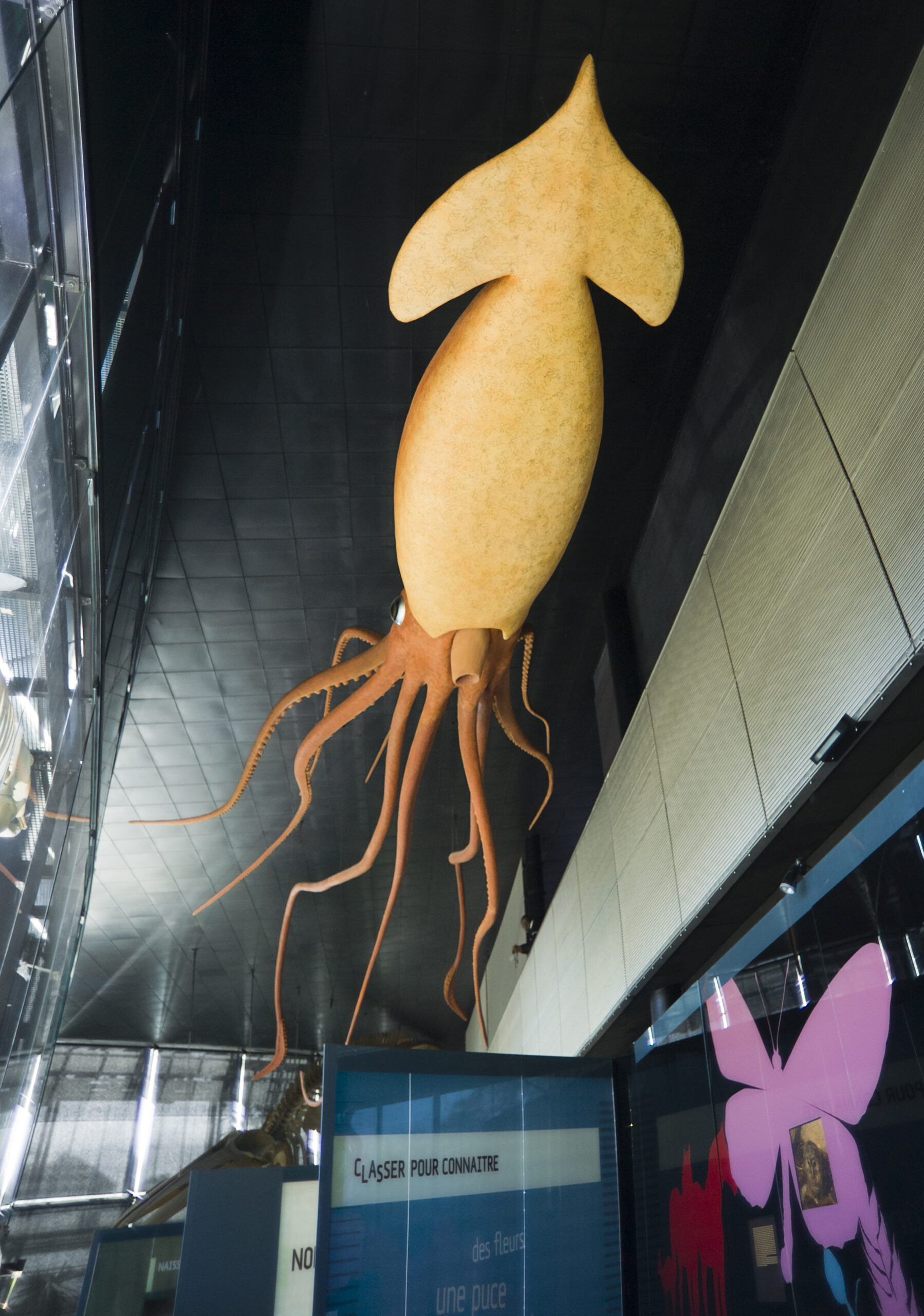
Giant Squid (Architeuthis dux) is one of the largest living invertebrates and among the least frequently observed large animals. It inhabits deep offshore water across much of the world, where darkness and pressure make direct study difficult. Most knowledge comes from stranded bodies, fishery bycatch, sperm-whale stomachs and a small number of live recordings. Its streamlined mantle, powerful fins, enormous eyes and long clubbed tentacles suit an active life in the dim ocean. This guide separates well-supported biology from common assumptions and covers identification, range, habitat, diet, behavior, reproduction and conservation.
Identification
A Giant Squid has a long muscular mantle, triangular terminal fins, eight shorter arms and two feeding tentacles that may extend far beyond the body. Each tentacle ends in an expanded club bearing toothed suckers. The arms also carry suckers with serrated rings. Its skin is reddish or maroon over pale tissue, and the paired eyes may approach dinner-plate size. A hard beak sits at the center of the arm crown. Females grow substantially larger than males. Mature males possess specialized reproductive structures and generally have shorter total length and lower mass.
Identification should combine body shape, markings, size, voice or movement, and location. One feature by itself can overlap with a related animal, a juvenile, or an individual in unusual light.
Photographs are most useful when they preserve scale and show several diagnostic features. Handling or repositioning a wild giant squid for identification can cause stress and is unnecessary.
Size and physical adaptations
Giant Squid typically measures Females may reach about 13 m total length; body and arms are much shorter than the extensible tentacles and weighs Large females commonly several hundred kilograms; reliable records are below a metric ton. Total length is easy to exaggerate because damaged tentacles stretch; mantle length is the more dependable scientific measure.
Its useful adaptations include enormous eyes gather faint light, two long tentacles strike distant prey, toothed sucker rings hold slippery animals, jet propulsion enables rapid movement, fins provide controlled swimming, ammonium-rich tissues aid buoyancy, copper-based hemocyanin carries oxygen in cold water, ink may interrupt an attack. These traits work together in the animal’s normal setting rather than serving as isolated curiosities.
Published measurements may use different methods, life stages or sample locations. Comparing figures responsibly means checking what was measured rather than selecting the largest number available.
Range and distribution
Giant Squid records occur in deep temperate and subtropical waters of the Atlantic, Pacific and Indian oceans. Strandings and captures cluster near continental slopes, submarine canyons and productive current systems, including waters near Newfoundland, northern Europe, Japan, New Zealand, southern Africa and South America. The species is not a shallow coastal resident despite occasional strandings. The native range includes United States, Canada, Mexico, Brazil, Argentina, South Africa, Spain, Portugal, United Kingdom, Ireland, Norway, Russia, Japan, New Zealand, Australia.
A country-level map indicates broad distribution, not continuous occupation. Climate, elevation, water, vegetation, prey, breeding sites, barriers and survey effort all affect where records occur.
Records near the edge of the range deserve careful documentation because they may reflect natural movement, improved survey coverage, accidental transport or a genuine distribution change.
Habitat
Mesopelagic and bathypelagic open ocean, often along continental slopes and canyons at several hundred to more than one thousand meters depth.
Depth use likely changes with body size, prey and time of day. Juveniles occur nearer the upper ocean, while adults occupy darker slope water. Neutral or weakly positive buoyancy helps the squid hold position without constant fast swimming. Rare surface appearances usually involve injured, disoriented or dying animals rather than normal habitat choice. Protecting a population therefore requires the feeding, shelter and breeding features that make a site usable, along with connections that allow movement.
Microhabitat matters. Shade, soil, current, moisture, shelter or host plants can determine whether a small area is usable even when the surrounding landscape appears suitable.
Diet and feeding
Giant Squid is a carnivore. Important foods include deep-sea fishes, hoki and other grenadiers, orange roughy, other squids, small schooling fishes, crustaceans eaten mainly by juveniles. The squid detects movement with its large eyes, extends two elastic tentacles and seizes prey with the toothed suckers on their terminal clubs. The tentacles retract toward the eight arms, which control the catch. A strong beak slices tissue, and a rasping radula moves pieces into the digestive tract. Stomach contents show fish and cephalopod prey rather than attacks on ships or whales.
Diet changes with age, season, location and food supply. A dramatic prey record does not establish what most individuals eat most of the time; repeated field observations provide a stronger picture.
Feeding opportunities also create risk. An animal focused on prey may be less alert to predators, traffic or people, while contaminated prey can transfer pollutants through the food web.
Behavior and communication
Deep-water activity is poorly known; live observations show controlled swimming and active tentacle strikes. Direct behavior has rarely been witnessed. Video shows that Giant Squid can approach bait horizontally, spread their arms and use the long tentacles in a rapid attack. They swim by undulating their fins and expelling water through a funnel, reversing direction when necessary. Pigment cells allow shifts in redness and contrast. Circular sucker scars on sperm whales document repeated predator-prey encounters but do not indicate that squid hunt whales.
Communication has not been documented in the wild. Like other open-ocean squids, Giant Squid may use changes in skin color and body posture at close range, but darkness limits long-distance visual display. Chemical cues probably assist recognition and reproduction. Much of the nervous system coordinates rapid mantle contractions, fin movement, eyes, arms and tentacles rather than social behavior. Behavior should be interpreted in context: alarm, courtship, feeding and temperature regulation can produce very different actions from the same animal.
Daily schedules are flexible responses, not rigid rules. Weather, breeding condition, disturbance, tides or food can move activity into a different part of the day.
Reproduction and development
Reproduction remains poorly observed. Males produce packets of sperm called spermatophores and apparently implant them into or beneath a female’s skin using a specialized terminal organ. Females carry enormous ovaries with millions of small eggs. Fertilization and spawning have not been witnessed, and scientists do not yet know whether eggs are released in gelatinous masses or by another method. Potentially millions of small eggs Eggs hatch into small paralarvae that live higher in the water column than adults. Young squid grow quickly, feeding first on small crustaceans and fishes before shifting to larger deep-water prey. Statolith growth rings suggest a surprisingly short life for such a large animal, with rapid maturation and likely a single major reproductive period.
Young animals face different risks and may use different microhabitats or food than adults. Breeding success depends on adult condition, suitable sites and the survival of offspring through vulnerable early stages.
Counts of eggs or young describe reproductive output, not the number expected to reach adulthood. Mortality is normally greatest during eggs, larval or juvenile stages.
Predators and ecological role
Giant Squid convert deep-water fish and squid biomass into prey for sperm whales, their best-known predator. Beaks accumulate in whale stomachs because chitin resists digestion, providing important evidence of distribution. Sleeper sharks, pilot whales and large predatory fishes may also take juveniles or weakened adults. Carcasses falling to the seabed feed scavengers and return nutrients to deep-ocean communities. Documented or likely predators include Sperm Whale, Southern Sleeper Shark, Pilot Whale, Human.
This animal is both a consumer and a food source. Its influence comes through many repeated interactions, so ecological claims should be based on measured populations rather than assumptions drawn from appearance.
Predator and prey relationships differ among places. A species can be ecologically influential without being abundant everywhere, and its role can change across its range.
Relationship with people
For centuries, incomplete carcasses helped inspire sea-monster stories. Today, specimens from strandings and fisheries are valuable scientific material, revealing genetics, anatomy, diet and age. The species is not normally targeted commercially because it is rare and its ammonium-rich flesh is unpalatable. Deep-sea cameras, environmental DNA and careful reporting by fishing crews now allow research with less dependence on damaged bodies.
A living Giant Squid is extremely unlikely to encounter a swimmer because its normal habitat is deep offshore water. Captured animals have powerful suckers, toothed rings and a beak, so only trained researchers should handle them. Boaters should report strandings or carcasses to a museum or marine authority and avoid towing, cutting or collecting parts without permission. Responsible observation means keeping an appropriate distance, avoiding capture or feeding, protecting habitat and following local wildlife or invasive-species guidance.
Wildlife guidance should come from the responsible local agency because collection rules, reporting requests and appropriate responses differ between native and introduced ranges.
Conservation
The IUCN assessment lists the Giant Squid as Least Concern, reflecting its enormous range rather than a precise population census. Deep habitat makes abundance difficult to measure. Fishery bycatch, ocean warming, deoxygenation and prey shifts deserve monitoring because local change could remain hidden for years. The reported global trend is Unknown; there is no reliable global time series.
Important pressures include bycatch in deep-water trawls, ocean warming and changing oxygen zones, pollution and persistent contaminants, changes in deep-sea fish prey, underreporting of captures, noise and disturbance in poorly studied habitat. Global status can hide local decline or recovery, so current regional monitoring and habitat management remain necessary.
The most useful conservation action follows the documented pressure. Protecting breeding sites, reducing road deaths or limiting pollutants can require different tools in different populations.
The Giant Squid is a ten-limbed deep-sea cephalopod; compare its anatomy with the eight-armed Giant Pacific Octopus and detritus-feeding Vampire Squid.