
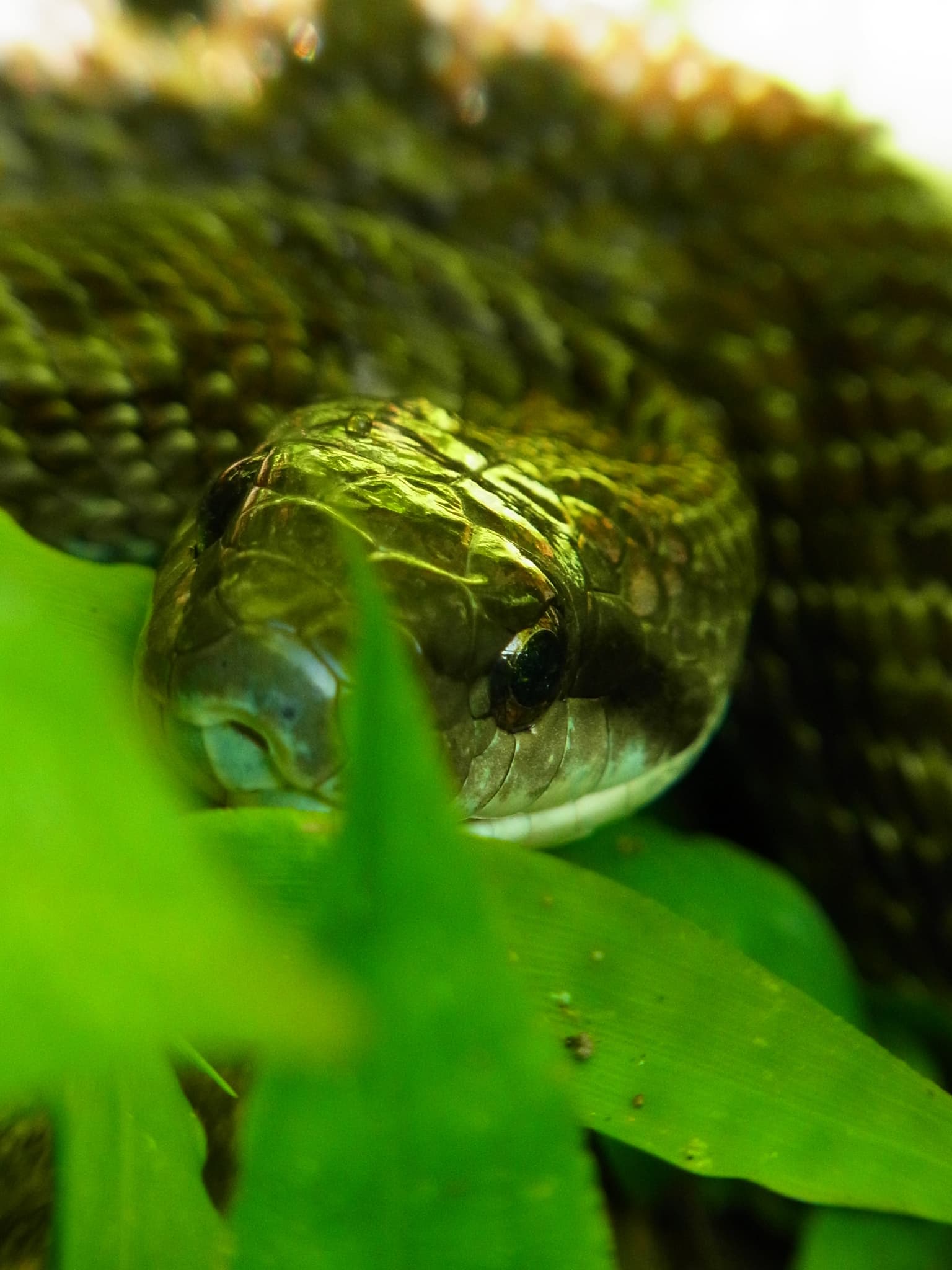
Japanese Rat Snake (Elaphe climacophora) is Elaphe climacophora, a nonvenomous constrictor native to the Japanese archipelago and Kunashir Island. Its Japanese name aodaisho means blue general, reflecting the blue-green cast of many adults. An agile climber, it follows rodents and birds into trees, barns, roof spaces and traditional buildings. This guide separates well-supported biology from common assumptions and covers identification, range, habitat, diet, behavior, reproduction and conservation.
Identification
Adults are long and moderately robust, colored olive green, gray-green, blue-gray or brown. Four faint dark longitudinal stripes often run down the back, while juveniles show stronger brown blotches that fade with age. The head is rectangular with round pupils and a dark eye stripe. The underside is pale yellow to cream, and keeled scales give the body grip. Males often have longer tails and may grow longer overall, while mature females become heavier through the body. Color and stripe intensity do not reliably identify sex.
Identification should combine body shape, markings, size, voice or movement, and location. One feature by itself can overlap with a related animal, a juvenile, or an individual in unusual light.
Photographs are most useful when they preserve scale and show several diagnostic features. Handling or repositioning a wild japanese rat snake for identification can cause stress and is unnecessary.
Size and physical adaptations
Japanese Rat Snake typically measures commonly 1–1.8 m; exceptional island animals may exceed 2 m and weighs often about 500–1,500 g, with exceptional adults heavier. Body size varies among islands and habitats; exceptionally large individuals have been studied as possible island gigantism.
Its useful adaptations include constriction subdues rodents, keeled scales grip bark, long body bridges branches, chemical senses locate nests, flexible jaws swallow eggs, seasonal brumation survives cold winters, muted color blends with woodland. These traits work together in the animal’s normal setting rather than serving as isolated curiosities.
Published measurements may use different methods, life stages or sample locations. Comparing figures responsibly means checking what was measured rather than selecting the largest number available.
Range and distribution
The species occurs across Japan’s main islands—Hokkaido, Honshu, Shikoku and Kyushu—and many nearby islands, extending north to Russian-administered Kunashir in the southern Kurils. It is absent from much of the far southwestern Ryukyu chain, where other endemic snakes occur. The native range includes Japan, Russia.
A country-level map indicates broad distribution, not continuous occupation. Climate, elevation, water, vegetation, prey, breeding sites, barriers and survey effort all affect where records occur.
Records near the edge of the range deserve careful documentation because they may reflect natural movement, improved survey coverage, accidental transport or a genuine distribution change.
Habitat
Deciduous and mixed forest, bamboo grove, river edge, rice field, farm, village garden, shrine woodland, barn and roof space.
Japanese Rat Snakes use the ground, shrubs, tree trunks and buildings. They enter cavities, attics and barns while following mice, rats and nesting birds. Stone walls, hollow trees and rock fissures offer shelter. In northern areas they spend winter in deep frost-free refuges, emerging to bask and forage when spring temperatures rise. Protecting a population therefore requires the feeding, shelter and breeding features that make a site usable, along with connections that allow movement.
Microhabitat matters. Shade, soil, current, moisture, shelter or host plants can determine whether a small area is usable even when the surrounding landscape appears suitable.
Diet and feeding
Japanese Rat Snake is a carnivorous constrictor of small vertebrates. Important foods include mice, rats, voles, birds, bird eggs, frogs, lizards. The snake follows scent trails into burrows, roof spaces and tree nests. It grips prey with recurved teeth, wraps coils around mammals or birds and tightens until circulation stops. Eggs may be swallowed whole and broken internally. Juveniles begin with frogs, lizards and newborn rodents before taking larger warm-blooded prey.
Diet changes with age, season, location and food supply. A dramatic prey record does not establish what most individuals eat most of the time; repeated field observations provide a stronger picture.
Feeding opportunities also create risk. An animal focused on prey may be less alert to predators, traffic or people, while contaminated prey can transfer pollutants through the food web.
Behavior and communication
Mostly diurnal and crepuscular in mild weather, shifting with heat; brumates through cold winters. This rat snake moves confidently on the ground and climbs bark, rafters and walls. It swims when crossing streams or flooded fields. Most flee when noticed. A cornered animal may flatten the neck, vibrate the tail, musk and strike. During winter several snakes may use suitable underground refuges in the same landscape.
Tongue flicks deliver chemical particles to the vomeronasal organ, revealing prey, predators and pheromone trails. Females attract males chemically in spring. Rival males use raised-body pushing contests. Tail vibration, musking, body kinking and striking communicate defense. Behavior should be interpreted in context: alarm, courtship, feeding and temperature regulation can produce very different actions from the same animal.
Daily schedules are flexible responses, not rigid rules. Weather, breeding condition, disturbance, tides or food can move activity into a different part of the day.
Reproduction and development
Mating follows spring emergence. Males track female pheromones and may engage in raised-body pushing contests. A female lays leathery eggs in warm, humid shelter such as decaying vegetation, a hollow log, compost, soil cavity or building recess. The eggs develop without parental attendance. Usually 7–20 eggs Hatchlings cut through the shell with an egg tooth and disperse without parental care. Their bold brown blotches offer camouflage in leaf litter and gradually fade into adult stripes. Growth depends on prey and local season length; northern snakes have shorter annual feeding periods.
Young animals face different risks and may use different microhabitats or food than adults. Breeding success depends on adult condition, suitable sites and the survival of offspring through vulnerable early stages.
Counts of eggs or young describe reproductive output, not the number expected to reach adulthood. Mortality is normally greatest during eggs, larval or juvenile stages.
Predators and ecological role
Japanese Rat Snakes are major predators of mice, rats and voles in forests, farms and settlements. They also take birds, eggs, frogs and lizards and serve as prey for eagles, owls, mammals and larger snakes. Their movement between fields, buildings and trees links human-modified landscapes with surrounding woodland food webs. Documented or likely predators include Mountain Hawk-Eagle, Ural Owl, Japanese Raccoon Dog, Japanese Weasel, Human.
This animal is both a consumer and a food source. Its influence comes through many repeated interactions, so ecological claims should be based on measured populations rather than assumptions drawn from appearance.
Predator and prey relationships differ among places. A species can be ecologically influential without being abundant everywhere, and its role can change across its range.
Relationship with people
The species often lives near people because farms and buildings support rodents. It is generally welcomed as natural pest control and appears in folklore and local nature education. Seal food and building gaps to prevent indoor visits. Never kill a snake based only on stripes or color; give it an escape route or contact a local wildlife professional.
Japanese Rat Snakes are nonvenomous. A restrained animal can bite and musk, producing punctures and scratches but no venom injury. Do not handle an unidentified snake because venomous species also occur in Japan. Wash any bite, control bleeding and seek medical care for deep wounds or infection. Responsible observation means keeping an appropriate distance, avoiding capture or feeding, protecting habitat and following local wildlife or invasive-species guidance.
Wildlife guidance should come from the responsible local agency because collection rules, reporting requests and appropriate responses differ between native and introduced ranges.
Conservation
The Japanese Rat Snake is widespread and considered secure overall, although island populations and local habitats can be vulnerable. Road mortality, building entrapment, persecution, development and illegal collection cause losses. The albino Iwakuni population receives special cultural and legal protection. The reported global trend is Generally stable overall with local declines and island vulnerability.
Important pressures include road mortality, habitat conversion, deliberate killing, building entrapment, illegal collection, loss of old trees, pesticide effects on prey. Global status can hide local decline or recovery, so current regional monitoring and habitat management remain necessary.
The most useful conservation action follows the documented pressure. Protecting breeding sites, reducing road deaths or limiting pollutants can require different tools in different populations.