
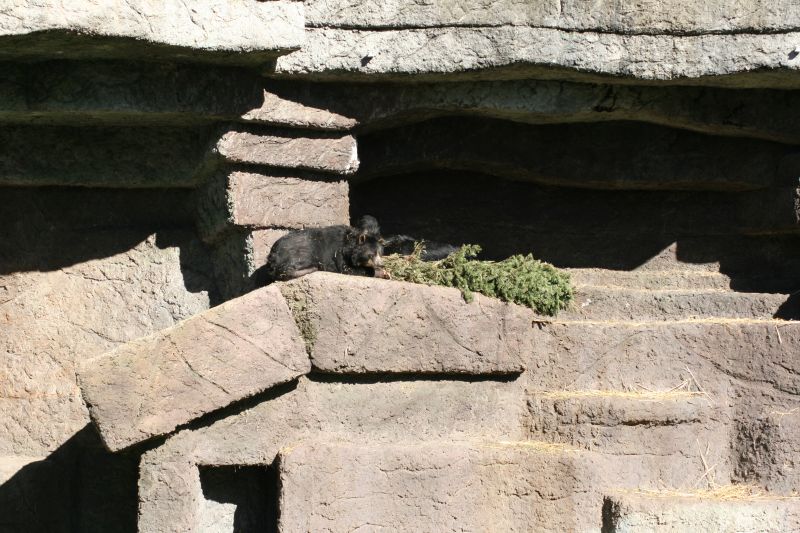
Spectacled Bear (Tremarctos ornatus) is a medium-sized bear native to the tropical Andes. Pale facial markings often form rings around the eyes, but every pattern is different and some bears have very little pale fur. This adaptable climber moves among cloud forest, dry forest, páramo and grassland as seasonal foods change. This guide separates well-supported biology from common assumptions and covers identification, range, habitat, diet, behavior, reproduction and conservation.
Identification
A stocky bear with thick black to dark-brown fur, a relatively short muzzle and small rounded ears. Cream, tan or whitish markings may circle the eyes and extend across the cheeks, throat and chest. These markings form an individual fingerprint rather than a fixed pair of spectacles. The front limbs are strong, the claws long and curved, and the feet plantigrade for climbing and digging. Adult males are much larger and heavier than females, sometimes approaching twice their mass. Both sexes can have facial markings, so color alone does not identify sex.
Identification should combine body shape, markings, size, voice or movement, and location. One feature by itself can overlap with a related animal, a juvenile, or an individual in unusual light.
Photographs are most useful when they preserve scale and show several diagnostic features. Handling or repositioning a wild spectacled bear for identification can cause stress and is unnecessary.
Size and physical adaptations
Spectacled Bear typically measures Head and body about 1.3–2.0 m and weighs Females often 35–82 kg; males commonly 100–175 kg. Size varies geographically and seasonally; large males can exceed typical values.
Its useful adaptations include long curved claws support climbing, powerful jaw muscles crush fibrous plants, broad molars grind bromeliads and palm tissues, dark thick fur insulates in cool cloud forest, individual facial markings aid visual identification, flexible diet tracks seasonal food, tree platforms provide feeding and resting sites, strong forelimbs tear apart tough vegetation. These traits work together in the animal’s normal setting rather than serving as isolated curiosities.
Published measurements may use different methods, life stages or sample locations. Comparing figures responsibly means checking what was measured rather than selecting the largest number available.
Range and distribution
Distributed discontinuously along the tropical Andes from western Venezuela through Colombia, Ecuador and Peru to Bolivia. Occasional reports occur near Panama and northern Argentina, but the secure core range lies in the five Andean countries. The native range includes Venezuela, Colombia, Ecuador, Peru, Bolivia.
A country-level map indicates broad distribution, not continuous occupation. Climate, elevation, water, vegetation, prey, breeding sites, barriers and survey effort all affect where records occur.
Records near the edge of the range deserve careful documentation because they may reflect natural movement, improved survey coverage, accidental transport or a genuine distribution change.
Habitat
Montane cloud forest, wet forest, elfin forest, dry inter-Andean forest, scrub, páramo and high grassland from low foothills to more than 4,000 m.
Bears move among elevation zones and vegetation types as fruit, bromeliads and other foods become available. Forest provides cover and climbing trees, while páramo and clearings provide seasonal forage. Connectivity is essential because roads, farms, mines and settlements can isolate feeding and breeding habitat. Protecting a population therefore requires the feeding, shelter and breeding features that make a site usable, along with connections that allow movement.
Microhabitat matters. Shade, soil, current, moisture, shelter or host plants can determine whether a small area is usable even when the surrounding landscape appears suitable.
Diet and feeding
Spectacled Bear is a omnivore with a strongly plant-based diet. Important foods include bromeliads, palm hearts, fruit, berries, cactus fruit, grasses, bulbs, corn, insects, small vertebrates, carrion. The bear tears open bromeliads, climbs for fruit, peels bark and digs for roots or bulbs. Strong jaws and broad cheek teeth process fibrous plant tissues. Animal food is opportunistic and varies locally. Crop raids, especially in maize fields, bring bears into conflict even though most of the natural diet is vegetation.
Diet changes with age, season, location and food supply. A dramatic prey record does not establish what most individuals eat most of the time; repeated field observations provide a stronger picture.
Feeding opportunities also create risk. An animal focused on prey may be less alert to predators, traffic or people, while contaminated prey can transfer pollutants through the food web.
Behavior and communication
Flexible; often crepuscular or nocturnal near people and more diurnal in quiet habitat. Adults usually travel alone except during courtship and when mothers accompany cubs. They are excellent climbers and can feed, rest or escape in trees. Bears leave claw marks, trails and feeding signs, and may build branch platforms. They do not undergo the deep winter hibernation typical of some temperate bears because food seasons differ in the tropical Andes.
Scent marks, scratches and feeding signs communicate presence across large home ranges. Close-range sounds include grunts, roars, growls and soft contact calls. Cubs vocalize to their mother, while posture, head position and direct approach communicate alarm or threat. Behavior should be interpreted in context: alarm, courtship, feeding and temperature regulation can produce very different actions from the same animal.
Daily schedules are flexible responses, not rigid rules. Weather, breeding condition, disturbance, tides or food can move activity into a different part of the day.
Reproduction and development
Males and females may remain together for one or two weeks during courtship. Mating can occur at different times, and delayed implantation helps align birth with favorable food conditions. The female prepares a secluded den and raises the litter without male help. Usually 1–2 cubs, occasionally 3 Cubs are born blind, nearly hairless and weighing only a few hundred grams. Their eyes open after about four to six weeks. They emerge from the den at roughly three months, learn climbing and foraging from the mother, and may remain with her for a year or more.
Young animals face different risks and may use different microhabitats or food than adults. Breeding success depends on adult condition, suitable sites and the survival of offspring through vulnerable early stages.
Counts of eggs or young describe reproductive output, not the number expected to reach adulthood. Mortality is normally greatest during eggs, larval or juvenile stages.
Predators and ecological role
Spectacled Bears disperse seeds over mountain slopes, open gaps while tearing vegetation and influence plant communities by feeding on bromeliads and palms. Protecting their large home ranges also safeguards Andean cloud forest water catchments and species such as Mountain Tapirs, Andean Condors and many endemic birds and amphibians. Documented or likely predators include Human, Jaguar, Puma, Domestic Dog.
This animal is both a consumer and a food source. Its influence comes through many repeated interactions, so ecological claims should be based on measured populations rather than assumptions drawn from appearance.
Predator and prey relationships differ among places. A species can be ecologically influential without being abundant everywhere, and its role can change across its range.
Relationship with people
The bear has deep cultural importance across the Andes and serves as a flagship for cloud-forest protection. Conflict arises when animals eat corn or are blamed for livestock deaths, some of which are unverified. Effective coexistence includes rapid investigation, crop protection, husbandry improvements, compensation where available and preserving natural foods away from farms.
Spectacled Bears usually avoid people, but any bear can injure when surprised or cornered. Never approach, feed or block one. Back away slowly, keep dogs restrained, secure food and crops, and follow local wildlife-authority guidance rather than attempting capture. Responsible observation means keeping an appropriate distance, avoiding capture or feeding, protecting habitat and following local wildlife or invasive-species guidance.
Wildlife guidance should come from the responsible local agency because collection rules, reporting requests and appropriate responses differ between native and introduced ranges.
Conservation
The IUCN lists the Spectacled Bear as Vulnerable. Habitat conversion for farming, grazing, mining, roads and energy development fragments its Andean range. Retaliatory killing, hunting and trade add mortality, while many protected areas are too isolated to support secure long-term populations. The reported global trend is Decreasing.
Important pressures include cloud-forest loss, agricultural expansion, mining and roads, habitat fragmentation, retaliatory killing, illegal hunting, climate-driven habitat shifts. Global status can hide local decline or recovery, so current regional monitoring and habitat management remain necessary.
The most useful conservation action follows the documented pressure. Protecting breeding sites, reducing road deaths or limiting pollutants can require different tools in different populations.
The Spectacled Bear is South America’s only living bear; compare its Andean plant-rich diet with the tropical Sun Bear.