
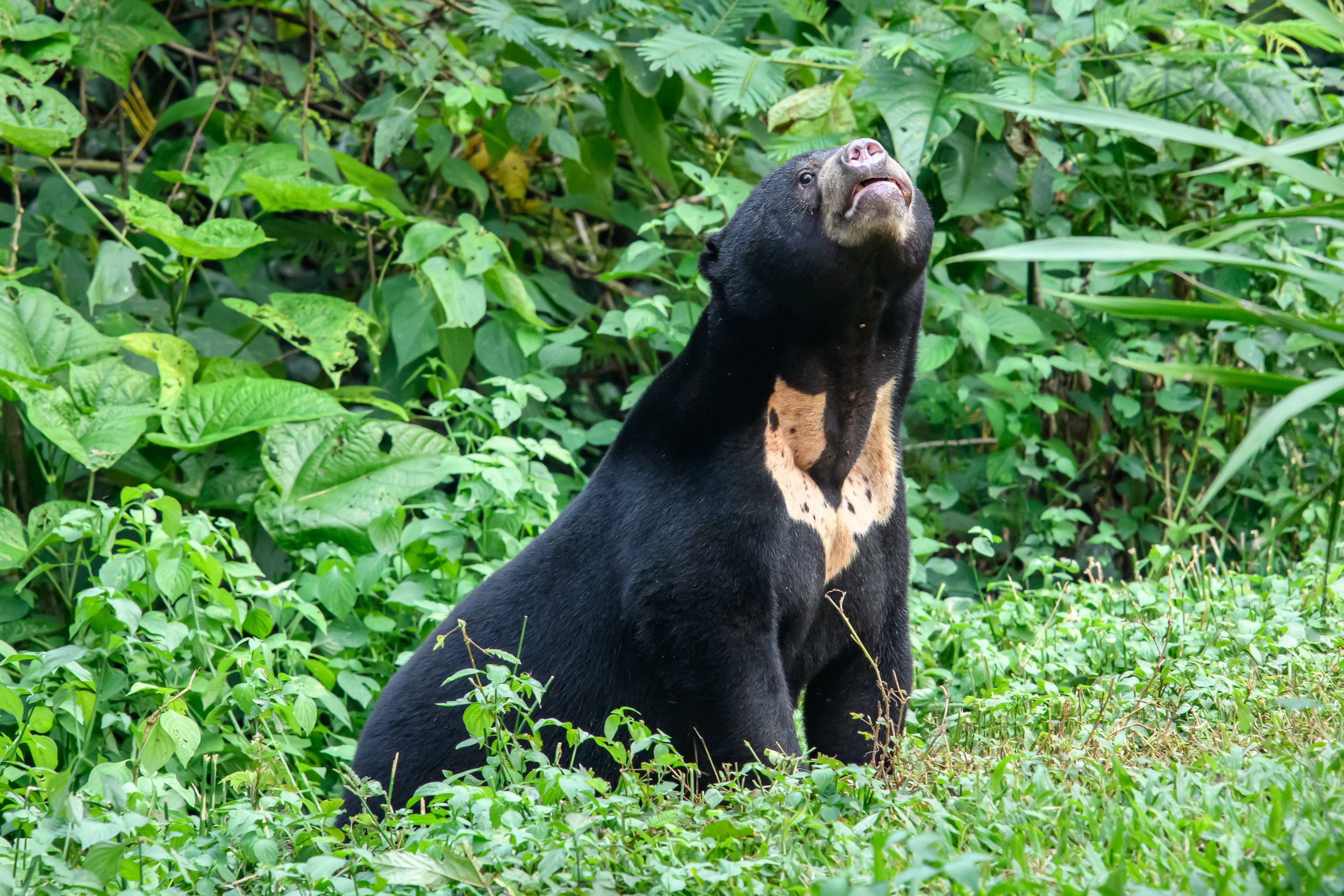
Sun Bear (Helarctos malayanus) is a compact forest bear of mainland Southeast Asia, Sumatra and Borneo. Its sleek black coat carries a pale chest crescent that inspired the English name. Powerful forelimbs, naked-soled paws and curved claws make it an agile climber, while a long tongue extracts termites, beetle larvae and honey from narrow cavities. This guide separates well-supported biology from common assumptions and covers identification, range, habitat, diet, behavior, reproduction and conservation.
Identification
The smallest living bear has a short broad muzzle, small round ears, inward-turned feet and a glossy black or dark-brown coat. Most individuals show a cream, yellow or orange horseshoe-shaped patch on the chest, but its form is unique and can be reduced or absent. The muzzle is pale, the tongue unusually long, and the front claws long and strongly curved. Males are commonly 10–20 percent larger than females, but both sexes share the same general coat pattern and climbing adaptations.
Identification should combine body shape, markings, size, voice or movement, and location. One feature by itself can overlap with a related animal, a juvenile, or an individual in unusual light.
Photographs are most useful when they preserve scale and show several diagnostic features. Handling or repositioning a wild sun bear for identification can cause stress and is unnecessary.
Size and physical adaptations
Sun Bear typically measures Head and body about 1.1–1.5 m and weighs Roughly 23–65 kg. Bornean sun bears average smaller than mainland animals, and adult males are heavier than females.
Its useful adaptations include long curved claws open trees and aid climbing, hairless soles grip trunks and branches, long tongue reaches insects and honey, powerful jaws crack nuts and woody nests, loose neck skin permits turning against an attacker, short dense coat protects in rain and branches, keen smell locates hidden food, chest patch can amplify defensive posture. These traits work together in the animal’s normal setting rather than serving as isolated curiosities.
Published measurements may use different methods, life stages or sample locations. Comparing figures responsibly means checking what was measured rather than selecting the largest number available.
Range and distribution
Survives in fragmented forests from northeastern India and Bangladesh through Myanmar, southern China and mainland Southeast Asia to Peninsular Malaysia, Sumatra and Borneo. It has disappeared from parts of its former range and is rare outside large forest blocks. The native range includes Bangladesh, India, China, Myanmar, Thailand, Laos, Cambodia, Vietnam, Malaysia, Brunei, Indonesia.
A country-level map indicates broad distribution, not continuous occupation. Climate, elevation, water, vegetation, prey, breeding sites, barriers and survey effort all affect where records occur.
Records near the edge of the range deserve careful documentation because they may reflect natural movement, improved survey coverage, accidental transport or a genuine distribution change.
Habitat
Lowland tropical rainforest, hill forest, swamp forest, seasonally dry evergreen forest and other dense tropical woodland with fruiting trees and dead wood.
Sun bears forage both on the ground and in the canopy, climbing for fruit, bee nests and safe resting platforms. Fallen logs and standing dead trees hold insect colonies. In undisturbed forest they can be active by day, but near people they often shift toward nighttime to avoid roads, hunters and farms. Protecting a population therefore requires the feeding, shelter and breeding features that make a site usable, along with connections that allow movement.
Microhabitat matters. Shade, soil, current, moisture, shelter or host plants can determine whether a small area is usable even when the surrounding landscape appears suitable.
Diet and feeding
Sun Bear is a opportunistic omnivore. Important foods include figs and other fruit, termites, ants, beetle larvae, honey, bee brood, earthworms, palm hearts, nuts, small vertebrates, carrion. The bear follows scent to fruit or insect nests, rips bark and rotten wood with its claws, and probes cavities with the tongue. Strong jaws open hard fruit and sometimes coconuts. Seasonal fruit drives movement, while termites, ants and larvae provide a more dependable resource when fruit is scarce.
Diet changes with age, season, location and food supply. A dramatic prey record does not establish what most individuals eat most of the time; repeated field observations provide a stronger picture.
Feeding opportunities also create risk. An animal focused on prey may be less alert to predators, traffic or people, while contaminated prey can transfer pollutants through the food web.
Behavior and communication
Cathemeral and flexible; often nocturnal where human disturbance is high. Adults usually forage alone, except mothers with cubs and temporary mating pairs. They climb rapidly and may sleep or sunbathe on branch platforms. Bears tear into logs, overturn soil and open cavities while feeding, leaving recognizable signs. Unlike northern bears, they do not hibernate because tropical food can remain available year-round.
Sun bears communicate through scent marks, scratches, body posture and varied sounds. Friendly contact may include clucking, while aggression brings barks, growls or roars. Cubs hum while nursing and cry or squawk for attention. The chest patch becomes prominent when a bear rears during confrontation. Behavior should be interpreted in context: alarm, courtship, feeding and temperature regulation can produce very different actions from the same animal.
Daily schedules are flexible responses, not rigid rules. Weather, breeding condition, disturbance, tides or food can move activity into a different part of the day.
Reproduction and development
Breeding can occur throughout the year. A female gives birth in a sheltered tree cavity, hollow log or dense ground nest. Pregnancy length varies in reports and may be influenced by delayed implantation or conditions, but direct wild data remain limited. Usually 1–2 cubs, occasionally 3 Cubs are born blind, nearly hairless and completely dependent, weighing only a few hundred grams. The mother nurses, warms and protects them, sometimes carrying a cub in her mouth or forepaws. Young begin active play after several months, are weaned around 18 months and may remain with the mother for about two years.
Young animals face different risks and may use different microhabitats or food than adults. Breeding success depends on adult condition, suitable sites and the survival of offspring through vulnerable early stages.
Counts of eggs or young describe reproductive output, not the number expected to reach adulthood. Mortality is normally greatest during eggs, larval or juvenile stages.
Predators and ecological role
Sun bears disperse seeds from many forest fruits and create cavities while opening trees for insects or honey. Those holes can later shelter other animals. Digging and log-breaking accelerate nutrient cycling, while predation on colonial insects influences forest invertebrate communities. Documented or likely predators include Tiger, Clouded Leopard, Reticulated Python, Human.
This animal is both a consumer and a food source. Its influence comes through many repeated interactions, so ecological claims should be based on measured populations rather than assumptions drawn from appearance.
Predator and prey relationships differ among places. A species can be ecologically influential without being abundant everywhere, and its role can change across its range.
Relationship with people
Sun bears raid oil palm, coconut and fruit crops when forest foods disappear, creating conflict. Cubs are captured for the illegal pet trade, often after mothers are killed, and adults are hunted for meat, paws or bile. Rescue centers care for confiscated bears, but release requires health screening, forest skills and secure habitat. Preventing capture is far better than lifetime sanctuary care.
A Sun Bear is small only compared with other bears. It has powerful jaws and long claws and can cause severe injury when cornered. Never feed, approach or keep one. Secure crops and waste, keep dogs controlled and contact wildlife authorities when conflict occurs. Responsible observation means keeping an appropriate distance, avoiding capture or feeding, protecting habitat and following local wildlife or invasive-species guidance.
Wildlife guidance should come from the responsible local agency because collection rules, reporting requests and appropriate responses differ between native and introduced ranges.
Conservation
The IUCN lists the Sun Bear as Vulnerable. Forest conversion, especially for industrial plantations, logging and roads, removes and fragments habitat. Hunting for body parts, bile and meat and capture for the pet trade continue across much of the range despite legal protection. The reported global trend is Decreasing.
Important pressures include deforestation, oil-palm expansion, logging and roads, illegal pet trade, hunting for bile and body parts, crop-conflict killing, forest fires. Global status can hide local decline or recovery, so current regional monitoring and habitat management remain necessary.
The most useful conservation action follows the documented pressure. Protecting breeding sites, reducing road deaths or limiting pollutants can require different tools in different populations.
For contrasts within the bear family, compare the Sun Bear with South America’s Spectacled Bear and the much larger Polar Bear.