
Home/Animals/Cephalopoda/Vampire Squid
Species profileIUCN: NE

Vampire Squid

Vampyroteuthis infernalis

A gentle deep-sea cephalopod that drifts through low-oxygen water, harvesting marine snow with two extraordinary filaments.

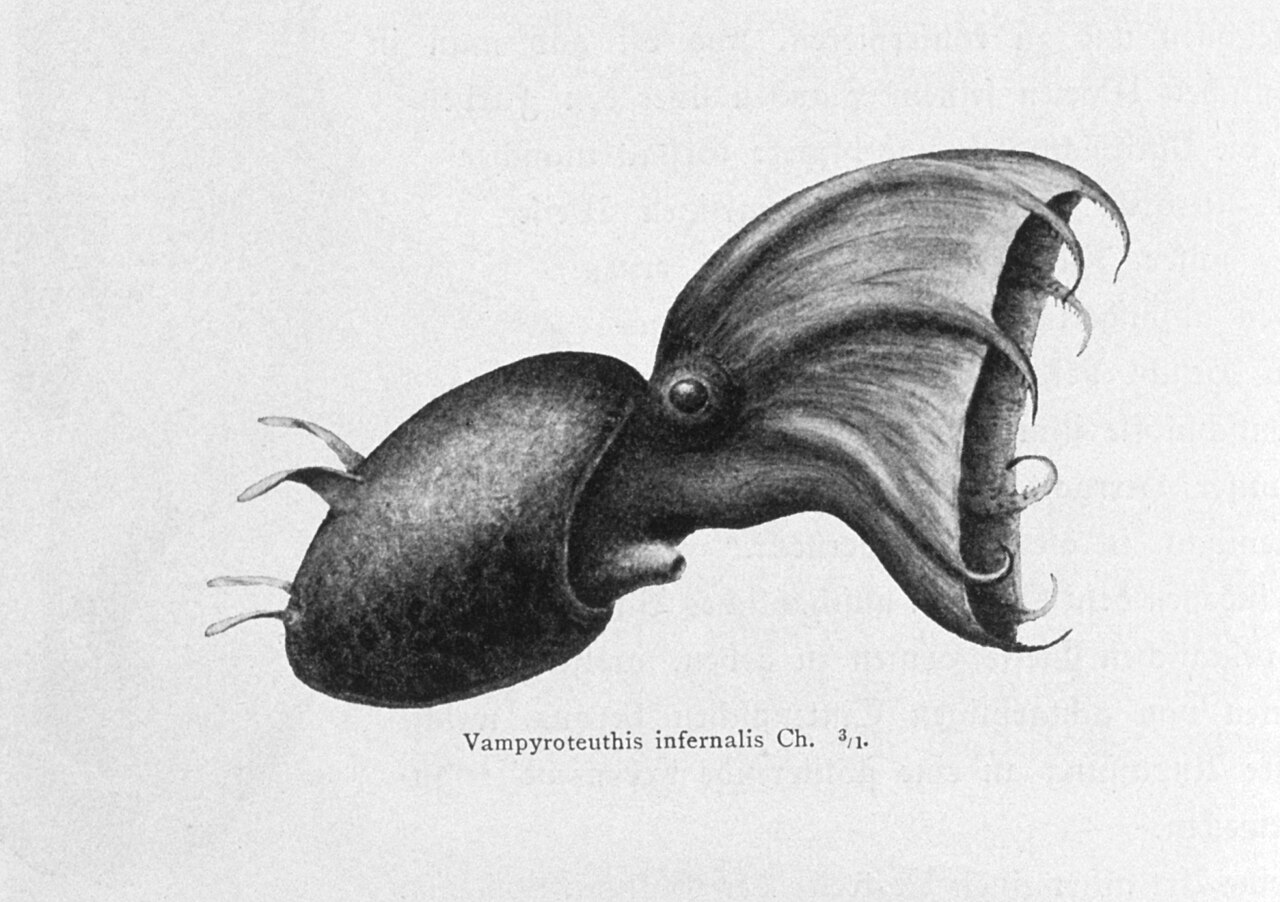
Scientific illustration of a vampire squid with webbed arms, paired fins and large eyes
Carl Chun / NOAA Photo Library / Public domain
🌐 Read in Language:

⚡ At a Glance

Species profile
Also Known As
Vampire squid from hell
Diet Category
Detritivore and opportunistic suspension feeder
Activity Rhythm
Slow-moving and continuously responsive in permanent darkness; activity is governed more by food and oxygen layers than by daylight at the surface.
Wild Lifespan
Exact wild lifespan is unknown but appears much longer than the one-to-two-year lives of many shallow-water cephalopods
Typical Weight
usually well under 1 kg; dependable wild mass ranges are scarce
Conservation Status
NE
💡 Key Biological Insight: Unlike known predatory cephalopods, the vampire squid can live mainly on sinking detritus called marine snow.

🌳 Scientific Taxonomy Hierarchy

Vampyroteuthis infernalis is the only living species in the family Vampyroteuthidae and order Vampyromorpha. It is an octopodiform cephalopod, closer to octopuses than to true squids, despite its common name and squid-like internal support.

KingdomAnimalia
PhylumMollusca
ClassCephalopoda
OrderVampyromorpha
FamilyVampyroteuthidae
GenusVampyroteuthis
SpeciesVampyroteuthis infernalis

Distinguishing Anatomical Features

  • ✓The gelatinous body is dark reddish brown to black, with a pair of ear-like fins and eight arms joined by a cloak-like web. Rows of soft finger-like cirri line the arm web. Two thread-thin feeding filaments retract into pockets between the arms, and very large clear eyes may reflect blue under submersible lights.
  • ✓Large gill surface extracts oxygen efficiently
  • ✓Hemocyanin binds oxygen strongly in oxygen-poor water
  • ✓Gelatinous tissue provides nearly neutral buoyancy
  • ✓Extremely low metabolism conserves energy
  • ✓Retractable filaments collect drifting food
  • ✓Photophores and glowing mucus confuse predators
  • ✓Dark red coloration appears black in deep water

📏 Physical Measurements

Total Lengthtotal length up to about 12 in; mantle commonly much shorter
Body Weightusually well under 2.2 lb; dependable wild mass ranges are scarce
Tail LengthNo tail; paired fins on the mantle provide slow propulsion
WingspanNot applicable
Top SpeedNo dependable universal maximumMovement changes with context and conditions.

🎨 Appearance & Distinctive Markings

Dark redReddish brownBlackBlue-white bioluminescenceBlackBlue

Skin / Covering: Soft gelatinous mantle with light-producing organs

Sexual Dimorphism: Females grow larger and mature through repeated reproductive cycles; external sex differences are subtle without close examination.

🗺️ Geographic Distribution & Habitat

Distributed through tropical and temperate oceans worldwide, generally in deep midwater below the sunlit surface. Country markers represent well-studied ocean regions rather than a coastal or land-bound range.

Mesopelagic and bathypelagic open water, often roughly 600–1,200 m deep within or near oxygen-minimum zones where dissolved oxygen is too low for many active predators.

Country-level distribution map

Native range
FijiTanzaniaWestern SaharaCanadaUnited States — Native rangeKazakhstanUzbekistanPapua New GuineaIndonesia — Native rangeArgentinaChile — Native rangeCongo - KinshasaSomaliaKenyaSudanChadHaitiDominican RepublicRussiaBahamasFalkland IslandsNorwayGreenlandFrench Southern TerritoriesTimor-LesteSouth Africa — Native rangeLesothoMexico — Native rangeUruguayBrazilBoliviaPeru — Native rangeColombiaPanamaCosta RicaNicaraguaHondurasEl SalvadorGuatemalaBelizeVenezuelaGuyanaSurinameFranceEcuadorPuerto RicoJamaicaCubaZimbabweBotswanaNamibiaSenegalMaliMauritaniaBeninNigerNigeriaCameroonTogoGhanaCôte d’IvoireGuineaGuinea-BissauLiberiaSierra LeoneBurkina FasoCentral African RepublicCongo - BrazzavilleGabonEquatorial GuineaZambiaMalawiMozambiqueEswatiniAngolaBurundiIsraelLebanonMadagascarPalestinian TerritoriesGambiaTunisiaAlgeriaJordanUnited Arab EmiratesQatarKuwaitIraqOmanVanuatuCambodiaThailandLaosMyanmar (Burma)VietnamNorth KoreaSouth KoreaMongoliaIndiaBangladeshBhutanNepalPakistanAfghanistanTajikistanKyrgyzstanTurkmenistanIranSyriaArmeniaSwedenBelarusUkrainePolandAustriaHungaryMoldovaRomaniaLithuaniaLatviaEstoniaGermanyBulgariaGreeceTürkiyeAlbaniaCroatiaSwitzerlandLuxembourgBelgiumNetherlandsPortugal — Native rangeSpain — Native rangeIrelandNew CaledoniaSolomon IslandsNew Zealand — Native rangeAustralia — Native rangeSri LankaChinaTaiwanItalyDenmarkUnited KingdomIcelandAzerbaijanGeorgiaPhilippines — Native rangeMalaysiaBruneiSloveniaFinlandSlovakiaCzechiaEritreaJapan — Native rangeParaguayYemenSaudi ArabiaCyprusMoroccoEgyptLibyaEthiopiaDjiboutiUgandaRwandaBosnia & HerzegovinaNorth MacedoniaSerbiaMontenegroKosovoTrinidad & TobagoSouth Sudan
Highlighted countries are recorded profile locations, not precise biological range boundaries.Map boundaries: Natural Earth

💡 Did You Know?

  • 💡Large gill surface extracts oxygen efficiently
  • 💡Hemocyanin binds oxygen strongly in oxygen-poor water
  • 💡Gelatinous tissue provides nearly neutral buoyancy
  • 💡Extremely low metabolism conserves energy
  • 💡Retractable filaments collect drifting food
  • 💡Photophores and glowing mucus confuse predators
  • 💡Dark red coloration appears black in deep water

🌿 Conservation Status & Threats

IUCN: NE — NE

“The species has not received a widely cited global IUCN assessment. Its ocean-wide range may provide resilience, but deep-sea population size and trends are unknown, and expanding oxygen-minimum zones could alter both habitat and food-web relationships.”

Population TrendUnknown
Wild Population EstimateNo global abundance estimate is available.

⚠️ Major Threats to Vampire Squid

  • •Climate-driven changes to oxygen-minimum zones
  • •Ocean warming
  • •Deep-sea pollution and microplastics
  • •Bycatch in deep pelagic trawls
  • •Changes in marine-snow supply
  • •Future deep-ocean industrial activity

🔄 Life Cycle & Reproduction

Wild vs. Captivity Lifespan Comparison

🌿 In the WildExact wild lifespan is unknown but appears much longer than the one-to-two-year lives of many shallow-water cephalopods
🏠 In Captivity (with veterinary care)Rarely maintained briefly in specialized cold, pressurized or low-light research systems; not a public-aquarium staple.
Clutch / Litter SizeSmall repeated batches; total lifetime output may reach thousands of eggs, but batch size varies
Incubation / GestationEgg development is slow in cold deep water; exact natural duration remains poorly documented
Fledging / WeaningTiny planktonic or midwater hatchlings with yolk reserves and changing fin arrangement
Sexual MaturitySlow-growing; precise age at maturity in the wild remains uncertain
Mating SystemA male transfers spermatophores; stored sperm may support multiple later spawning events
Nesting / Den TypeNo nest; eggs are released into deep pelagic water

🦅 Behavior & Field Ecology

Detritivore and opportunistic suspension feeder

🌐 Ecological Food Web & Relationships: The vampire squid converts dilute sinking waste into animal biomass, creating a route by which carbon and nutrients moving toward the deep sea re-enter food webs. It consumes fragments left by plankton, gelatinous animals and crustaceans and is itself eaten by deep-diving fishes, seals and cetaceans.

Social Group SizePresumed mostly solitary
Activity RhythmSlow-moving and continuously responsive in permanent darkness; activity is governed more by food and oxygen layers than by daylight at the surface.
Feeding StrategyDetritivore and opportunistic suspension feeder

🥩 Primary Prey & Preferred Diet

✓ Marine snow✓ Crustacean remains✓ Mucus houses✓ Fecal pellets✓ Dead plankton✓ Occasional tiny zooplankton

📢 Communication & Territorial Signals

  • Bioluminescent displays
  • Visual detection with large eyes
  • Chemical cues
  • Tactile contact

🐾 Wild Temperament & Traits

• Slow-moving• Energy-conserving• Nonaggressive• Defensive when disturbed

🤝 Human Interaction & Pet Advisory

⚠️ Strictly Wild Species
🚫

Can You Keep a Vampire Squid as a Pet?

Impossible to keep responsibly in a home aquarium. It requires cold, dark, oxygen-poor deep-water conditions, specialized food delivery and expert life-support equipment.

Domestication StatusWild deep-sea cephalopod; not domesticated
Danger to HumansNone to people under natural conditions
Economic & Ecotourism RoleDeep-sea nutrient cycling, carbon transfer, research into low-oxygen physiology, bioluminescence and cephalopod evolution.

⚠️ Behavioral Risk Factors & Wildlife Safety

  • Lives in inaccessible deep water
  • Lacks large prey-capturing tentacles
  • Feeds mainly on detritus

🌐 Ecological Food Web & Relationships

🦅 Natural Predators (5)

Sperm WhalePhyseter macrocephalus
Elephant SealMirounga spp.
Deep-sea SharksMultiple taxa
GrenadiersMacrouridae
Tuna and BillfishScombridae and Istiophoridae

🧬 Related Species (4)

Dumbo OctopusGrimpoteuthis spp.Another finned octopodiform of the deep sea
Common OctopusOctopus vulgaris species complexModern octopus relative
Firefly SquidWatasenia scintillansBioluminescent true squid
Ram’s Horn SquidSpirula spirulaDeep pelagic squid relative with an internal shell

Vampire Squid (Vampyroteuthis infernalis) is the sole living member of Vampyroteuthidae, an ancient cephalopod lineage related to octopuses and squids but belonging to neither modern group. This guide separates well-supported biology from common assumptions and covers identification, range, habitat, diet, behavior, reproduction and conservation.

Identification

The gelatinous body is dark reddish brown to black, with a pair of ear-like fins and eight arms joined by a cloak-like web. Rows of soft finger-like cirri line the arm web. Two thread-thin feeding filaments retract into pockets between the arms, and very large clear eyes may reflect blue under submersible lights. Females grow larger and mature through repeated reproductive cycles; external sex differences are subtle without close examination.

Identification should combine body shape, markings, size, voice or movement, and location. One feature by itself can overlap with a related animal, a juvenile, or an individual in unusual light.

Photographs are most useful when they preserve scale and show several diagnostic features. Handling or repositioning a wild vampire squid for identification can cause stress and is unnecessary.

Size and physical adaptations

Vampire Squid typically measures total length up to about 30 cm; mantle commonly much shorter and weighs usually well under 1 kg; dependable wild mass ranges are scarce. Sources sometimes use total length and mantle length inconsistently; 30 cm is best treated as an approximate maximum total size.

Its useful adaptations include large gill surface extracts oxygen efficiently, hemocyanin binds oxygen strongly in oxygen-poor water, gelatinous tissue provides nearly neutral buoyancy, extremely low metabolism conserves energy, retractable filaments collect drifting food, photophores and glowing mucus confuse predators, dark red coloration appears black in deep water. These traits work together in the animal’s normal setting rather than serving as isolated curiosities.

Published measurements may use different methods, life stages or sample locations. Comparing figures responsibly means checking what was measured rather than selecting the largest number available.

Range and distribution

Distributed through tropical and temperate oceans worldwide, generally in deep midwater below the sunlit surface. Country markers represent well-studied ocean regions rather than a coastal or land-bound range. The native range includes United States, Mexico, Japan, Philippines, Indonesia, Australia, New Zealand, South Africa, Chile, Peru, Spain, Portugal.

A country-level map indicates broad distribution, not continuous occupation. Climate, elevation, water, vegetation, prey, breeding sites, barriers and survey effort all affect where records occur.

Records near the edge of the range deserve careful documentation because they may reflect natural movement, improved survey coverage, accidental transport or a genuine distribution change.

Habitat

Mesopelagic and bathypelagic open water, often roughly 600–1,200 m deep within or near oxygen-minimum zones where dissolved oxygen is too low for many active predators.

The animal hangs nearly motionless in dark midwater, supported by buoyant tissue and slow fin beats. It can occupy the core of oxygen-minimum layers, where food arrives as falling particles and few fast predators can sustain prolonged activity. Protecting a population therefore requires the feeding, shelter and breeding features that make a site usable, along with connections that allow movement.

Microhabitat matters. Shade, soil, current, moisture, shelter or host plants can determine whether a small area is usable even when the surrounding landscape appears suitable.

Diet and feeding

Vampire Squid is a detritivore and opportunistic suspension feeder. Important foods include marine snow, crustacean remains, mucus houses, fecal pellets, dead plankton, occasional tiny zooplankton. A vampire squid extends one sticky filament into the water. Fine hairs and sensory cells detect and collect falling particles, which are drawn back to the arms. Suckers add mucus, soft cirri transfer the resulting food mass to the mouth, and the animal feeds with very little swimming effort.

Diet changes with age, season, location and food supply. A dramatic prey record does not establish what most individuals eat most of the time; repeated field observations provide a stronger picture.

Feeding opportunities also create risk. An animal focused on prey may be less alert to predators, traffic or people, while contaminated prey can transfer pollutants through the food web.

Behavior and communication

Slow-moving and continuously responsive in permanent darkness; activity is governed more by food and oxygen layers than by daylight at the surface. Rather than chase prey, the vampire squid drifts and samples marine snow. When disturbed it may pulse its arm-tip lights, roll the webbed arms over the body in a pineapple or cloak posture, or release a cloud of glowing mucus. It lacks the dark ink used by many shallow-water cephalopods.

Direct social communication is poorly known because encounters are difficult to observe. Vision is important in the dim deep sea, and controlled photophores may function in defense, species recognition or reproductive signaling. Chemical and tactile cues probably operate at close range. Behavior should be interpreted in context: alarm, courtship, feeding and temperature regulation can produce very different actions from the same animal.

Daily schedules are flexible responses, not rigid rules. Weather, breeding condition, disturbance, tides or food can move activity into a different part of the day.

Reproduction and development

Vampire squid differ from most living cephalopods by maturing and spawning repeatedly rather than reproducing once and dying soon afterward. Females can release many small egg batches separated by resting periods, spreading reproduction across a long adult life. Small repeated batches; total lifetime output may reach thousands of eggs, but batch size varies Hatchlings have a single pair of fins and proportions unlike adults. A second fin pair develops during growth, after which the original pair is resorbed. Juveniles shift toward the adult webbed form and filament-feeding lifestyle.

Young animals face different risks and may use different microhabitats or food than adults. Breeding success depends on adult condition, suitable sites and the survival of offspring through vulnerable early stages.

Counts of eggs or young describe reproductive output, not the number expected to reach adulthood. Mortality is normally greatest during eggs, larval or juvenile stages.

Predators and ecological role

The vampire squid converts dilute sinking waste into animal biomass, creating a route by which carbon and nutrients moving toward the deep sea re-enter food webs. It consumes fragments left by plankton, gelatinous animals and crustaceans and is itself eaten by deep-diving fishes, seals and cetaceans. Documented or likely predators include Sperm Whale, Elephant Seal, Deep-sea Sharks, Grenadiers, Tuna and Billfish.

This animal is both a consumer and a food source. Its influence comes through many repeated interactions, so ecological claims should be based on measured populations rather than assumptions drawn from appearance.

Predator and prey relationships differ among places. A species can be ecologically influential without being abundant everywhere, and its role can change across its range.

Relationship with people

People encounter vampire squid mainly through remotely operated vehicles, research trawls and museum specimens. The species does not threaten swimmers or fisheries. Its unusual physiology helps scientists understand oxygen-minimum zones, cephalopod evolution, marine snow and how expanding low-oxygen waters may alter deep-ocean communities.

No special public safety measures are needed because the animal lives hundreds of metres below the surface and is not dangerous. Any specimen should remain with permitted researchers; bringing a pressure-adapted animal rapidly to the surface is usually fatal. Responsible observation means keeping an appropriate distance, avoiding capture or feeding, protecting habitat and following local wildlife or invasive-species guidance.

Wildlife guidance should come from the responsible local agency because collection rules, reporting requests and appropriate responses differ between native and introduced ranges.

Conservation

The species has not received a widely cited global IUCN assessment. Its ocean-wide range may provide resilience, but deep-sea population size and trends are unknown, and expanding oxygen-minimum zones could alter both habitat and food-web relationships. The reported global trend is Unknown.

Important pressures include climate-driven changes to oxygen-minimum zones, ocean warming, deep-sea pollution and microplastics, bycatch in deep pelagic trawls, changes in marine-snow supply, future deep-ocean industrial activity. Global status can hide local decline or recovery, so current regional monitoring and habitat management remain necessary.

The most useful conservation action follows the documented pressure. Protecting breeding sites, reducing road deaths or limiting pollutants can require different tools in different populations.

The Vampire Squid collects drifting organic particles rather than pursuing large prey like the Giant Squid.

Sources and further reading

❓ Frequently Asked Questions

Answers to frequently asked questions verified against peer-reviewed zoological research.

No. Vampyroteuthis infernalis is the only living member of Vampyroteuthidae, an octopodiform lineage related to octopuses and squids but outside the modern true-squid group.