
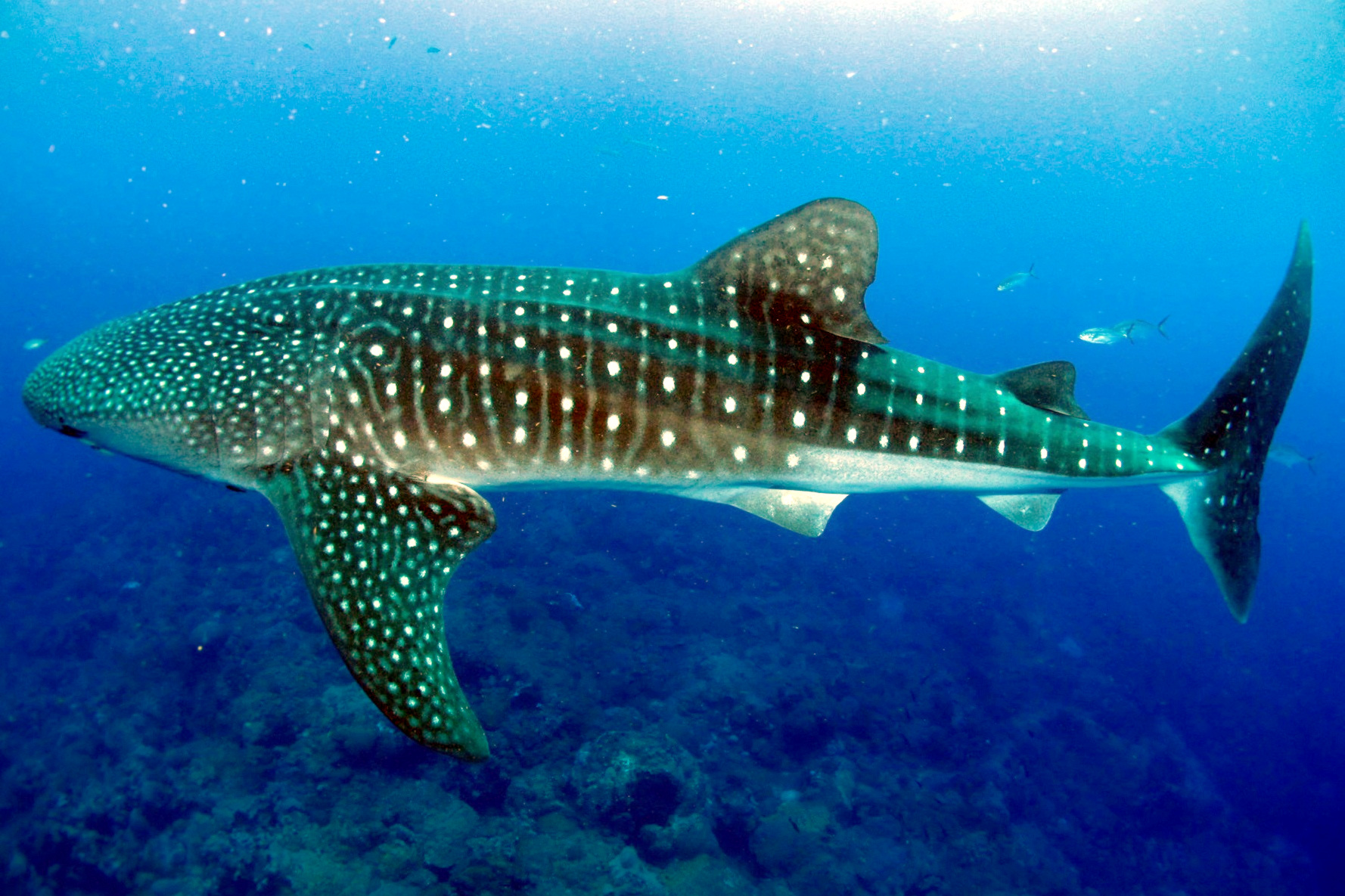
Whale Shark (Rhincodon typus) is the only living member of the family Rhincodontidae and the largest fish alive today. Despite its immense mouth and body, it feeds mostly on plankton, fish eggs and small schooling animals, gathering seasonally where currents and spawning events concentrate food. This guide separates well-supported biology from common assumptions and covers identification, range, habitat, diet, behavior, reproduction and conservation.
Identification
A broad, flattened head carries a huge terminal mouth in front of two small eyes. The dark blue-gray, gray-brown or greenish back is covered with pale spots and crossbars arranged like a checkerboard, while the underside is light. Three strong longitudinal ridges run along each side. Five large gill slits contain filtering structures, and adults have a powerful crescent-shaped tail. No two documented spot patterns are identical, allowing researchers to identify individuals from photographs. Females appear to attain larger maximum sizes than males, although aggregation samples are often biased toward juvenile males. Adult males have paired claspers beside the pelvic fins. External coloration does not reliably indicate sex, age or reproductive condition.
Identification should combine body shape, markings, size, voice or movement, and location. One feature by itself can overlap with a related animal, a juvenile, or an individual in unusual light.
Photographs are most useful when they preserve scale and show several diagnostic features. Handling or repositioning a wild whale shark for identification can cause stress and is unnecessary.
Size and physical adaptations
Whale Shark typically measures commonly observed at 5.5–10 m, with verified individuals around 12 m and reports of larger animals and weighs large adults may weigh well over 10,000 kg; mass estimates vary because free-swimming giants are difficult to weigh. It is the largest living fish. Maximum claims should be treated cautiously because some historical records relied on estimates rather than standardized measurements.
Its useful adaptations include gill-filter pads strain food from seawater, a wide terminal mouth captures dense plankton patches, unique spot patterns provide camouflage and individual identity, thick skin protects a huge slow-moving body, a streamlined trunk and crescent tail support long migrations, sensory organs detect chemical, pressure and electrical cues, suction feeding accesses food below the surface. These traits work together in the animal’s normal setting rather than serving as isolated curiosities.
Published measurements may use different methods, life stages or sample locations. Comparing figures responsibly means checking what was measured rather than selecting the largest number available.
Range and distribution
Circumtropical and warm-temperate, occurring across the Atlantic, Indian and Pacific oceans roughly between 30° north and 35° south. Major seasonal aggregations occur off Mexico, Belize, the Galápagos, Mozambique, the Maldives, the Philippines and Western Australia. The native range includes United States, Mexico, Belize, Honduras, Ecuador, Panama, Brazil, South Africa, Mozambique, Tanzania, Kenya, Egypt, Saudi Arabia, Oman, Qatar, India, Sri Lanka, Maldives, Thailand, Philippines, Indonesia, Taiwan, Japan, Australia.
A country-level map indicates broad distribution, not continuous occupation. Climate, elevation, water, vegetation, prey, breeding sites, barriers and survey effort all affect where records occur.
Records near the edge of the range deserve careful documentation because they may reflect natural movement, improved survey coverage, accidental transport or a genuine distribution change.
Habitat
Coastal shelves, reef passages, island slopes, lagoons and open ocean, generally in warm water but with dives into cold deep layers.
Whale sharks follow temporary food pulses rather than occupying one habitat continuously. Coastal feeding grounds form where upwelling, reef spawning, fish spawning or seasonal plankton blooms concentrate prey. Satellite tags also record long oceanic journeys and deep dives, showing that visible surface aggregations represent only a fraction of their lives. Juveniles dominate many tourism sites; adult females and newborns are rarely seen, leaving important nursery and breeding habitat poorly known. Protecting a population therefore requires the feeding, shelter and breeding features that make a site usable, along with connections that allow movement.
Microhabitat matters. Shade, soil, current, moisture, shelter or host plants can determine whether a small area is usable even when the surrounding landscape appears suitable.
Diet and feeding
Whale Shark is a filter-feeding carnivore. Important foods include copepods and other zooplankton, fish eggs, krill, small schooling fish, squid, crab and shrimp larvae, small jellyfish. A whale shark can ram-feed by swimming forward with its mouth open or use suction, repeatedly opening and closing the mouth while nearly stationary or vertical. Water exits through the gills, where filter pads retain prey before it is swallowed. The animal targets dense patches and can adjust direction within a feeding group. Its thousands of tiny teeth do not cut large prey and play little role in normal feeding.
Diet changes with age, season, location and food supply. A dramatic prey record does not establish what most individuals eat most of the time; repeated field observations provide a stronger picture.
Feeding opportunities also create risk. An animal focused on prey may be less alert to predators, traffic or people, while contaminated prey can transfer pollutants through the food web.
Behavior and communication
Active by day and night, with feeding and diving timed to local prey, currents, light and temperature. Individuals travel alone but may gather by the dozens or hundreds at predictable feeding events. They alternate surface feeding with long-distance movement and dives that can exceed several hundred metres. Many return to the same region in later years, yet movements also connect countries and ocean basins. They generally swim slowly near feeding sites, but a relaxed appearance does not mean boats or swimmers can crowd them safely.
No species-specific sound communication is known. Whale sharks perceive nearby animals through vision, smell, water movement and electroreception. Swimming direction, spacing and changes in depth help individuals avoid collisions within feeding groups. Researchers should not interpret tolerance of divers as social attachment or an invitation to touch. Behavior should be interpreted in context: alarm, courtship, feeding and temperature regulation can produce very different actions from the same animal.
Daily schedules are flexible responses, not rigid rules. Weather, breeding condition, disturbance, tides or food can move activity into a different part of the day.
Reproduction and development
Reproduction is aplacental viviparity: eggs hatch inside the mother, and young are born alive without a placental connection. Knowledge comes largely from one pregnant female caught near Taiwan that contained more than 300 embryos at different stages. Genetic work suggested the female may store sperm and fertilize egg batches over time, but mating, birth grounds and reproductive intervals remain largely unknown. Potentially more than 300 embryos, based on one exceptional documented female Newborns measure roughly 40–60 cm in documented material and receive no parental care. Juveniles grow slowly and move among productive coastal areas. Size-at-maturity estimates differ, but males often mature near 8–9 m and females later and larger. Because few mature females or newborn pups are encountered, researchers cannot yet define a complete reproductive cycle.
Young animals face different risks and may use different microhabitats or food than adults. Breeding success depends on adult condition, suitable sites and the survival of offspring through vulnerable early stages.
Counts of eggs or young describe reproductive output, not the number expected to reach adulthood. Mortality is normally greatest during eggs, larval or juvenile stages.
Predators and ecological role
Whale sharks transfer energy from dense plankton and small schooling prey into the bodies of very large, highly mobile consumers. Their movements link offshore, island and coastal food webs. They host remoras and other hitchhikers, visit cleaner-fish stations and may become prey to large sharks or orcas when young. Aggregations also give scientists a visible indicator of ocean productivity and seasonal spawning events. Documented or likely predators include Orca, Great White Shark, Tiger Shark, Humans.
This animal is both a consumer and a food source. Its influence comes through many repeated interactions, so ecological claims should be based on measured populations rather than assumptions drawn from appearance.
Predator and prey relationships differ among places. A species can be ecologically influential without being abundant everywhere, and its role can change across its range.
Relationship with people
Whale sharks were historically hunted for meat, fins and liver oil, and illegal capture still occurs despite national protections. Today, photo identification, satellite tags and carefully managed tourism generate knowledge and income in many coastal communities. Poorly managed tourism can bring propeller wounds, crowding and repeated contact. Shipping and fishing vessels also strike sharks that feed or travel near the surface, while entanglement and bycatch remain major threats.
Whale sharks are not predatory toward people, but their enormous body and tail can injure a swimmer accidentally. Follow local approach distances, enter the water quietly, stay to the side rather than blocking the head or tail, never touch or ride the shark, and avoid flash photography. Vessel operators should slow down, use lookouts and never cut across an animal’s path. Responsible observation means keeping an appropriate distance, avoiding capture or feeding, protecting habitat and following local wildlife or invasive-species guidance.
Wildlife guidance should come from the responsible local agency because collection rules, reporting requests and appropriate responses differ between native and introduced ranges.
Conservation
The IUCN Red List classifies the whale shark as Endangered. Documented declines, vessel strikes, fishing mortality and very slow maturation make recovery difficult even though the species is protected in many countries. The reported global trend is Decreasing.
Important pressures include vessel strikes, incidental capture and entanglement, illegal or historical targeted fishing, unregulated tourism and repeated disturbance, plastic and other marine pollution, climate-driven changes to prey concentrations, late maturity and poorly known breeding areas. Global status can hide local decline or recovery, so current regional monitoring and habitat management remain necessary.
The most useful conservation action follows the documented pressure. Protecting breeding sites, reducing road deaths or limiting pollutants can require different tools in different populations.
Despite its enormous size, the Whale Shark filter-feeds; compare it with the predatory Great White Shark and bottom-associated Zebra Shark.