
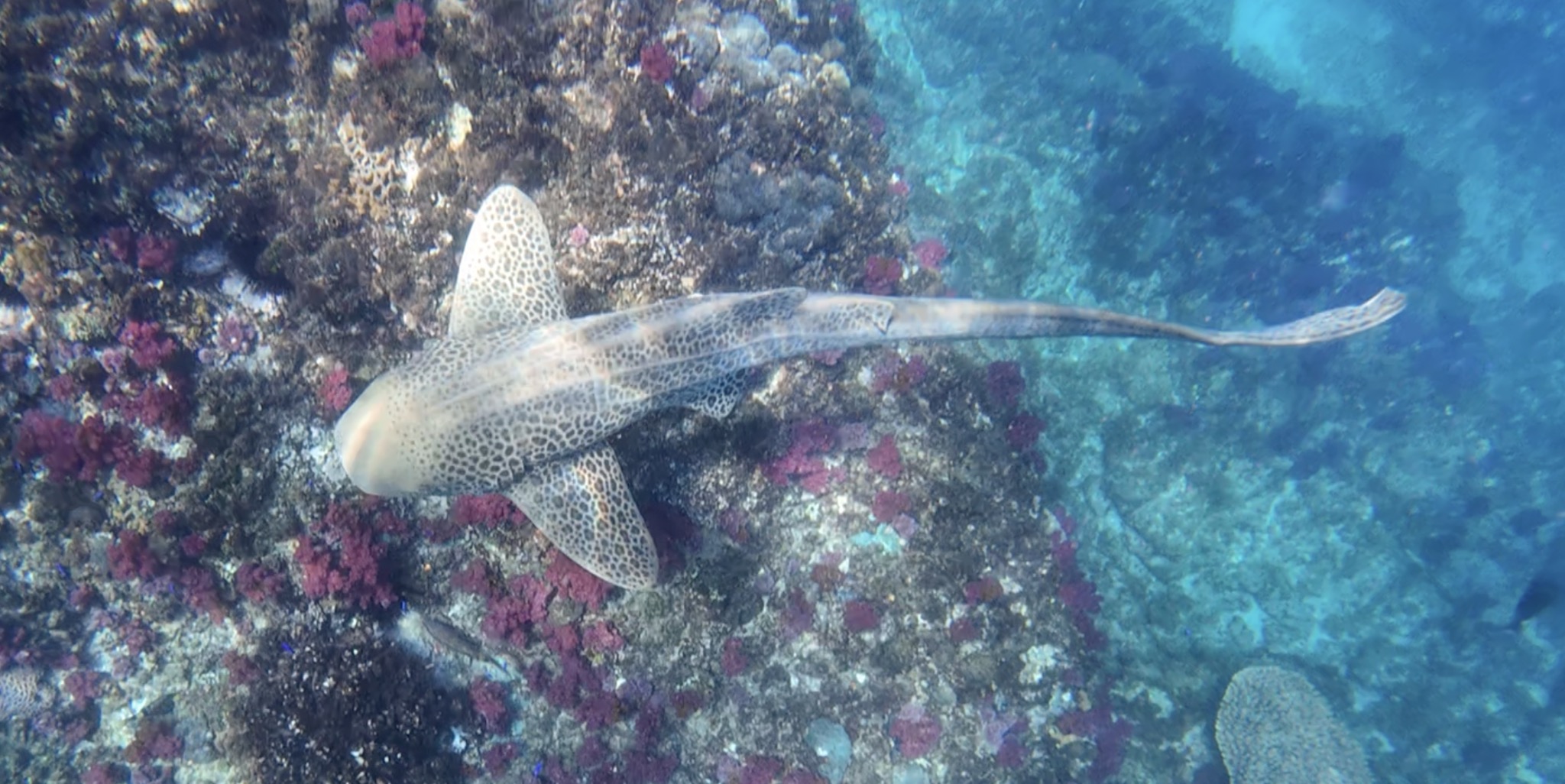
Zebra Shark (Stegostoma tigrinum) is a bottom-associated carpet shark of warm Indo-West Pacific seas. Juveniles wear dark zebra bands, while adults are sandy yellow with leopard-like spots and a tail almost as long as the rest of the body. This guide separates well-supported biology from common assumptions and covers identification, range, habitat, diet, behavior, reproduction and conservation.
Identification
A juvenile is dark brown to black with narrow white or yellow bars and blotches. By adulthood the pattern reverses into many dark spots on a yellow-brown body. Five raised ridges run along the adult back and flanks. The head is broad and rounded with small barbels near the nostrils, the pectoral fins are large, and the exceptionally long upper caudal lobe creates a ribbon-like tail. The last three of five small gill slits sit behind the pectoral-fin origin. Males have paired claspers beside the pelvic fins; females lack them and may grow slightly larger. Color pattern is similar between the sexes.
Identification should combine body shape, markings, size, voice or movement, and location. One feature by itself can overlap with a related animal, a juvenile, or an individual in unusual light.
Photographs are most useful when they preserve scale and show several diagnostic features. Handling or repositioning a wild zebra shark for identification can cause stress and is unnecessary.
Size and physical adaptations
Zebra Shark typically measures commonly about 2.0–2.5 m; exceptional reports approach 3.5 m and weighs large adults can exceed 30 kg, but mass varies with length and condition. Older maximum-length reports vary; about 2.4–2.5 metres is well documented and far more typical than the largest claimed records.
Its useful adaptations include nasal barbels detect prey near the bottom, powerful buccal suction extracts animals from crevices, flattened teeth crush shelled prey, flexible body enters narrow reef channels, spiracles draw water while resting on the seabed, long tail supports slow efficient swimming. These traits work together in the animal’s normal setting rather than serving as isolated curiosities.
Published measurements may use different methods, life stages or sample locations. Comparing figures responsibly means checking what was measured rather than selecting the largest number available.
Range and distribution
Tropical Indo-West Pacific from the Red Sea, Persian Gulf and East African coast east through South and Southeast Asia to southern Japan, northern Australia, New Caledonia and Fiji. It occurs around continental shelves, islands and reef systems rather than in the open ocean. The native range includes Australia, Bahrain, China, Djibouti, Egypt, Fiji, India, Indonesia, Japan, Kenya, Madagascar, Malaysia, Maldives, Mozambique, Oman, Papua New Guinea, Philippines, Saudi Arabia, Seychelles, Somalia, South Africa, Sri Lanka, Sudan, Tanzania, Thailand, United Arab Emirates, Vietnam, Yemen.
A country-level map indicates broad distribution, not continuous occupation. Climate, elevation, water, vegetation, prey, breeding sites, barriers and survey effort all affect where records occur.
Records near the edge of the range deserve careful documentation because they may reflect natural movement, improved survey coverage, accidental transport or a genuine distribution change.
Habitat
Coral and rocky reefs, sandy flats, lagoons, channels and continental or island shelves from very shallow water to about 90 m, most often 5–30 m.
Adults commonly rest on open sand near reef structure during daylight, facing currents that carry oxygenated water over the gills. At night they patrol reef edges, rubble and channels for prey. Their flexible body and small mouth reach into holes inaccessible to bulkier sharks. Juveniles use shallower protected water and may resemble venomous banded sea snakes when viewed from above, a possible defensive benefit that remains a hypothesis rather than a proven fact. Protecting a population therefore requires the feeding, shelter and breeding features that make a site usable, along with connections that allow movement.
Microhabitat matters. Shade, soil, current, moisture, shelter or host plants can determine whether a small area is usable even when the surrounding landscape appears suitable.
Diet and feeding
Zebra Shark is a nocturnal carnivore specializing in bottom-dwelling invertebrates. Important foods include gastropod snails, bivalve molluscs, crabs, shrimps, small bony fish, cephalopods, occasional sea snakes. The shark searches with smell, touch and electroreception, then presses its rounded snout close to a crevice or sandy patch. Strong throat and mouth muscles create suction that pulls prey free. Numerous small teeth have a central cusp and side cusplets suited to gripping and crushing rather than cutting large prey. A slender flexible body allows the head to probe beneath ledges while the tail remains outside.
Diet changes with age, season, location and food supply. A dramatic prey record does not establish what most individuals eat most of the time; repeated field observations provide a stronger picture.
Feeding opportunities also create risk. An animal focused on prey may be less alert to predators, traffic or people, while contaminated prey can transfer pollutants through the food web.
Behavior and communication
Mostly nocturnal; often rests openly on sand or reef rubble by day. Zebra sharks are slow, deliberate swimmers and are usually solitary, although adults gather seasonally at productive sites. A resting shark may prop itself on its pectoral fins and pump water through the mouth and spiracles, so it does not need to swim continuously. Individuals show site fidelity but can also travel hundreds of kilometres. They are generally tolerant of divers, yet touching, chasing or blocking an animal changes its behavior and wastes energy.
Direct social signals are poorly studied. Like other sharks, zebra sharks detect dissolved chemicals with the nostrils, pressure and vibration through the lateral-line system, and weak electrical fields with ampullae of Lorenzini. These senses reveal hidden prey and nearby animals in darkness. During courtship, touch and body positioning become important. Behavior should be interpreted in context: alarm, courtship, feeding and temperature regulation can produce very different actions from the same animal.
Daily schedules are flexible responses, not rigid rules. Weather, breeding condition, disturbance, tides or food can move activity into a different part of the day.
Reproduction and development
During courtship a male may follow and bite a female’s pectoral fin to hold position while using one clasper for internal fertilization. Females store sperm and lay repeated egg cases over a season. Captive observations have also documented facultative parthenogenesis, in which a female produced offspring without recent genetic contribution from a male, but ordinary sexual reproduction remains the normal pathway. Eggs laid in repeated small batches; a female may produce dozens across a breeding season The female lays large dark brown or purplish egg cases marked by longitudinal ridges. Dense hair-like fibres anchor each case to reef structure so currents do not sweep it away. The embryo develops on yolk inside and hatches at roughly 20–26 cm long. Young sharks have strong zebra bands and no parental care; their pattern gradually breaks into spots as the body grows.
Young animals face different risks and may use different microhabitats or food than adults. Breeding success depends on adult condition, suitable sites and the survival of offspring through vulnerable early stages.
Counts of eggs or young describe reproductive output, not the number expected to reach adulthood. Mortality is normally greatest during eggs, larval or juvenile stages.
Predators and ecological role
By eating molluscs, crustaceans and small fish, zebra sharks connect hard-shelled reef prey to larger marine food webs. Their need for healthy reefs, sandy feeding grounds and migration corridors makes them vulnerable to combined habitat and fishing pressure. Large tiger sharks and other predators may take young animals, while egg cases support small scavengers if an embryo fails. The species also has high value for low-impact dive tourism and public education. Documented or likely predators include Tiger Shark, Bull Shark, Large Groupers, Humans.
This animal is both a consumer and a food source. Its influence comes through many repeated interactions, so ecological claims should be based on measured populations rather than assumptions drawn from appearance.
Predator and prey relationships differ among places. A species can be ecologically influential without being abundant everywhere, and its role can change across its range.
Relationship with people
Zebra sharks are taken for meat, fins, liver oil and fishmeal and are also caught incidentally in trawls, gillnets and reef fisheries. Their shallow coastal habitat makes them accessible, while slow growth and low reproductive output delay recovery. Declines are severe in much of the range, although protection has helped some Australian populations. Dive tourism can make a living shark economically valuable, provided operators maintain distance and never feed or handle animals. Aquarium breeding and carefully governed reintroduction projects may supplement habitat and fishery protection but cannot replace it.
The species is considered harmless to divers under normal conditions, but any large wild shark can bite defensively. Do not touch, ride, feed or corner one, and never pull the tail. Keep clear of the head and allow an escape route. Divers should follow local wildlife rules and maintain neutral buoyancy to avoid damaging the reef while watching. Responsible observation means keeping an appropriate distance, avoiding capture or feeding, protecting habitat and following local wildlife or invasive-species guidance.
Wildlife guidance should come from the responsible local agency because collection rules, reporting requests and appropriate responses differ between native and introduced ranges.
Conservation
The IUCN assesses the Zebra Shark as Endangered. Fishing has caused broad declines outside well-managed refuges, and the species’ slow growth, late maturity and egg-laying reproduction limit population recovery. The reported global trend is Decreasing globally, with stronger regional security in parts of Australia.
Important pressures include targeted shark fisheries, bycatch in trawls and gillnets, fin and meat trade, coral reef degradation, loss of egg-laying habitat, slow growth and late maturity, coastal pollution. Global status can hide local decline or recovery, so current regional monitoring and habitat management remain necessary.
The most useful conservation action follows the documented pressure. Protecting breeding sites, reducing road deaths or limiting pollutants can require different tools in different populations.
The Zebra Shark forages along the seabed; compare its shape and feeding style with the open-water Great Hammerhead Shark.