
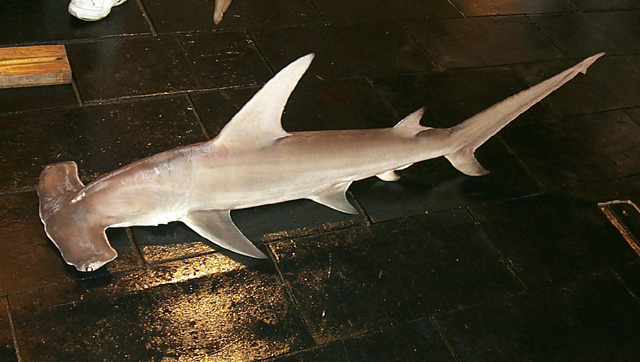
Great Hammerhead Shark (Sphyrna mokarran) is a large tropical and warm-temperate predator found from shallow lagoons to offshore waters. Its broad cephalofoil expands sensory coverage and vision, while its low reproductive rate and exceptionally valuable fins have left it Critically Endangered. This guide separates well-supported biology from common assumptions and covers identification, range, habitat, diet, behavior, reproduction and conservation.
Identification
The wide cephalofoil is nearly straight across its leading edge in adults, with a distinct central indentation and eyes at the outer tips. The first dorsal fin is extremely tall, pointed and swept backward. Pelvic fins also have strongly concave rear edges. The stout body is olive, brown or gray above and pale below, generally without bold adult fin markings. Triangular serrated teeth become more oblique toward the jaw corners. Females attain greater average and maximum size than males. Mature males have paired claspers beside the pelvic fins. Juveniles have a more curved front edge to the head, so identification should combine head shape, dorsal-fin height and pelvic-fin form.
Identification should combine body shape, markings, size, voice or movement, and location. One feature by itself can overlap with a related animal, a juvenile, or an individual in unusual light.
Photographs are most useful when they preserve scale and show several diagnostic features. Handling or repositioning a wild great hammerhead shark for identification can cause stress and is unnecessary.
Size and physical adaptations
Great Hammerhead Shark typically measures adults commonly about 3–4.5 m, with exceptional individuals reaching 6.1 m and weighs large adults commonly exceed 230 kg; exceptional records approach 450 kg. It is the largest hammerhead species. Verified extreme size is rare, and sex, age and measurement method explain some variation among reports.
Its useful adaptations include wide cephalofoil spreads electroreceptors over a broad search area, widely separated eyes increase visual coverage, the head can pin stingrays against the seafloor, a tall dorsal fin stabilizes turns, serrated teeth cut fish and rays, countershading reduces visibility from above and below, sideways swimming can reduce transport costs. These traits work together in the animal’s normal setting rather than serving as isolated curiosities.
Published measurements may use different methods, life stages or sample locations. Comparing figures responsibly means checking what was measured rather than selecting the largest number available.
Range and distribution
Circumtropical in coastal and semi-oceanic waters, broadly between about 40°N and 35°S in the Atlantic, Indian and Pacific oceans, including the Caribbean, Mediterranean, Red Sea and Gulf regions. The native range includes United States, Mexico, Belize, Cuba, Bahamas, Brazil, Uruguay, Morocco, Senegal, South Africa, Mozambique, Tanzania, Kenya, Somalia, Egypt, Saudi Arabia, Oman, India, Sri Lanka, Thailand, Malaysia, Indonesia, Philippines, Japan, Australia, New Caledonia, French Polynesia, Ecuador, Peru.
A country-level map indicates broad distribution, not continuous occupation. Climate, elevation, water, vegetation, prey, breeding sites, barriers and survey effort all affect where records occur.
Records near the edge of the range deserve careful documentation because they may reflect natural movement, improved survey coverage, accidental transport or a genuine distribution change.
Habitat
Continental shelves, lagoons, coral reefs, sandy flats, bays, shelf edges and offshore waters to at least 300 m.
Great hammerheads often patrol shallow flats and reef edges where rays and fishes are available, then move across shelves and into open water. Seasonal migrations can carry them poleward during warmer months. Adults use coastal and offshore habitats, while young sharks rely more heavily on productive shallow areas. The combination of predictable routes and surface fins makes the species accessible to both researchers and fisheries. Protecting a population therefore requires the feeding, shelter and breeding features that make a site usable, along with connections that allow movement.
Microhabitat matters. Shade, soil, current, moisture, shelter or host plants can determine whether a small area is usable even when the surrounding landscape appears suitable.
Diet and feeding
Great Hammerhead Shark is a carnivore. Important foods include stingrays, eagle rays, bony fish, smaller sharks, squid, octopus, crabs, lobsters. Stingrays are especially important prey. A hammerhead sweeps its head above the bottom, using electroreceptors to detect bioelectric signals even when a ray is buried. It may strike and pin the ray with the cephalofoil before biting the wings. Serrated teeth also handle fishes and other sharks. Feeding varies by region, body size and opportunity, so no single prey dominates every population.
Diet changes with age, season, location and food supply. A dramatic prey record does not establish what most individuals eat most of the time; repeated field observations provide a stronger picture.
Feeding opportunities also create risk. An animal focused on prey may be less alert to predators, traffic or people, while contaminated prey can transfer pollutants through the food web.
Behavior and communication
Active day and night, with much hunting near dusk and movement shaped by prey, tide and temperature. Unlike scalloped hammerheads that can form large schools, great hammerheads are usually solitary. They travel steadily across flats, reef slopes and offshore corridors and may return seasonally to productive regions. Individuals sometimes roll far onto one side during long swims; hydrodynamic research indicates this posture lets the tall dorsal fin generate lift efficiently. At cleaning stations they slow while small fishes remove parasites.
No social vocalization is known. Body orientation, swimming speed, approach and avoidance convey spacing at close range. The lateral line senses water movement, smell detects chemical trails and the ampullae of Lorenzini detect weak electrical fields. Wide-set eyes give substantial binocular overlap in front and improved vertical vision compared with a conventional shark head. Behavior should be interpreted in context: alarm, courtship, feeding and temperature regulation can produce very different actions from the same animal.
Daily schedules are flexible responses, not rigid rules. Weather, breeding condition, disturbance, tides or food can move activity into a different part of the day.
Reproduction and development
Fertilization is internal. Embryos initially use yolk and later connect to the mother through a yolk-sac placenta, receiving nutrients until live birth. Mating likely includes biting and close alignment, as in related sharks. Females reproduce on a multi-year cycle, so even a relatively large litter does not translate into rapid population replacement. Usually about 6–42 live pups Pups are born in warm shallow habitat at roughly 50–70 cm long and receive no parental care. They feed on smaller fish and invertebrates before adding larger rays and sharks as they grow. Maturity and growth vary by region, with females maturing larger than males. Longevity estimates extend beyond three decades and may exceed 40 years.
Young animals face different risks and may use different microhabitats or food than adults. Breeding success depends on adult condition, suitable sites and the survival of offspring through vulnerable early stages.
Counts of eggs or young describe reproductive output, not the number expected to reach adulthood. Mortality is normally greatest during eggs, larval or juvenile stages.
Predators and ecological role
As a large apex predator, the great hammerhead links reef, sandy-bottom and offshore food webs. Predation on rays and sharks can influence prey behavior and abundance, while the shark itself supports scavengers after death. Juveniles remain vulnerable to larger sharks, and adults may be attacked by orcas. Removing a wide-ranging predator can alter coastal food-web relationships in ways that extend beyond one prey species. Documented or likely predators include Orca, Tiger Shark, Larger Shark, Humans.
This animal is both a consumer and a food source. Its influence comes through many repeated interactions, so ecological claims should be based on measured populations rather than assumptions drawn from appearance.
Predator and prey relationships differ among places. A species can be ecologically influential without being abundant everywhere, and its role can change across its range.
Relationship with people
The species is caught intentionally and as bycatch in longlines, gillnets, trawls and hook fisheries. Its large fins bring high prices in international trade, and carcasses may be discarded after finning. Release does not always ensure survival because capture stress can be severe. Dive tourism in places such as the Bahamas gives living sharks economic value, while tagging and photo records reveal migrations needed for cross-border management.
A great hammerhead is capable of severe injury and should never be approached, fed, hooked or cornered. Encounters with people are uncommon, but divers should follow trained operators, remain calm, keep visual contact and give the shark a clear route. Swimmers should heed closures and avoid fishing activity, bait schools and distressed animals. Fishers must follow local protected-species handling rules. Responsible observation means keeping an appropriate distance, avoiding capture or feeding, protecting habitat and following local wildlife or invasive-species guidance.
Wildlife guidance should come from the responsible local agency because collection rules, reporting requests and appropriate responses differ between native and introduced ranges.
Conservation
The IUCN Red List classifies the great hammerhead as Critically Endangered. Global fishing mortality, valuable fins and low population growth have produced severe declines across much of its range. The reported global trend is Decreasing.
Important pressures include targeted shark fisheries, bycatch in longlines, gillnets and trawls, international demand for large fins, finning and illegal retention, capture stress and post-release mortality, loss or degradation of coastal nursery habitat, slow population recovery. Global status can hide local decline or recovery, so current regional monitoring and habitat management remain necessary.
The most useful conservation action follows the documented pressure. Protecting breeding sites, reducing road deaths or limiting pollutants can require different tools in different populations.
The Great Hammerhead’s expanded head and ray-heavy diet contrast with the filter-feeding Whale Shark and ambush-oriented Zebra Shark.