
Savannah Cat
Savannah cat guide covering generations, realistic size, temperament, enrichment, diet, legal checks and responsible ownership.
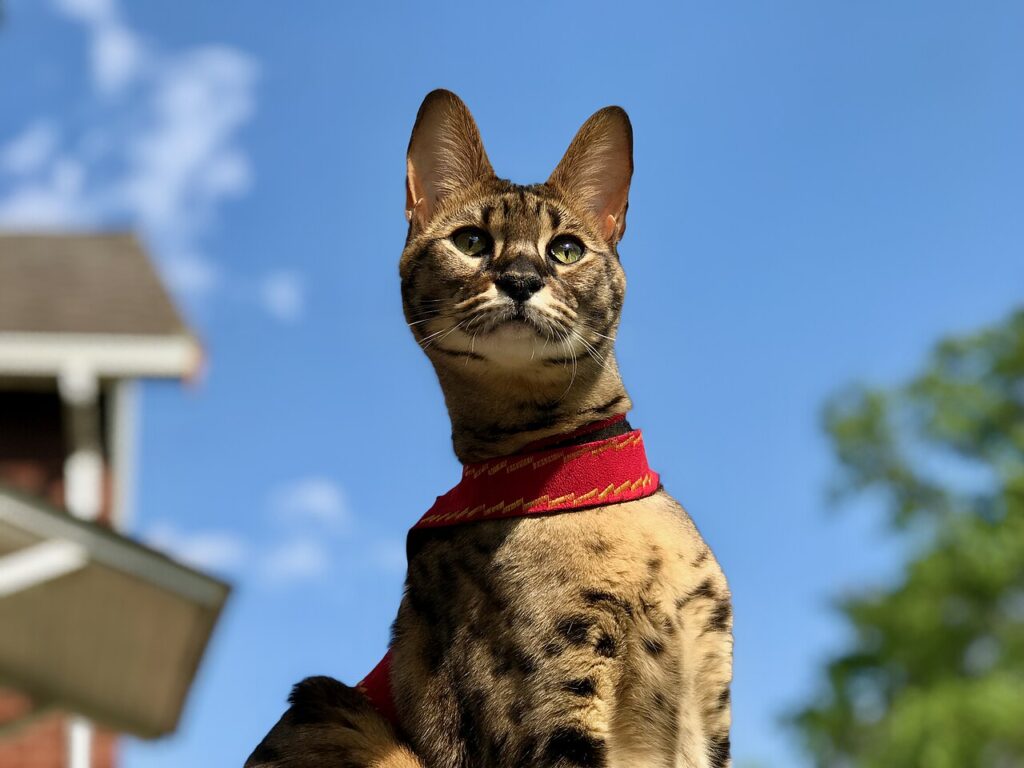
Savannah Cat (Felis catus) is a domestic hybrid breed known for long legs, large ears and a spotted coat. This guide separates well-supported biology from common assumptions and covers identification, range, habitat, diet, behavior, reproduction and conservation.
Identification
A tall, lean cat with a small head, large upright ears, long neck and legs, hooded eyes and bold solid spots over a gold, silver, brown or smoke background. Males are usually larger than females, especially in earlier generations, but individual size varies widely.
Identification should combine body shape, markings, size, voice or movement, and location. One feature by itself can overlap with a related animal, a juvenile, or an individual in unusual light.
Photographs are most useful when they preserve scale and show several diagnostic features. Handling or repositioning a wild savannah cat for identification can cause stress and is unnecessary.
Size and physical adaptations
Savannah Cat typically measures highly variable; often 40–50 cm body length and weighs commonly 5–10 kg, with wide variation. Generation, sex and individual inheritance matter; marketing claims about guaranteed giant size are unreliable.
Its useful adaptations include long legs support athletic jumps, large mobile ears localize sounds, spotted coat reflects serval ancestry, high curiosity supports complex problem-solving. These traits work together in the animal’s normal setting rather than serving as isolated curiosities.
Published measurements may use different methods, life stages or sample locations. Comparing figures responsibly means checking what was measured rather than selecting the largest number available.
Range and distribution
Developed as a breed in the United States and now kept internationally where local laws allow. The native range includes United States.
A country-level map indicates broad distribution, not continuous occupation. Climate, elevation, water, vegetation, prey, breeding sites, barriers and survey effort all affect where records occur.
Records near the edge of the range deserve careful documentation because they may reflect natural movement, improved survey coverage, accidental transport or a genuine distribution change.
Habitat
A secure, enriched indoor home with tall climbing structures, hiding areas, scratchers and protected outdoor access such as a catio.
Vertical territory and daily interactive play are essential; doors, windows and screens must resist an athletic, curious cat. Protecting a population therefore requires the feeding, shelter and breeding features that make a site usable, along with connections that allow movement.
Microhabitat matters. Shade, soil, current, moisture, shelter or host plants can determine whether a small area is usable even when the surrounding landscape appears suitable.
Diet and feeding
Savannah Cat is a obligate carnivore. Important foods include complete balanced commercial cat food, measured treats, fresh water. Feed an age-appropriate complete and balanced feline diet. Raw or homemade diets risk pathogens and nutrient imbalance unless formulated by a board-certified veterinary nutritionist.
Diet changes with age, season, location and food supply. A dramatic prey record does not establish what most individuals eat most of the time; repeated field observations provide a stronger picture.
Feeding opportunities also create risk. An animal focused on prey may be less alert to predators, traffic or people, while contaminated prey can transfer pollutants through the food web.
Behavior and communication
Highly active with daily play and climbing needs. Savannahs often explore, jump, retrieve, open simple fixtures and form close bonds, but personality differs by individual and generation.
Meows, chirps, purrs, scent and posture communicate needs and emotion. Behavior should be interpreted in context: alarm, courtship, feeding and temperature regulation can produce very different actions from the same animal.
Daily schedules are flexible responses, not rigid rules. Weather, breeding condition, disturbance, tides or food can move activity into a different part of the day.
Reproduction and development
Responsible breeders prioritize health, temperament and genetic diversity rather than extreme size or appearance. Domestic cats commonly have several kittens per litter. undefined
Young animals face different risks and may use different microhabitats or food than adults. Breeding success depends on adult condition, suitable sites and the survival of offspring through vulnerable early stages.
Counts of eggs or young describe reproductive output, not the number expected to reach adulthood. Mortality is normally greatest during eggs, larval or juvenile stages.
Predators and ecological role
Domestic companion breed; must not roam because hunting threatens wildlife and escape can endanger the cat. Documented or likely predators include Vehicles, Dogs, Wild Carnivores.
This animal is both a consumer and a food source. Its influence comes through many repeated interactions, so ecological claims should be based on measured populations rather than assumptions drawn from appearance.
Predator and prey relationships differ among places. A species can be ecologically influential without being abundant everywhere, and its role can change across its range.
Relationship with people
Owners need time for daily play, reward-based training, secure containment, routine veterinary care and careful introductions to children and other pets.
Check national, state and municipal ownership rules before acquisition because restrictions may depend on filial generation. Never declaw; provide scratching surfaces and cooperative handling. Responsible observation means keeping an appropriate distance, avoiding capture or feeding, protecting habitat and following local wildlife or invasive-species guidance.
Wildlife guidance should come from the responsible local agency because collection rules, reporting requests and appropriate responses differ between native and introduced ranges.
Conservation
Domestic breeds do not receive a wild-species IUCN assessment. The reported global trend is Not applicable to a domestic breed.
Important pressures include irresponsible breeding, escape and road injury, obesity from excess feeding, under-stimulation. Global status can hide local decline or recovery, so current regional monitoring and habitat management remain necessary.
The most useful conservation action follows the documented pressure. Protecting breeding sites, reducing road deaths or limiting pollutants can require different tools in different populations.
Savannah cat FAQs
What do F1, F2 and later Savannah labels mean?
They describe how many generations a cat is removed from a serval ancestor. The label does not guarantee an exact size, appearance or temperament.
Are Savannah cats legal everywhere?
No. Rules differ by country, state and municipality and may depend on filial generation. Check current local law before acquiring or moving with one.
How big does a Savannah cat get?
Size varies widely with sex, generation and individual inheritance. Many are comparable to a large domestic cat, while some early-generation males are larger.
Do Savannah cats need special food?
They need a complete and balanced feline diet. Use raw or homemade diets only with qualified veterinary nutrition guidance because nutritional errors and pathogens can cause harm.
Are Savannah cats good family pets?
Some thrive in active, experienced homes, but energy, prey drive and handling tolerance differ. Careful supervision, secure containment and gradual introductions are essential.
For another athletic spotted cat with intensive enrichment needs, compare the Bengal guide; ownership rules and ancestry still require separate checking.