
Anaconda (Eunectes) refers here to the living snakes in genus Eunectes, not to one unusually large individual. The Reptile Database currently recognizes the green anaconda, yellow anaconda, dark-spotted anaconda and Beni anaconda. All are nonvenomous boas associated with rivers, marshes, flooded grasslands, swamps and other wet habitats in South America. Their eyes and nostrils sit high on the head, and their muscular bodies are powerful in water. Species differ in range, size, pattern and conservation circumstances, so this genus profile keeps those distinctions visible. This guide separates well-supported biology from common assumptions and covers identification, range, habitat, diet, behavior, reproduction and conservation.
Identification
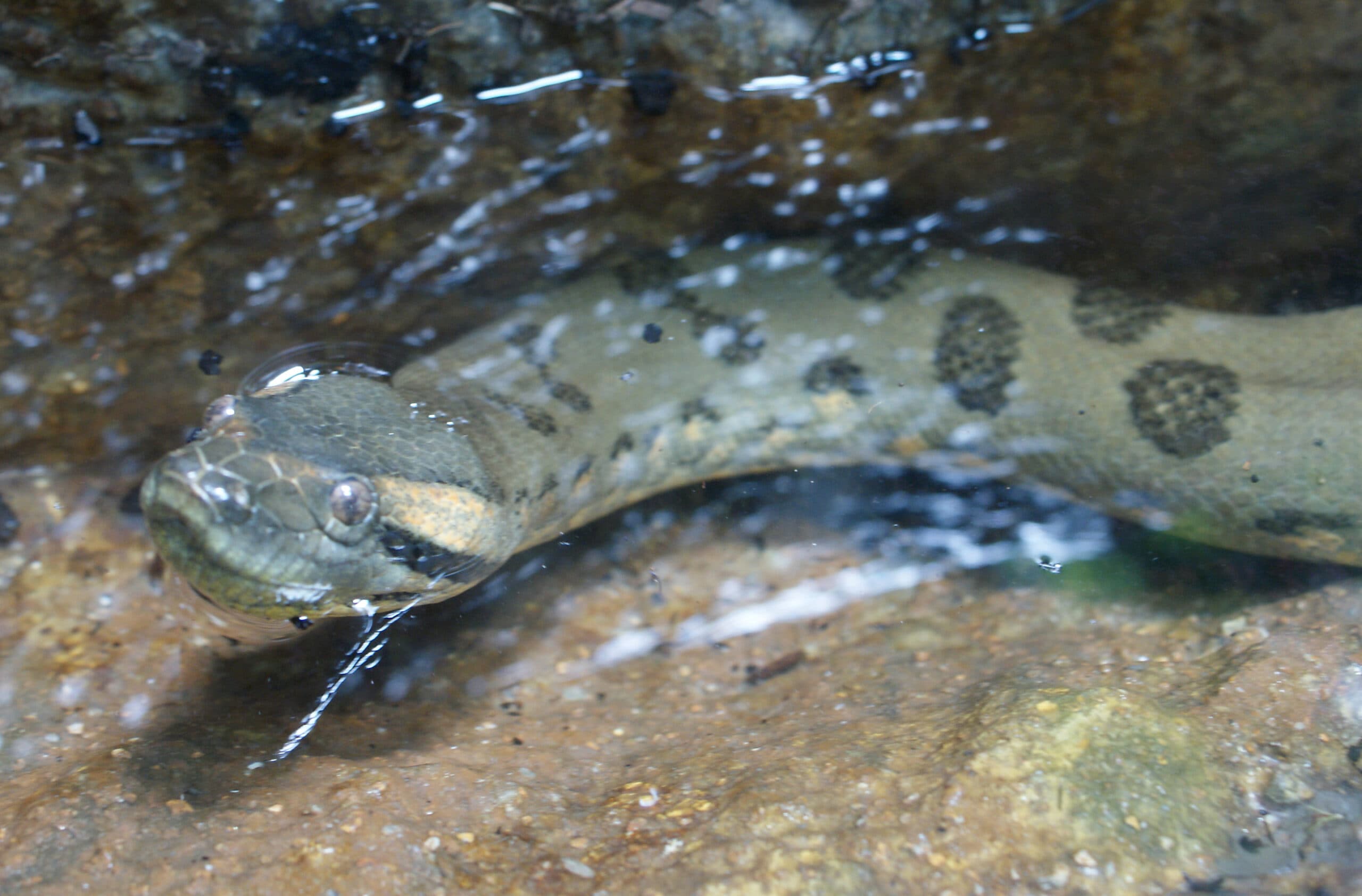
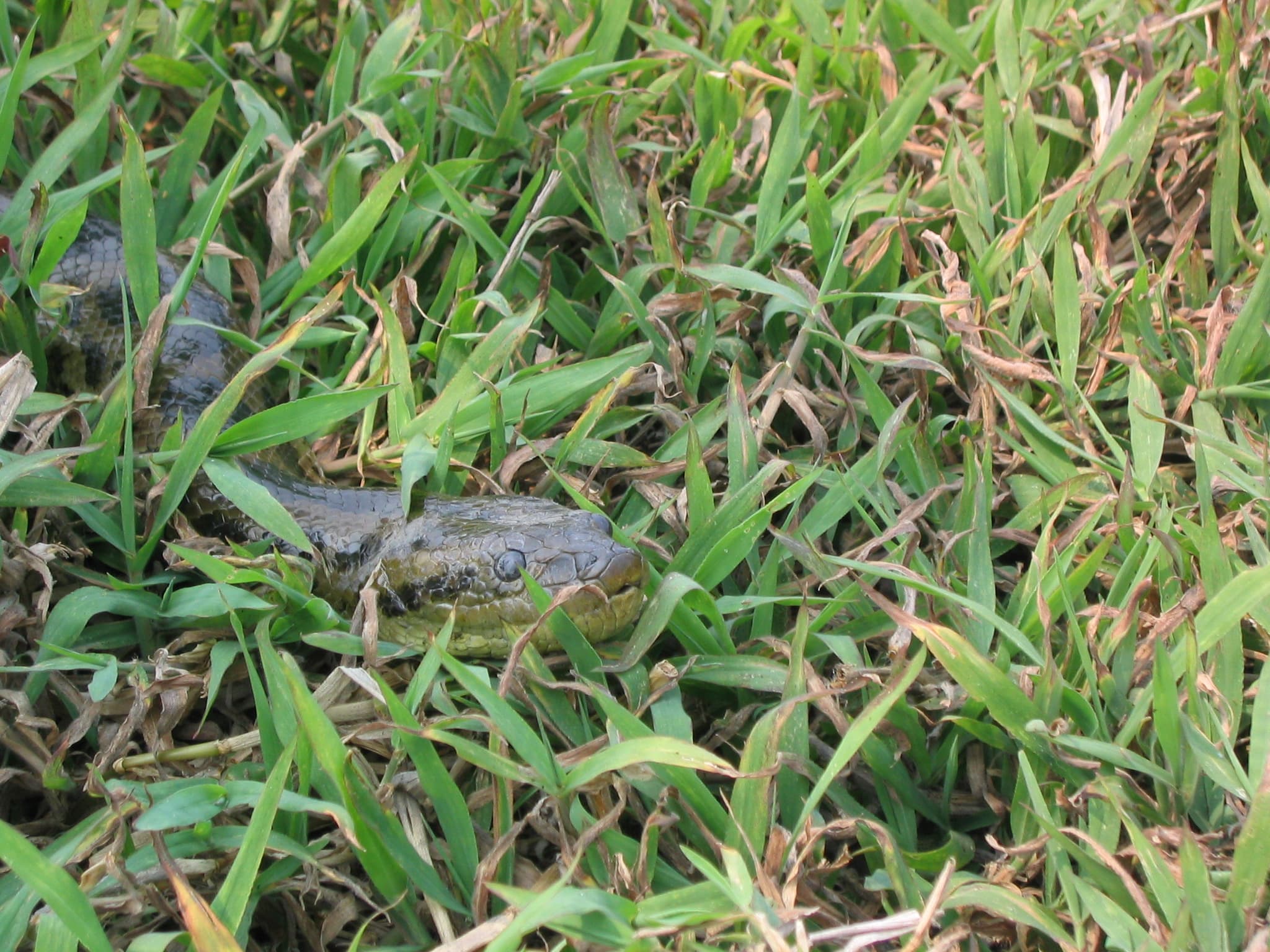
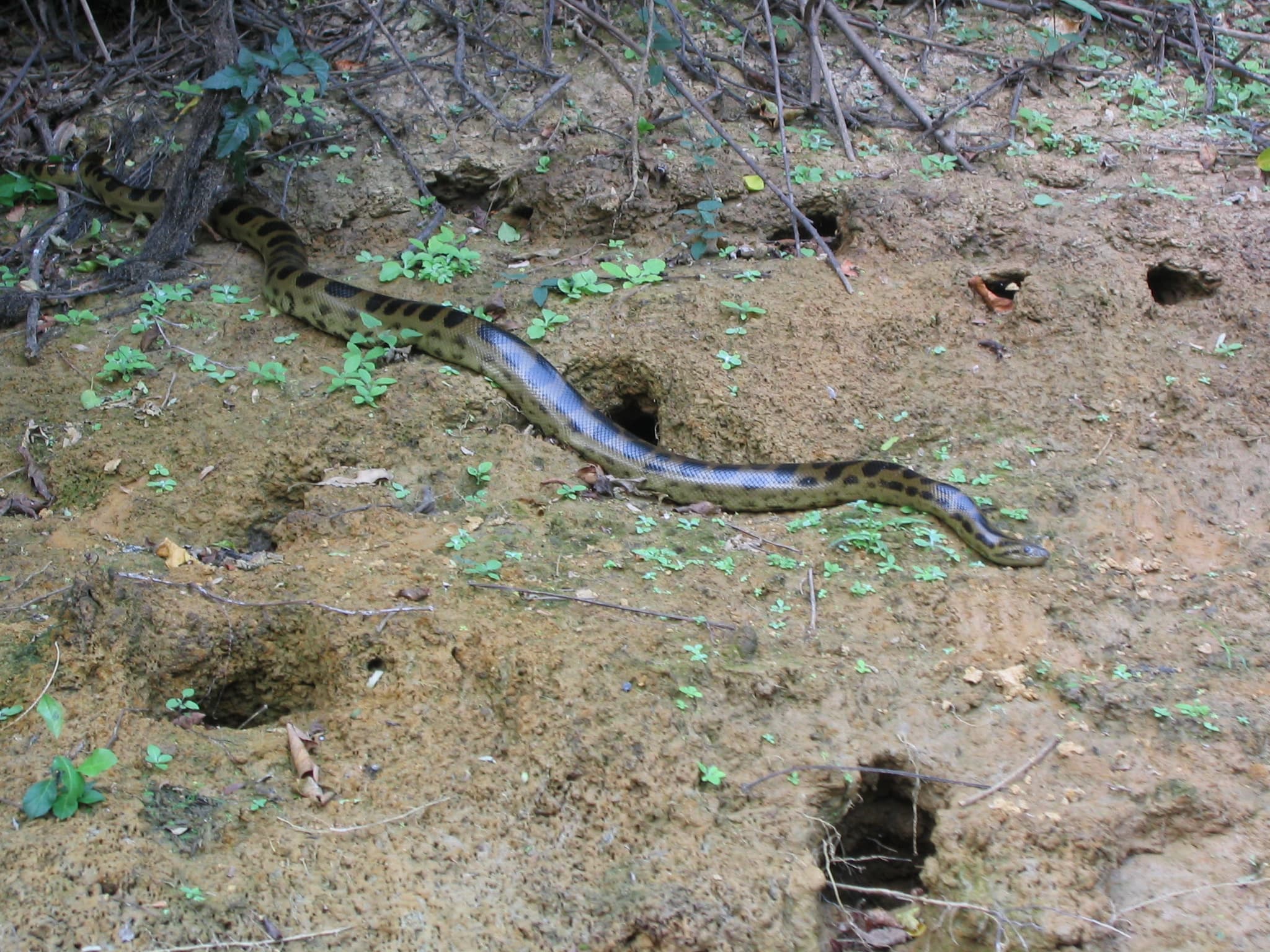
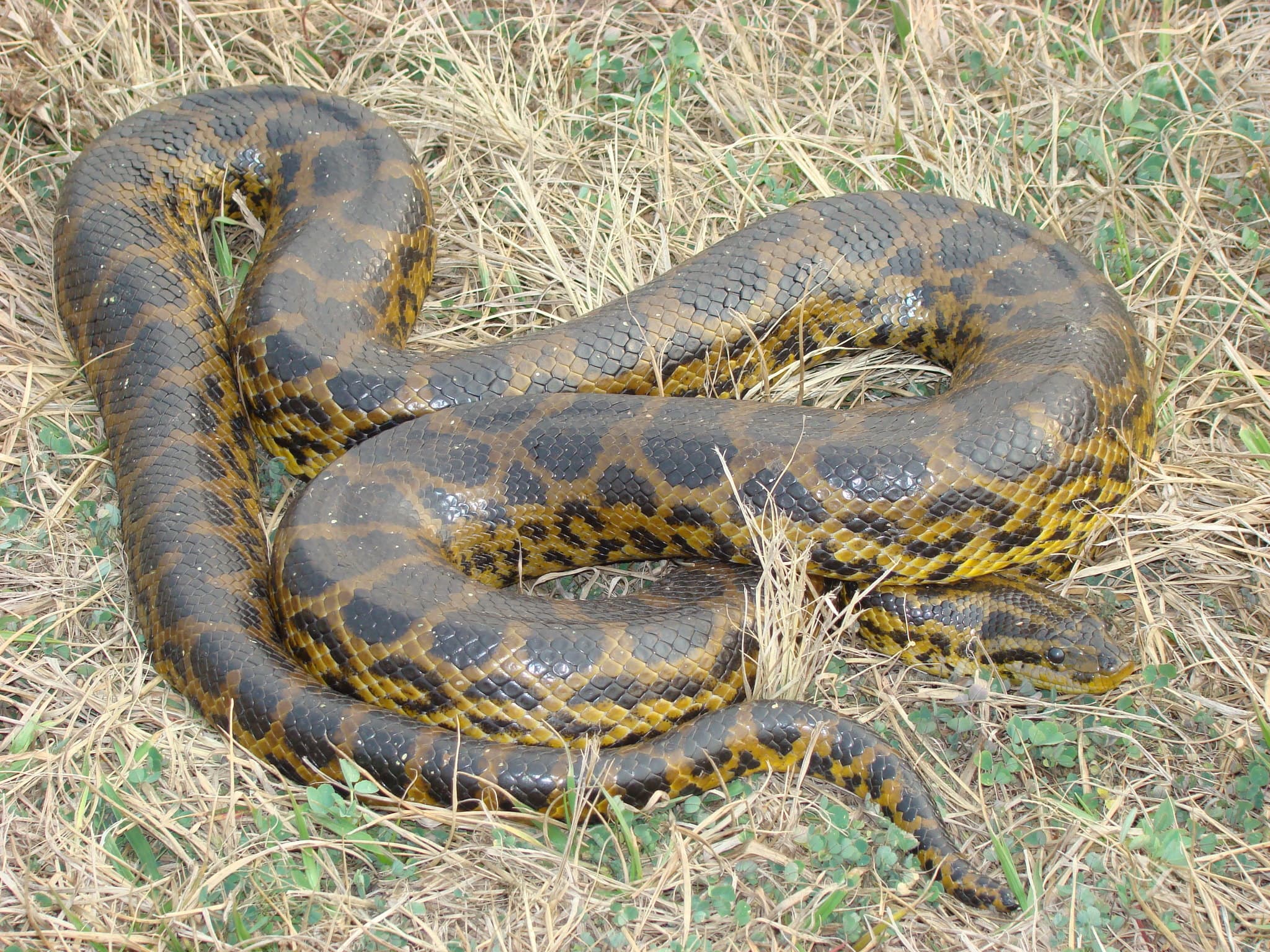
Anacondas are thick-bodied snakes with small, smooth-looking scales, a relatively narrow head and eyes and nostrils positioned toward the top of the snout. That arrangement lets a snake see and breathe while much of its head remains at the surface. Green anacondas are olive to greenish brown with large dark oval blotches. Yellow anacondas have a more yellow, golden or tan ground color with dark saddles and spots. Beni and dark-spotted anacondas have their own geographic ranges and pattern details, so a photograph should be identified to species only when its source supports that identification. Females are substantially larger and heavier than males in well-studied anaconda species. Size dimorphism is especially marked in the green anaconda, but exact adult measurements vary among species, populations and individuals.
Identification should combine body shape, markings, size, voice or movement, and location. One feature by itself can overlap with a related animal, a juvenile, or an individual in unusual light.
Photographs are most useful when they preserve scale and show several diagnostic features. Handling or repositioning a wild anaconda for identification can cause stress and is unnecessary.
Size and physical adaptations
Anaconda typically measures Species and sex dependent; green anaconda females commonly exceed males, while other species are generally smaller and weighs Highly variable; large green anaconda females are the heaviest members of the genus. No single length or mass describes all anacondas. Extraordinary historical claims are often poorly documented, so this page avoids presenting record stories as typical measurements.
Its useful adaptations include eyes and nostrils high on the head for breathing and watching at the surface, powerful trunk muscles for constriction, strong swimming ability in still and slow-moving water, camouflaging blotched patterns, heat-sensitive labial pits that help detect warm prey, valved nostrils and aquatic habits suited to wetlands. These traits work together in the animal’s normal setting rather than serving as isolated curiosities.
Published measurements may use different methods, life stages or sample locations. Comparing figures responsibly means checking what was measured rather than selecting the largest number available.
Range and distribution
Across the genus, anacondas occur in tropical and subtropical South America. Green anacondas have the broadest distribution across the Amazon and Orinoco regions and the Guianas, with records from Trinidad. Yellow anacondas occupy more southerly wetlands in Bolivia, Paraguay, southern Brazil and northern Argentina. The Beni anaconda is centered in Bolivia, while the dark-spotted anaconda has a more northeastern distribution. Each species occupies only part of the combined map. The native range includes Northern and central South America, Amazon and Orinoco basins, Pantanal and Paraguay–Paraná wetlands, Guiana Shield wetlands, Beni region of Bolivia.
A country-level map indicates broad distribution, not continuous occupation. Climate, elevation, water, vegetation, prey, breeding sites, barriers and survey effort all affect where records occur.
Records near the edge of the range deserve careful documentation because they may reflect natural movement, improved survey coverage, accidental transport or a genuine distribution change.
Habitat
Freshwater marshes, swamps, flooded savannas, oxbow lakes, slow rivers, streams, seasonally inundated forest and vegetated river margins.
Water supports movement and the heavy body, provides cover and concentrates prey. Anacondas may rest under floating vegetation, among roots or beside banks with only the head exposed. Seasonal flooding expands feeding habitat, while falling water can confine snakes and prey to smaller pools. Intact wetland mosaics are therefore more useful than isolated strips of shoreline. Protecting a population therefore requires the feeding, shelter and breeding features that make a site usable, along with connections that allow movement.
Microhabitat matters. Shade, soil, current, moisture, shelter or host plants can determine whether a small area is usable even when the surrounding landscape appears suitable.
Diet and feeding
Anaconda is a carnivorous. Important foods include fish, turtles and other reptiles, waterbirds, rodents and other mammals, amphibians, capybaras, caimans or similar large prey for sufficiently large individuals. Anacondas are ambush predators. A snake waits in water or dense vegetation, seizes prey with recurved teeth and wraps muscular coils around it. Constriction disrupts circulation and breathing; the snake does not crush prey into pieces. Prey is swallowed whole, usually head first when its shape permits. Meal size depends heavily on the snake’s own size. Young anacondas take smaller fish, frogs and other manageable animals, while only large adults can subdue large mammals or reptiles.
Diet changes with age, season, location and food supply. A dramatic prey record does not establish what most individuals eat most of the time; repeated field observations provide a stronger picture.
Feeding opportunities also create risk. An animal focused on prey may be less alert to predators, traffic or people, while contaminated prey can transfer pollutants through the food web.
Behavior and communication
Often crepuscular or nocturnal, with activity shaped by temperature, flooding and prey Anacondas swim with lateral body waves and can move quietly through vegetation-choked water. On land their great mass makes movement slower, although they travel between pools and bask when conditions allow. They generally avoid people and rely on concealment. Individuals may spend long periods waiting near game trails or shallow water, then become more mobile during seasonal changes or breeding.
Like other snakes, anacondas collect airborne and surface chemicals with the forked tongue and deliver them to the vomeronasal organ. Touch and body contact matter during courtship, when several males may gather around one female. Vibrations and visual cues can also alert a resting snake to nearby animals. Behavior should be interpreted in context: alarm, courtship, feeding and temperature regulation can produce very different actions from the same animal.
Daily schedules are flexible responses, not rigid rules. Weather, breeding condition, disturbance, tides or food can move activity into a different part of the day.
Reproduction and development
Anacondas reproduce through internal fertilization and give birth to live young. During courtship, multiple males may form a breeding aggregation around a large female. Gestation lasts for months and places major energetic demands on the mother. Litter size varies with species and female size, and published figures for the green anaconda should not automatically be transferred to all members of the genus. Live litter; number varies widely by species and female size Newborn anacondas are independent immediately. They receive no prolonged parental care and begin by taking small aquatic or waterside prey. Rapid growth improves their ability to avoid predators and expand their prey range, although survival is uncertain for young snakes.
Young animals face different risks and may use different microhabitats or food than adults. Breeding success depends on adult condition, suitable sites and the survival of offspring through vulnerable early stages.
Counts of eggs or young describe reproductive output, not the number expected to reach adulthood. Mortality is normally greatest during eggs, larval or juvenile stages.
Predators and ecological role
Anacondas are important wetland predators. By taking fish, reptiles, birds and mammals, they connect aquatic and terrestrial food webs. Juveniles are themselves eaten by caimans, large birds, predatory fish and other snakes. Adults, especially large females, have fewer natural predators but still face injuries, drought, habitat disruption and conflict with people. Their presence reflects productive wetlands with cover and varied prey. Documented or likely predators include Caimans, Large birds, Large predatory fish, People.
This animal is both a consumer and a food source. Its influence comes through many repeated interactions, so ecological claims should be based on measured populations rather than assumptions drawn from appearance.
Predator and prey relationships differ among places. A species can be ecologically influential without being abundant everywhere, and its role can change across its range.
Relationship with people
Anacondas feature prominently in South American stories and global films, where their size and danger are routinely exaggerated. Wild snakes usually avoid people, and confirmed predatory attacks on humans are extraordinarily rare. Fishers and farmers may still kill anacondas out of fear or because the snakes sometimes take domestic animals. Responsible wildlife tourism should keep distance, avoid baiting and never pull a snake from the water for a photograph.
Anacondas are nonvenomous but are powerful wild constrictors with sharp teeth. Large individuals can cause serious injury if approached, cornered or handled. Keep a generous distance, supervise children and pets near habitat, and contact trained wildlife authorities rather than attempting capture. Responsible observation means keeping an appropriate distance, avoiding capture or feeding, protecting habitat and following local wildlife or invasive-species guidance.
Wildlife guidance should come from the responsible local agency because collection rules, reporting requests and appropriate responses differ between native and introduced ranges.
Conservation
The genus has no single conservation category. Species and regional populations require separate assessments. Habitat loss, wetland drainage, persecution, road mortality, fishing gear and wildlife trade can create local pressure even where a species remains widespread. The reported global trend is No single genus-wide trend.
Important pressures include wetland drainage and river alteration, deforestation and fire around floodplains, deliberate killing driven by fear, road mortality, entanglement or capture in fishing gear, illegal or poorly regulated wildlife trade. Global status can hide local decline or recovery, so current regional monitoring and habitat management remain necessary.
The most useful conservation action follows the documented pressure. Protecting breeding sites, reducing road deaths or limiting pollutants can require different tools in different populations.