
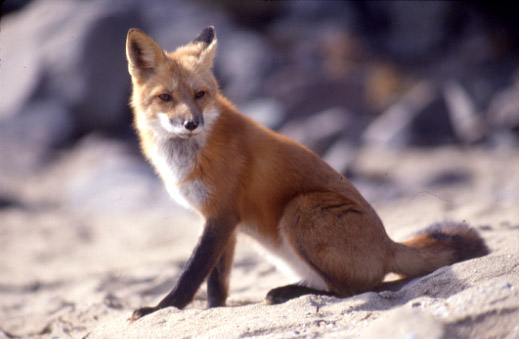
Red Fox (Vulpes vulpes) is a small, adaptable canid recognized by its pointed face, upright ears and long bushy tail, usually tipped with white. Native across much of the Northern Hemisphere, it occupies an extraordinary range of climates and landscapes. Acute hearing, a flexible omnivorous diet and the ability to live near people have helped it become the most geographically widespread living wild canid. This guide separates well-supported biology from common assumptions and covers identification, range, habitat, diet, behavior, reproduction and conservation.
Identification
Most Red Foxes have rusty red upperparts, dark lower legs, pale underparts and throat, black-backed ears and a long bushy tail with a white tip. Color varies widely: cross foxes carry a dark stripe across the shoulders, silver foxes are mostly black with silver-tipped hairs, and some animals are pale or nearly black. The narrow muzzle, large triangular ears, relatively slender legs and oval pupils distinguish the species from many other canids. Males average somewhat larger and heavier than females, but the sexes overlap substantially in appearance.
Identification should combine body shape, markings, size, voice or movement, and location. One feature by itself can overlap with a related animal, a juvenile, or an individual in unusual light.
Photographs are most useful when they preserve scale and show several diagnostic features. Handling or repositioning a wild red fox for identification can cause stress and is unnecessary.
Size and physical adaptations
Red Fox typically measures Body 45.5–90 cm; tail 30–55.5 cm and weighs About 3–14 kg. Body size varies geographically, and animals in colder northern regions are often larger.
Its useful adaptations include large mobile ears locate prey beneath vegetation or snow, bushy tail aids balance and can cover the face during cold rest, flexible omnivorous diet supports life in seasonal habitats, sensitive nose and hearing detect hidden food, digitigrade legs permit quick acceleration and agile pounces, food caching buffers periods of low prey availability, seasonal coat provides insulation, behavioral flexibility supports rural and urban living. These traits work together in the animal’s normal setting rather than serving as isolated curiosities.
Published measurements may use different methods, life stages or sample locations. Comparing figures responsibly means checking what was measured rather than selecting the largest number available.
Range and distribution
Native across most of North America, Europe, temperate and northern Asia, and parts of North Africa and the Middle East. Red Foxes were introduced to Australia in the nineteenth century and also occur as introductions on islands including the Falklands. Range limits vary with climate, prey, competitors and persecution. The native range includes United States, Canada, Mexico, United Kingdom, Ireland, Iceland, Norway, Sweden, Finland, Denmark, France, Germany, Spain, Portugal, Italy, Poland, Ukraine, Turkey, Russia, Kazakhstan, China, Mongolia, Japan, India, Pakistan, Iran, Iraq, Syria, Israel, Jordan, Saudi Arabia, Egypt, Morocco, Algeria, Tunisia.
A country-level map indicates broad distribution, not continuous occupation. Climate, elevation, water, vegetation, prey, breeding sites, barriers and survey effort all affect where records occur.
Records near the edge of the range deserve careful documentation because they may reflect natural movement, improved survey coverage, accidental transport or a genuine distribution change.
Habitat
Tundra, boreal and temperate forest, grassland, shrubland, desert margins, mountains, farmland, suburbs and urban green space.
Red Foxes use mosaics that combine cover, den sites and open hunting ground. Edges between woodland and fields are especially useful, while cities provide gardens, vacant lots, rail corridors and abundant rodents. Dens may be dug by foxes or enlarged from burrows made by other animals. Individuals shelter in dense vegetation and use several resting places within a home range. Protecting a population therefore requires the feeding, shelter and breeding features that make a site usable, along with connections that allow movement.
Microhabitat matters. Shade, soil, current, moisture, shelter or host plants can determine whether a small area is usable even when the surrounding landscape appears suitable.
Diet and feeding
Red Fox is a omnivore. Important foods include mice and voles, rabbits, birds and eggs, insects, earthworms, carrion, berries, other fruit, human food waste where accessible. Red Foxes hunt alone, walking quietly and pausing to listen before making a high arcing pounce. Rodents and rabbits are important prey, but diet changes with season and place. Invertebrates, fruit, birds, eggs, reptiles, carrion and occasionally fish broaden the menu. Surplus food is buried in small caches and recovered later by scent and memory.
Diet changes with age, season, location and food supply. A dramatic prey record does not establish what most individuals eat most of the time; repeated field observations provide a stronger picture.
Feeding opportunities also create risk. An animal focused on prey may be less alert to predators, traffic or people, while contaminated prey can transfer pollutants through the food web.
Behavior and communication
Often crepuscular or nocturnal near people, but active by day where disturbance is low or young require frequent feeding. Adults usually forage alone, although a breeding pair and related helpers may share a territory. Foxes travel along familiar routes, scent-mark prominent points and rest above ground outside the breeding season. They trot efficiently over long distances and can run, jump, swim and dig. Urban animals remain wild and generally avoid direct contact, adjusting timing and routes around human activity.
Red Foxes communicate with scent from urine and specialized glands, body posture and a diverse vocabulary. Short barks can advertise presence, screams and calls are especially noticeable during the winter breeding season, and growls or gekkering sounds occur during close encounters. Mothers and pups use quieter whines and contact calls around the den. Behavior should be interpreted in context: alarm, courtship, feeding and temperature regulation can produce very different actions from the same animal.
Daily schedules are flexible responses, not rigid rules. Weather, breeding condition, disturbance, tides or food can move activity into a different part of the day.
Reproduction and development
Breeding usually occurs once each year in winter, with timing shifting by latitude. Pair bonds may be monogamous for a season, while some populations include one male with several females or nonbreeding females that help raise pups. Birth takes place in a sheltered earth den after a gestation of roughly seven to eight weeks. Usually 4–6 pups, with larger or smaller litters possible Pups are born blind, deaf and dark-furred. Their mother remains close during the first weeks while a mate or helper brings food. Eyes open after roughly two weeks, pups emerge at around four to five weeks and play near the den while learning social and hunting skills. They are weaned over subsequent weeks and most disperse in autumn, although some females remain with the family.
Young animals face different risks and may use different microhabitats or food than adults. Breeding success depends on adult condition, suitable sites and the survival of offspring through vulnerable early stages.
Counts of eggs or young describe reproductive output, not the number expected to reach adulthood. Mortality is normally greatest during eggs, larval or juvenile stages.
Predators and ecological role
Red Foxes are mid-sized predators and scavengers that regulate rodents, disperse seeds after eating fruit and transfer nutrients through prey remains and caches. They compete with coyotes, wolves, golden jackals, lynx and other carnivores; larger predators can suppress fox abundance. In introduced Australian ecosystems, predation by Red Foxes is a major threat to native mammals, birds and reptiles, so control is a conservation priority. Documented or likely predators include Coyote, Gray Wolf, Golden Eagle, Human.
This animal is both a consumer and a food source. Its influence comes through many repeated interactions, so ecological claims should be based on measured populations rather than assumptions drawn from appearance.
Predator and prey relationships differ among places. A species can be ecologically influential without being abundant everywhere, and its role can change across its range.
Relationship with people
Red Foxes have long appeared in folklore as clever or deceptive characters and have been hunted for fur, sport and livestock protection. They often benefit people by consuming rodents but may take poultry when coops are poorly secured. In cities, intentional feeding encourages crowding and habituation. Coexistence works best when food waste is secured, poultry is protected with buried mesh and animals retain a healthy distance from people.
A healthy Red Fox normally avoids people. Never approach, corner or feed one. Keep pets vaccinated, supervise small pets outdoors, secure garbage and poultry, and contact local wildlife or public-health authorities if a fox is unusually disoriented, aggressive, unable to flee or appears seriously ill. Foxes can carry rabies in some regions as well as parasites and mange. Responsible observation means keeping an appropriate distance, avoiding capture or feeding, protecting habitat and following local wildlife or invasive-species guidance.
Wildlife guidance should come from the responsible local agency because collection rules, reporting requests and appropriate responses differ between native and introduced ranges.
Conservation
The IUCN lists the Red Fox as Least Concern because it has an enormous range, occupies many habitats and remains abundant overall. Local populations can decline through disease, persecution or habitat change, while introduced populations can require intensive control to protect native wildlife. The reported global trend is Stable globally, with substantial local variation.
Important pressures include road traffic, rabies and canine distemper, sarcoptic mange, poisoning and persecution, habitat fragmentation, competition with larger carnivores. Global status can hide local decline or recovery, so current regional monitoring and habitat management remain necessary.
The most useful conservation action follows the documented pressure. Protecting breeding sites, reducing road deaths or limiting pollutants can require different tools in different populations.
The widespread Red Fox occupies more habitats than the desert-specialized Fennec Fox or cold-adapted Arctic Fox.