
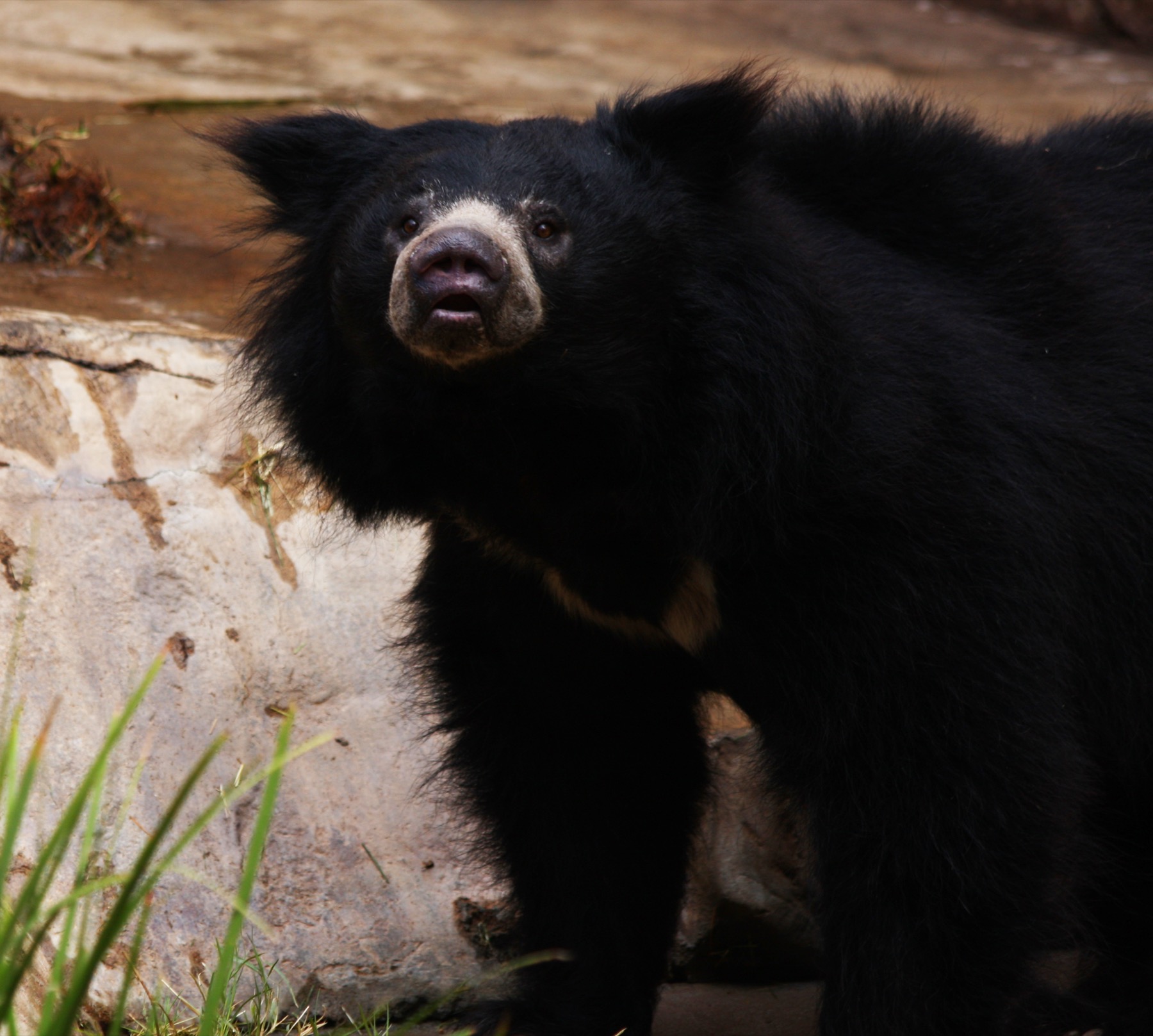
Sloth Bear (Melursus ursinus) is a specialized insect-eating bear of the Indian subcontinent. Long curved claws tear into hard termite mounds, nostrils close against dust, and a gap behind the upper lip helps create powerful suction. Despite the misleading name, it is a true bear and is unrelated to tree sloths. This guide separates well-supported biology from common assumptions and covers identification, range, habitat, diet, behavior, reproduction and conservation.
Identification
A medium-sized bear with a long shaggy black coat, pale mobile muzzle, large outward-curving claws and a cream, white or chestnut V- or Y-shaped chest mark. The ears look large and furry. Adults lack the two central upper incisors, leaving a gap through which termites are sucked. Feet turn slightly inward, and the mane is especially long around the shoulders. Males are usually 30–40 percent heavier than females, with broader heads and heavier shoulders. Both sexes share the shaggy coat, long claws and variable chest marking.
Identification should combine body shape, markings, size, voice or movement, and location. One feature by itself can overlap with a related animal, a juvenile, or an individual in unusual light.
Photographs are most useful when they preserve scale and show several diagnostic features. Handling or repositioning a wild sloth bear for identification can cause stress and is unnecessary.
Size and physical adaptations
Sloth Bear typically measures Head and body about 1.4–1.9 m and weighs Females roughly 55–95 kg; males about 80–145 kg. Sri Lankan animals average smaller, and body condition changes with fruit and insect availability.
Its useful adaptations include long claws open termite mounds, flexible lips form a suction tube, missing upper incisors create an intake gap, closable nostrils exclude dust and insects, long tongue reaches into galleries, shaggy coat protects from insects and heat, strong forelimbs excavate hard soil, mothers carry cubs on long back fur. These traits work together in the animal’s normal setting rather than serving as isolated curiosities.
Published measurements may use different methods, life stages or sample locations. Comparing figures responsibly means checking what was measured rather than selecting the largest number available.
Range and distribution
Occurs across fragmented parts of India, southern Nepal and Sri Lanka. It is considered extirpated from Bangladesh and may no longer persist in Bhutan. Strongholds lie in protected dry forests and adjoining landscapes of central and southern India and Sri Lanka. The native range includes India, Nepal, Sri Lanka.
A country-level map indicates broad distribution, not continuous occupation. Climate, elevation, water, vegetation, prey, breeding sites, barriers and survey effort all affect where records occur.
Records near the edge of the range deserve careful documentation because they may reflect natural movement, improved survey coverage, accidental transport or a genuine distribution change.
Habitat
Dry and moist deciduous forest, thorn scrub, savanna woodland, rocky hills and tall grassland with termite colonies, fruiting trees and secure daytime shelter.
Bears forage across forest and grass mosaics, den or rest in caves, rock crevices and dense vegetation, and visit seasonal fruit trees. Activity shifts toward night where farms, roads or people are common. Fragmented corridors force bears through crop fields and villages, increasing dangerous encounters. Protecting a population therefore requires the feeding, shelter and breeding features that make a site usable, along with connections that allow movement.
Microhabitat matters. Shade, soil, current, moisture, shelter or host plants can determine whether a small area is usable even when the surrounding landscape appears suitable.
Diet and feeding
Sloth Bear is a omnivore specializing on ants and termites. Important foods include termites, ants, mangoes, figs, mahua flowers, ebony fruit, honey, beetle grubs, carrion, cultivated crops. A bear rips open a mound, closes its nostrils, blows away dust and sucks termites with loud huffs. During monsoon fruiting, fruit can dominate the diet and seeds are dispersed in dung. Honey, grubs and flowers add seasonal variety, while crop feeding increases conflict near forest edges.
Diet changes with age, season, location and food supply. A dramatic prey record does not establish what most individuals eat most of the time; repeated field observations provide a stronger picture.
Feeding opportunities also create risk. An animal focused on prey may be less alert to predators, traffic or people, while contaminated prey can transfer pollutants through the food web.
Behavior and communication
Flexible and often nocturnal near people; can be diurnal in secure protected habitat. Adults usually forage alone except mothers with cubs and temporary feeding groups. Sloth Bears dig powerfully, climb for fruit or honey and rest in caves or dense cover during heat. They do not hibernate. Poor visibility in scrub and a tendency to stand and defend rather than flee can make surprise encounters dangerous.
The species is unusually vocal for a bear. Grunts, snorts and sucking noises accompany foraging; barks, screams, roars and growls occur during alarm or conflict. Scent and tree scratches advertise presence. Cubs keep contact with their mother through calls while riding or following. Behavior should be interpreted in context: alarm, courtship, feeding and temperature regulation can produce very different actions from the same animal.
Daily schedules are flexible responses, not rigid rules. Weather, breeding condition, disturbance, tides or food can move activity into a different part of the day.
Reproduction and development
In much of India mating peaks from late spring into early summer; breeding is less seasonal in Sri Lanka. Pairs may associate noisily for several days. Delayed implantation contributes to variable pregnancy length, and the female prepares a cave or underground den before birth. Usually 1–2 cubs, rarely 3 Cubs are born blind and helpless in a den and open their eyes after roughly two to three weeks. They emerge at about two to three months and ride on the mother’s back by gripping her long fur, an unusual routine among bears. They nurse for about a year and may remain with her for two to three years.
Young animals face different risks and may use different microhabitats or food than adults. Breeding success depends on adult condition, suitable sites and the survival of offspring through vulnerable early stages.
Counts of eggs or young describe reproductive output, not the number expected to reach adulthood. Mortality is normally greatest during eggs, larval or juvenile stages.
Predators and ecological role
Sloth Bears regulate termite and ant colonies, excavate soil and dead wood, and disperse seeds from many fruits. Their digging creates small disturbed patches used by other organisms. They share landscapes with Tigers, Leopards, Dholes, elephants and people, making them important indicators of connected South Asian forest. Documented or likely predators include Tiger, Leopard, Dhole, Human.
This animal is both a consumer and a food source. Its influence comes through many repeated interactions, so ecological claims should be based on measured populations rather than assumptions drawn from appearance.
Predator and prey relationships differ among places. A species can be ecologically influential without being abundant everywhere, and its role can change across its range.
Relationship with people
Forest collection, grazing and farms bring people into feeding habitat. Sudden close encounters cause serious injuries to both bears and people, especially where dense scrub blocks visibility. Historically, cubs were captured and trained as dancing bears; coordinated livelihood programs and law enforcement greatly reduced that practice in India, though illegal capture and trade remain concerns.
In Sloth Bear country, travel in groups, make normal conversation in dense cover, avoid nighttime walking and never approach cubs or a carcass. If a bear is encountered, do not run or crowd it; back away while leaving an escape route and follow local wildlife guidance. Vehicle visitors should remain inside. Responsible observation means keeping an appropriate distance, avoiding capture or feeding, protecting habitat and following local wildlife or invasive-species guidance.
Wildlife guidance should come from the responsible local agency because collection rules, reporting requests and appropriate responses differ between native and introduced ranges.
Conservation
The IUCN lists the Sloth Bear as Vulnerable. Habitat loss, degradation and fragmentation combine with conflict killing, accidental capture, illegal trade and disturbance. Populations persist in many reserves, but corridors and safer shared landscapes are necessary because bears regularly move beyond protected boundaries. The reported global trend is Decreasing.
Important pressures include forest loss and fragmentation, human-bear conflict, road and rail mortality, illegal capture and trade, disturbance at den sites, forest-product collection, wildfire. Global status can hide local decline or recovery, so current regional monitoring and habitat management remain necessary.
The most useful conservation action follows the documented pressure. Protecting breeding sites, reducing road deaths or limiting pollutants can require different tools in different populations.
The shaggy Sloth Bear is adapted to termites and ants, unlike the largely arboreal, fruit-eating Sun Bear and ice-dependent Polar Bear.