
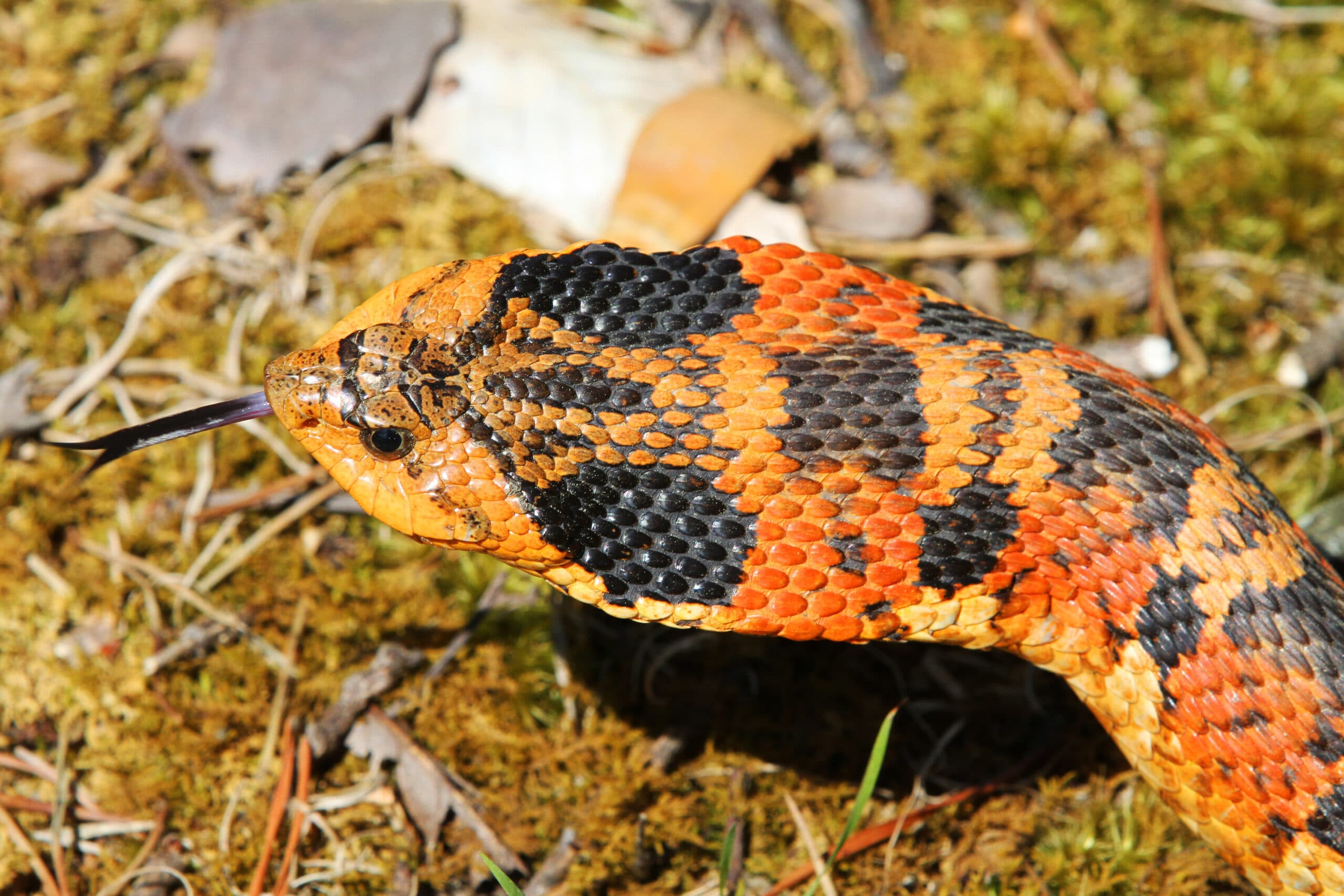
Snake (Serpentes) is any living member of the reptile suborder Serpentes. The Reptile Database listed 4,249 species in late 2026, ranging from tiny burrowing threadsnakes to giant boas and pythons. Snakes occur on every continent except Antarctica and occupy deserts, forests, grasslands, fresh water and tropical seas. This page describes the group; measurements, venom, diet and conservation status differ sharply among species. This guide separates well-supported biology from common assumptions and covers identification, range, habitat, diet, behavior, reproduction and conservation. Readers comparing venomous lineages can examine the European Asp Viper and the Arabian Peninsula’s Arabian Cobra, which use different fang systems and habitats.
Identification
Snakes have elongated bodies, no external limbs, no movable eyelids and no external ear openings. Their transparent spectacle scales cover the eyes. Broad belly scales help many species grip surfaces, while skull and jaw joints allow the mouth to expand around prey. Body form varies: burrowers may be short and cylindrical, tree snakes slender, and sea snakes laterally compressed with paddle-shaped tails. Sex differences are often subtle and species-specific. Females are larger in many boas and vipers, while males may have proportionally longer tails because the paired hemipenes lie near the tail base. Color or scale differences occur in some species, but external appearance alone is not a reliable universal guide.
Identification should combine body shape, markings, size, voice or movement, and location. One feature by itself can overlap with a related animal, a juvenile, or an individual in unusual light.
Photographs are most useful when they preserve scale and show several diagnostic features. Handling or repositioning a wild snake for identification can cause stress and is unnecessary.
Size and physical adaptations
Snake typically measures about 10 cm in the smallest threadsnakes to more than 6 m in the largest pythons and weighs less than 2 g in tiny species to more than 100 kg in giant constrictors. These are suborder-wide extremes; most species occupy a far narrower range.
Its useful adaptations include overlapping keratin scales that reduce abrasion and water loss, wide ventral scales and coordinated muscles for traction, a highly kinetic skull for swallowing prey whole, forked tongue and vomeronasal organ for tracking chemical trails, ectothermy that lowers energy demands, venom, constriction or rapid seizure depending on lineage. These traits work together in the animal’s normal setting rather than serving as isolated curiosities.
Published measurements may use different methods, life stages or sample locations. Comparing figures responsibly means checking what was measured rather than selecting the largest number available.
Range and distribution
Snakes occur naturally across most tropical and temperate regions on every continent except Antarctica. They live from below sea level to high mountains and on many islands, while true sea snakes occupy warm Indian and Pacific waters. No single species has this combined range, and isolated islands and cold polar regions may have none. The native range includes Every continent except Antarctica, Most tropical and temperate land regions, Freshwater habitats worldwide, Tropical Indian and Pacific oceans.
A country-level map indicates broad distribution, not continuous occupation. Climate, elevation, water, vegetation, prey, breeding sites, barriers and survey effort all affect where records occur.
Records near the edge of the range deserve careful documentation because they may reflect natural movement, improved survey coverage, accidental transport or a genuine distribution change.
Habitat
Forests, savannas, deserts, farms, wetlands, rivers, oceans, caves, leaf litter and underground burrows, depending on species.
A snake needs the right mix of shelter, temperature, prey and breeding sites. Rock cracks, logs, vegetation, burrows and water edges provide cover and hunting opportunities. Because snakes regulate temperature behaviorally, removing shade, refuges or seasonal movement corridors can make otherwise suitable ground unusable. Protecting a population therefore requires the feeding, shelter and breeding features that make a site usable, along with connections that allow movement.
Microhabitat matters. Shade, soil, current, moisture, shelter or host plants can determine whether a small area is usable even when the surrounding landscape appears suitable.
Diet and feeding
Snake is a carnivore. Important foods include rodents and other mammals, birds and eggs, lizards and other snakes, frogs and salamanders, fish and eels, invertebrates such as snails, worms and insects. All snakes swallow prey whole, but capture methods vary. Some seize small prey directly, some constrict it, and venomous species inject toxins through specialized teeth. Flexible skull joints let the left and right sides advance alternately over food. Digestion accelerates after a meal, and large-feeding species may go long periods between meals.
Diet changes with age, season, location and food supply. A dramatic prey record does not establish what most individuals eat most of the time; repeated field observations provide a stronger picture.
Feeding opportunities also create risk. An animal focused on prey may be less alert to predators, traffic or people, while contaminated prey can transfer pollutants through the food web.
Behavior and communication
Diurnal, nocturnal or crepuscular depending on species, season and temperature. Snakes combine muscular waves with their belly scales to move. Lateral undulation is common, concertina movement helps in narrow passages or climbing, rectilinear motion carries heavy-bodied snakes forward in a straight line, and sidewinding reduces contact with loose hot sand. Aquatic species undulate through water, and a few tree snakes flatten the body to glide.
Chemical information dominates snake communication. Tongue flicks deliver airborne and surface particles to the vomeronasal organ, helping locate prey and mates. Snakes also sense ground vibration, use touch during courtship and may hiss, rattle scales or vibrate the tail as defensive signals. Behavior should be interpreted in context: alarm, courtship, feeding and temperature regulation can produce very different actions from the same animal.
Daily schedules are flexible responses, not rigid rules. Weather, breeding condition, disturbance, tides or food can move activity into a different part of the day.
Reproduction and development
Most snakes reproduce sexually through internal fertilization. Many lay leathery-shelled eggs, while boas, vipers, sea snakes and other groups include species that give birth to live young. Females of some pythons coil around eggs, and a few species guard nests or remain with young briefly, but extended parental care is uncommon. From one or two young to more than 80 eggs or newborns depending on species Young are independent at birth or hatching and must find shelter and prey immediately. Juveniles shed frequently as they grow. Maturity may arrive within a year in small fast-growing species or take many years in large boas and pythons.
Young animals face different risks and may use different microhabitats or food than adults. Breeding success depends on adult condition, suitable sites and the survival of offspring through vulnerable early stages.
Counts of eggs or young describe reproductive output, not the number expected to reach adulthood. Mortality is normally greatest during eggs, larval or juvenile stages.
Predators and ecological role
Snakes are both predators and prey. By consuming rodents, frogs, fish, lizards and invertebrates they help move energy through food webs and can limit locally abundant prey. Raptors, mammals, crocodilians and other snakes eat them. Burrowing species influence soil communities, while aquatic snakes connect food webs across water and land. Documented or likely predators include Birds of prey, Mongooses, Other snakes, Crocodilians, Humans.
This animal is both a consumer and a food source. Its influence comes through many repeated interactions, so ecological claims should be based on measured populations rather than assumptions drawn from appearance.
Predator and prey relationships differ among places. A species can be ecologically influential without being abundant everywhere, and its role can change across its range.
Relationship with people
Snakes benefit people through pest control, research and venom-derived medicines, yet fear leads many harmless individuals to be killed. Around buildings, reducing rodent food and sealing gaps is safer than attempting capture. Identification should come from local experts or wildlife authorities because color and head shape alone can mislead.
Never handle or approach an unidentified wild snake. Step back, keep children and pets away and contact trained local wildlife services if removal is needed. After a suspected venomous bite, seek emergency medical care immediately, keep the person still and remove rings or tight items. Do not cut, suck, ice or tourniquet the bite. Responsible observation means keeping an appropriate distance, avoiding capture or feeding, protecting habitat and following local wildlife or invasive-species guidance.
Wildlife guidance should come from the responsible local agency because collection rules, reporting requests and appropriate responses differ between native and introduced ranges.
Conservation
Serpentes has no single IUCN category. Conservation must be assessed species by species. Some snakes remain widespread, while restricted island, forest, freshwater and heavily traded species face severe risk. Applying Least Concern to the entire suborder would be false. The reported global trend is No single global trend; populations vary by species and region.
Important pressures include habitat loss and fragmentation, road mortality, deliberate killing from fear, unsustainable harvest and illegal trade, invasive predators on islands, pollution and climate change. Global status can hide local decline or recovery, so current regional monitoring and habitat management remain necessary.
The most useful conservation action follows the documented pressure. Protecting breeding sites, reducing road deaths or limiting pollutants can require different tools in different populations.
