
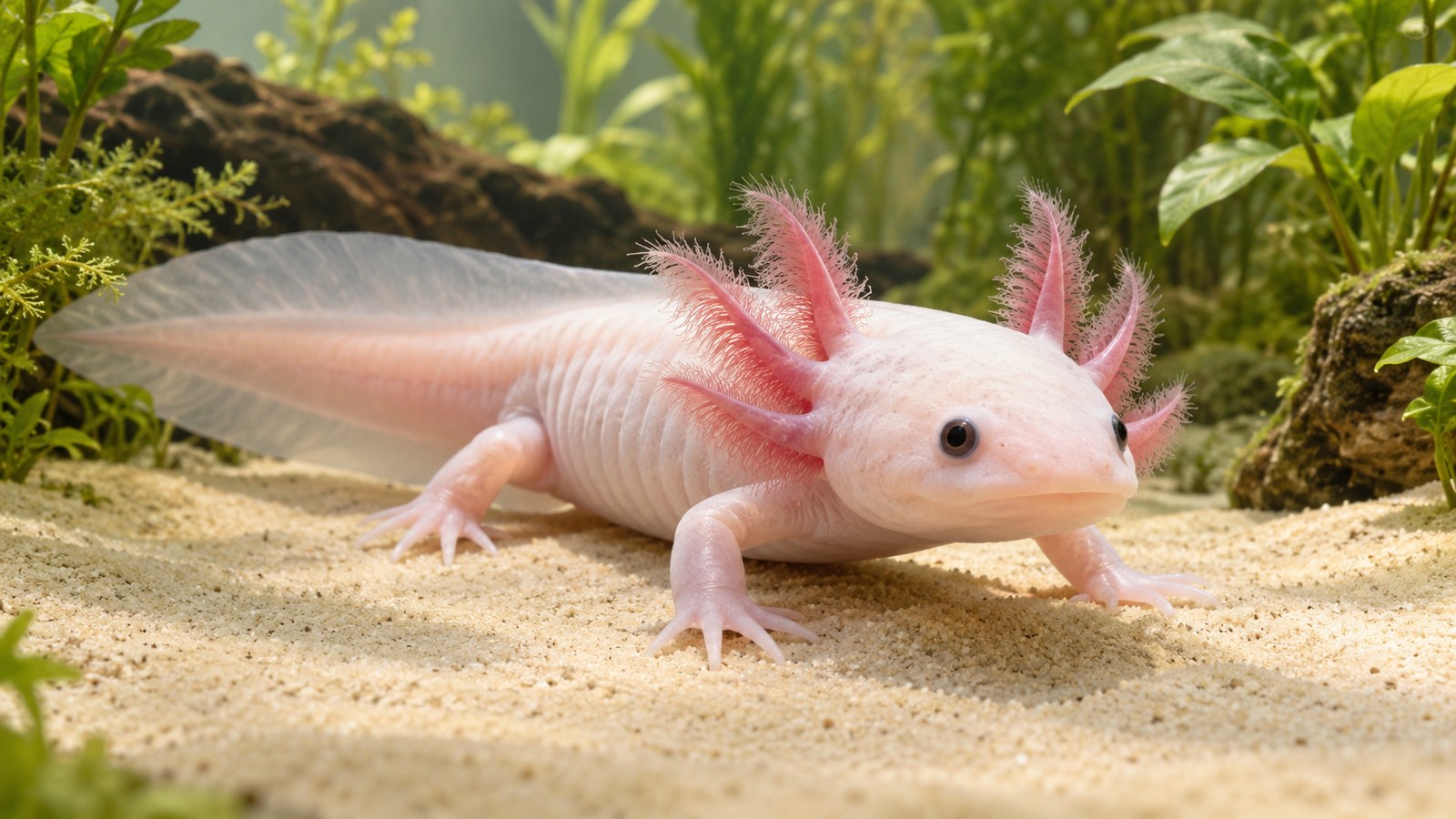
What if an animal could grow back a lost leg and keep its baby features as an adult? These fun facts about axolotls begin with real biology that sounds like a tall tale. The axolotl is a freshwater salamander from Mexico, with feathery gills and a life story far stranger than its aquarium portraits suggest.
You will discover what those head frills do, why pink does not always mean albino, and how a tiny animal became part of both laboratory research and Aztec mythology. Along the way, we will separate common claims from careful facts, meet its wild habitat, and learn why an animal loved around the world still needs protection at home.
1. They Can Regrow Entire Limbs
Fun Fact: A lost leg can be replaced with a new limb containing several kinds of tissue.
Losing a limb would change most animals’ lives forever. An axolotl can rebuild one, including structures needed for movement. Researchers study how its cells organize that repair. Regeneration takes time, and injuries still matter: this ability does not make the animal indestructible or safe to handle roughly. NIH: axolotl regeneration
2. They Can Repair Parts of Their Hearts
Quick Facts: Ability: Heart tissue repair | Studied in: Axolotls | Meaning: Regeneration after injury
The surprise continues inside the body. Scientists have documented axolotls repairing damaged heart tissue and recovering heart function after experimental injury. That does not mean a heart can be removed and replaced without consequences. The useful discovery is how living tissue rebuilds itself, a question researchers are still investigating. Cardiac regeneration research
3. They Can Regenerate Parts of Their Spinal Cords
- The spinal cord carries signals between brain and body.
- Axolotls can regenerate damaged spinal cord tissue.
- Researchers study both tissue repair and movement.
- Results in salamanders do not establish a human treatment.
Behind each small step lies a nervous system sending messages to muscles. An axolotl can repair spinal cord damage in ways humans cannot routinely achieve. Scientists examine that process to understand the cells involved. It is a real biological ability, but its medical possibilities need careful study rather than promises. Aarhus University: spinal cord regeneration
4. They Keep Their Baby Features as Adults
| Feature | What happens in an adult |
|---|---|
| External gills | Usually remain visible |
| Tail fin | Remains suited to swimming |
| Reproduction | Adults can breed despite juvenile traits |
Growing up does not always mean changing your whole appearance. Axolotls reach adulthood while keeping features associated with young salamanders. Scientists call this paedomorphosis, often described as neoteny. Their youthful shape is a normal part of their life history, not proof that every frilly animal you see is a baby. Natural History Museum
5. Their Feathery Head Frills Are Gills
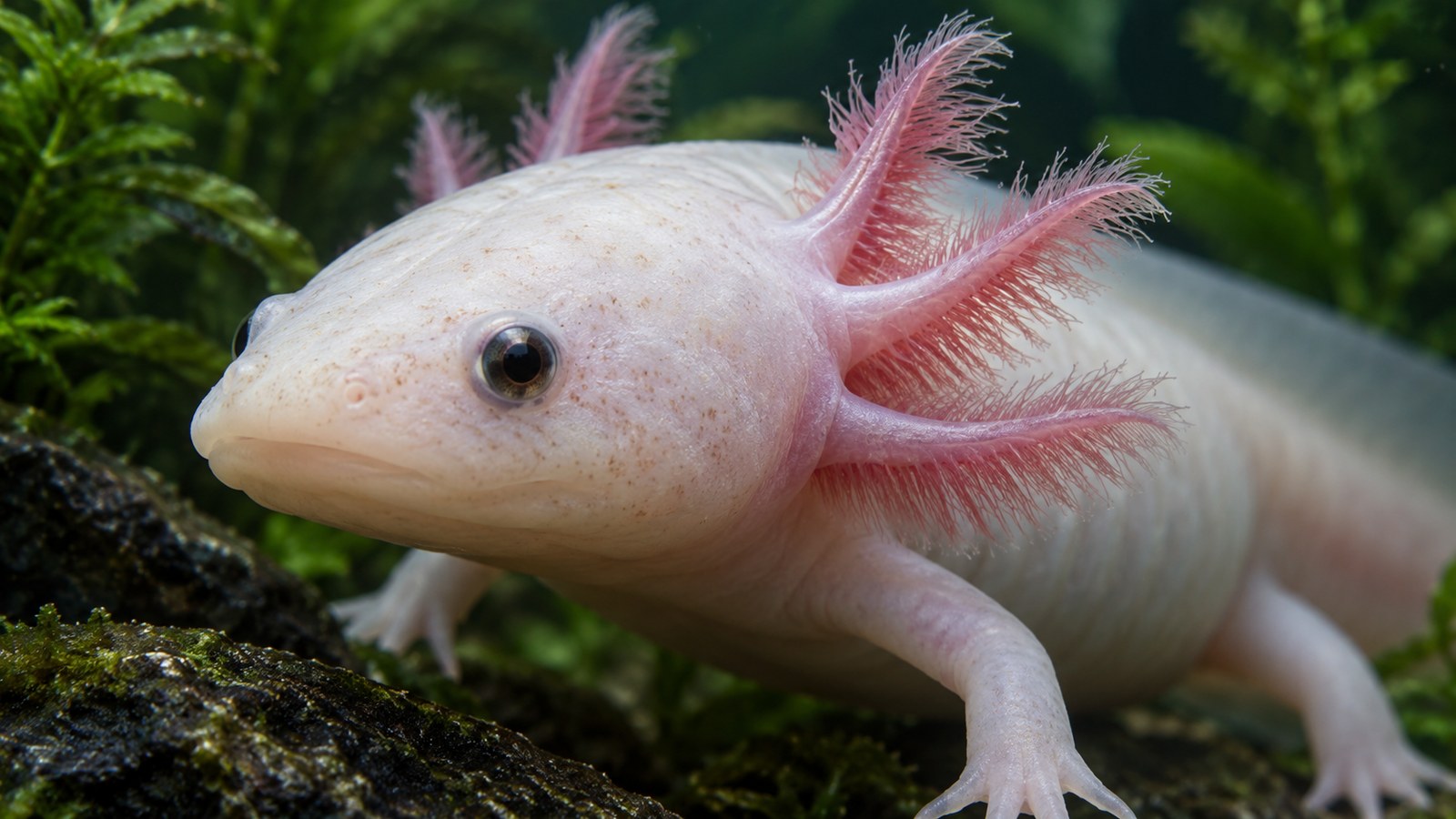
Fun Fact: Those fluffy-looking branches are breathing structures, not hair, ears or decorations.
Look beside the head and you will see three branching gill stalks on each side. Their delicate filaments help exchange gases with the surrounding water. This makes a close photograph a useful biology lesson: the prettiest feature in the portrait is also part of the equipment keeping the animal alive. Point Defiance Zoo & Aquarium
6. They Have Lungs Alongside Their Gills
Quick Facts: Breathing structures: Gills, lungs and skin | Home: Freshwater | Surface visits: Possible
A trip toward the water surface can have a simple explanation. Axolotls possess lungs and sometimes take in air, even though their gills remain prominent. Having lungs does not turn them into ordinary land pets. Their usual way of life still depends on staying in a suitable aquatic environment. Akron Zoo
7. Their Skin Helps Them Breathe
- Gills are not their only breathing surface.
- Gas exchange also occurs through the skin.
- The skin remains in contact with the water.
- A healthy aquatic environment matters throughout life.
Skin does more than wrap an axolotl’s body. It contributes to breathing, alongside the other structures you have already met. That is a useful reminder when learning about amphibians: a body surface can have several jobs. For a pet, water conditions belong at the centre of everyday care. Royal Veterinary College care guide
8. They Are Salamanders, Not Fish
| Name or group | Does it fit? |
|---|---|
| Amphibian | Yes |
| Salamander | Yes |
| Mexican walking fish | Nickname, not scientific classification |
Despite the nickname, this animal belongs with salamanders in the amphibian group. Its scientific name is Ambystoma mexicanum. The tiger salamander is a relative, while a goldfish belongs to a different branch of the animal family tree. Sharing an underwater home does not make two animals close relatives. University of Michigan: Animal Diversity Web
9. They Usually Spend Their Whole Lives Underwater
Fun Fact: An adult axolotl can reproduce without making the usual salamander transition to life on land.
For many amphibians, growing up includes a major change in body shape and habitat. Axolotls usually keep their aquatic form instead. Rare metamorphosis can occur, so saying they can never change is too strong. Their normal life story, however, does not require leaving the water to become an adult. American Museum of Natural History
10. Their Wild Home Is in Mexico City
Quick Facts: Native region: Central Mexico | Famous habitat: Xochimilco | Setting: Freshwater wetlands and canals
Think of Mexico City and busy streets may come to mind before salamanders. Yet the Xochimilco wetland and canal system is central to the wild axolotl’s story. Its ancestors occupied a larger lake landscape. Understanding that small geographic home helps explain why protecting particular waterways matters so much today. San Diego Zoo Wildlife Alliance: distribution
11. They Live in Freshwater, Not the Sea
- Their natural habitat is inland.
- Lakes and canals belong to their story.
- Ocean reefs do not.
- Aquatic means living in water, not necessarily seawater.
A frilly face can look at home in ocean artwork, but the real animal belongs in freshwater. A seahorse makes a better example of marine wildlife. For a school project, placing axolotls beside lakes, aquatic plants and canals gives a much more accurate picture of their natural setting. University of Michigan: Animal Diversity Web
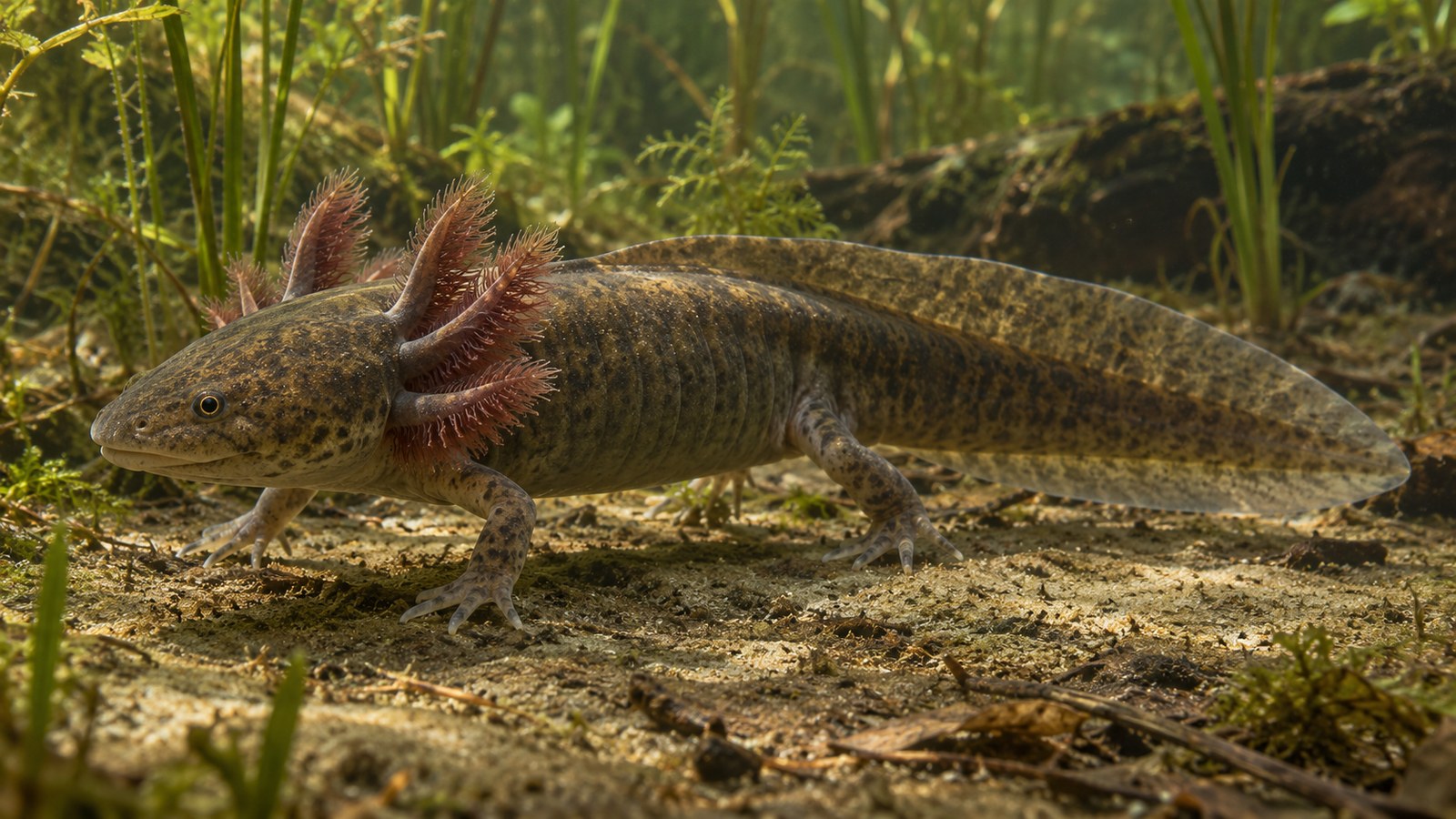
12. Wild Axolotls Usually Have Dark Colors
| Appearance | Where it fits |
|---|---|
| Dark brown or nearly black | Typical wild coloration |
| Mottled skin | Helps the animal blend with its surroundings |
| Pale or golden varieties | Familiar in managed care |
Brown is easy to overlook when pink animals fill your screen. Wild axolotls typically wear darker colors that suit muddy surroundings. This is the version to remember when thinking about their original habitat. A pale aquarium animal and a dark wild-type animal can still belong to the same species. San Diego Zoo Wildlife Alliance: characteristics
13. Pink Axolotls Are Not Always Albino
Fun Fact: A pale axolotl with dark eyes may be leucistic rather than albino.
Color names describe different pigment patterns, not different species. Leucistic axolotls can have pale bodies while retaining dark eye pigment. Albino animals lack dark melanin pigment, including in their eyes. A photograph needs clear detail before you label it, especially when lighting changes how pink or white the skin looks. Axolotl colour genetics
14. They Suck Food Into Their Mouths
Quick Facts: Diet: Carnivore | Feeding method: Suction | Wild prey: Small aquatic animals
Dinner arrives in a sudden gulp. By opening its mouth quickly, an axolotl draws in water and nearby prey. Small animals such as worms and insect larvae can become a meal. Its quiet appearance can be misleading: this gentle-looking face belongs to a predator built for catching food underwater. San Diego Zoo Wildlife Alliance: diet
15. Their Tiny Teeth Grip Rather Than Chew
- Axolotls do have teeth.
- The teeth are small.
- They help capture and hold food.
- They do not chew food the way people do.
That wide mouth hides teeth much less dramatic than a crocodile‘s. An axolotl uses its small teeth during food capture, then swallows rather than grinding a meal into pieces. The interesting contrast is between its modest dental equipment and the quick suction action that brings prey within reach. San Diego Zoo Wildlife Alliance: characteristics
16. They Are Often More Active at Night
| Observation | Careful interpretation |
|---|---|
| Activity after dark | Reported in managed care |
| Daytime hiding | Can occur |
| Wild daily routine | Less fully documented |
Evening can reveal movement that a daytime visitor misses. Axolotls are often described as nocturnal, and keepers report increased activity at night. Still, their wild behavior is not fully understood. It is more accurate to describe a tendency than to claim every animal follows exactly the same daily timetable. San Diego Zoo Wildlife Alliance: behavior
17. Their Front and Back Feet Have Different Toe Counts
Fun Fact: A typical axolotl has four digits on each front foot and five on each back foot.
Count carefully in a clear photograph and the front and rear feet reveal different patterns. Four at the front, five at the back is the usual arrangement. Individual differences can occur, including after injury. This makes counting toes a good observation activity, provided you use photographs instead of handling animals. Axolotl limb research
18. Females Can Lay Hundreds of Eggs
Quick Facts: Reproduction: Eggs | Egg covering: Jelly | Attachment sites: Underwater surfaces and vegetation
One female can produce hundreds of eggs, with the number varying between animals and conditions. Jelly surrounds the developing embryos, and eggs attach to underwater surfaces. A large clutch does not guarantee a large surviving family. Eggs and young face risks, which helps explain why breeding and conservation are different challenges. San Diego Zoo Wildlife Alliance: reproduction
19. Their Name Has Roots in Nahuatl
- The name comes from Nahuatl.
- English translations vary.
- Water dog is one familiar translation.
- The word carries cultural history as well as a species identity.
Before axolotls became international aquarium favourites, people in Mexico already knew and named them. Their Nahuatl name is often translated as water dog or water monster, among other interpretations. Keeping that language connection in the story helps readers see a local animal with a history, rather than just an internet character. San Diego Zoo Wildlife Alliance: taxonomy
20. They Have a Place in Aztec Mythology
| Part of the story | What it represents |
|---|---|
| Xolotl | A deity in Mexica or Aztec tradition |
| Transformation into an axolotl | An element of mythology |
| Modern axolotl research | Biological study of a real amphibian |
According to an Aztec tradition, the god Xolotl took the form of an axolotl while trying to escape death. That is a cultural story, not a scientific explanation for regeneration. Reading the two side by side makes the animal more interesting: its place in human imagination has deep local roots. San Diego Zoo Wildlife Alliance: taxonomy
21. Popularity as Pets Has Not Saved Them in the Wild
Fun Fact: An animal can be familiar in aquariums while its wild population remains in serious trouble.
The IUCN Red List classifies Ambystoma mexicanum as Critically Endangered. Habitat damage, pollution and introduced fish threaten wild animals. Captive breeding does not automatically restore healthy wetlands or the original population. Protecting this axolotl means caring about its home, not simply counting how many pets appear in photographs. San Diego Zoo Wildlife Alliance: population
Frequently Asked Questions
Are axolotls good pets for kids?
Axolotls can interest children, but their care should be an adult responsibility. They need a suitable aquarium, stable water conditions and careful maintenance. They are animals to observe rather than cuddle. Before getting one, discuss the setup with an amphibian-experienced vet and learn what daily care involves. VCA: axolotls as pets
Can axolotls live out of water?
Normally, no. Axolotls live in water and retain the gills and body form suited to that habitat. Rare metamorphosis is possible, but that does not make taking a normal pet onto land safe. Watch them through the aquarium glass and keep routine handling to a minimum. Natural History Museum
What do axolotls eat?
Axolotls eat animal prey, including worms, insect larvae and other small aquatic creatures. Pet diets need to suit the animal’s size and life stage. Ask an amphibian-experienced vet before changing a diet, and avoid treating a list of wild prey as a complete feeding plan for an aquarium animal. VCA: axolotls as pets
Why are axolotls endangered?
Wild axolotls face habitat loss, polluted water and pressure from introduced fish. Their small natural range makes damage to those waterways especially serious. The IUCN lists the species as Critically Endangered. Animals bred as pets do not remove the need to protect and restore the wild habitat. IUCN Red List assessment
How big do axolotls get?
Axolotls can reach about 30 cm (12 in) in total length, although individual size varies. Their tail makes up a noticeable part of that measurement. A tiny juvenile therefore does not stay tiny forever, which matters when planning a suitable home or comparing photographs taken at different ages. American Museum of Natural History
Which Axolotl Fact Surprised You Most?
A salamander that can rebuild a limb already sounds invented. Add gills that remain into adulthood, feet with different toe counts, and a name tied to an old tradition, and the real animal becomes even more memorable. These fun facts about axolotls also lead back to one important place: the freshwater habitat they need in Mexico.
Save this pin for your next homeschool science session or animal quiz. Then explore more animals on All About Creatures, from the spotted salamander to other amphibians with life stories worth a closer look.